What to Do When Your Business Can’t Make Payroll This Week
Payroll doesn’t negotiate. Rent can sometimes wait a few days. A vendor might work with you on timing. But the people on your team who showed up, did the work, and are counting on that deposit hitting their account — they can’t be told “soon.” If you’re staring down a payroll date with less in the account than you need, you’re dealing with one of the most stressful moments a business owner can face, and you’re far from the only one who’s been here.
This is a genuinely common situation. A late-paying client, a seasonal dip, an unexpected repair bill — any of these can turn a normally healthy business into one that’s short on a specific date. The good news is that a payroll cash flow gap is usually a timing problem, not a business-health problem, and timing problems have real solutions if you move on them early.
First, Separate the Real Problem From the Panic
Before looking at payroll financing or emergency payroll funding, get precise about what you’re actually facing:
- What is the exact number? Not “we’re short” — the specific dollar gap between what’s in the account and what payroll (plus taxes and processing fees) requires.
- Is this a one-time gap or a pattern? If this is the third tight payroll in a row, the fix might be different than if this is a one-off caused by a specific delayed payment.
- What’s actually coming in, and when? A confirmed invoice landing three business days after payroll is a very different situation than genuinely uncertain revenue.
- What’s your real timeline? Same-week gaps limit your options to things that move fast; a two-week runway opens up more choices.
Getting this clear takes 20 minutes and changes everything about which option actually makes sense.
Option 1: Delay Non-Critical Expenses (Carefully)
If the gap is small, sometimes the fastest fix is shifting a vendor payment or a subscription renewal by a few days — not skipping it, just resequencing it. This only works if you’re confident the delayed expense won’t create its own emergency (a vendor who cuts off supply, a fee that penalizes lateness).
Option 2: Use an Existing Line of Credit
If you already have a line of credit in place, this is often the fastest and lowest-friction option, since the underwriting work is already done. This is exactly why it’s worth setting up access to credit before you’re in an emergency — not during one.
Option 3: Emergency Payroll Funding
When there’s no existing credit line and the gap needs to be closed this week, purpose-built emergency business funding is where most business owners land. Here’s what actually matters when payroll is the deadline:
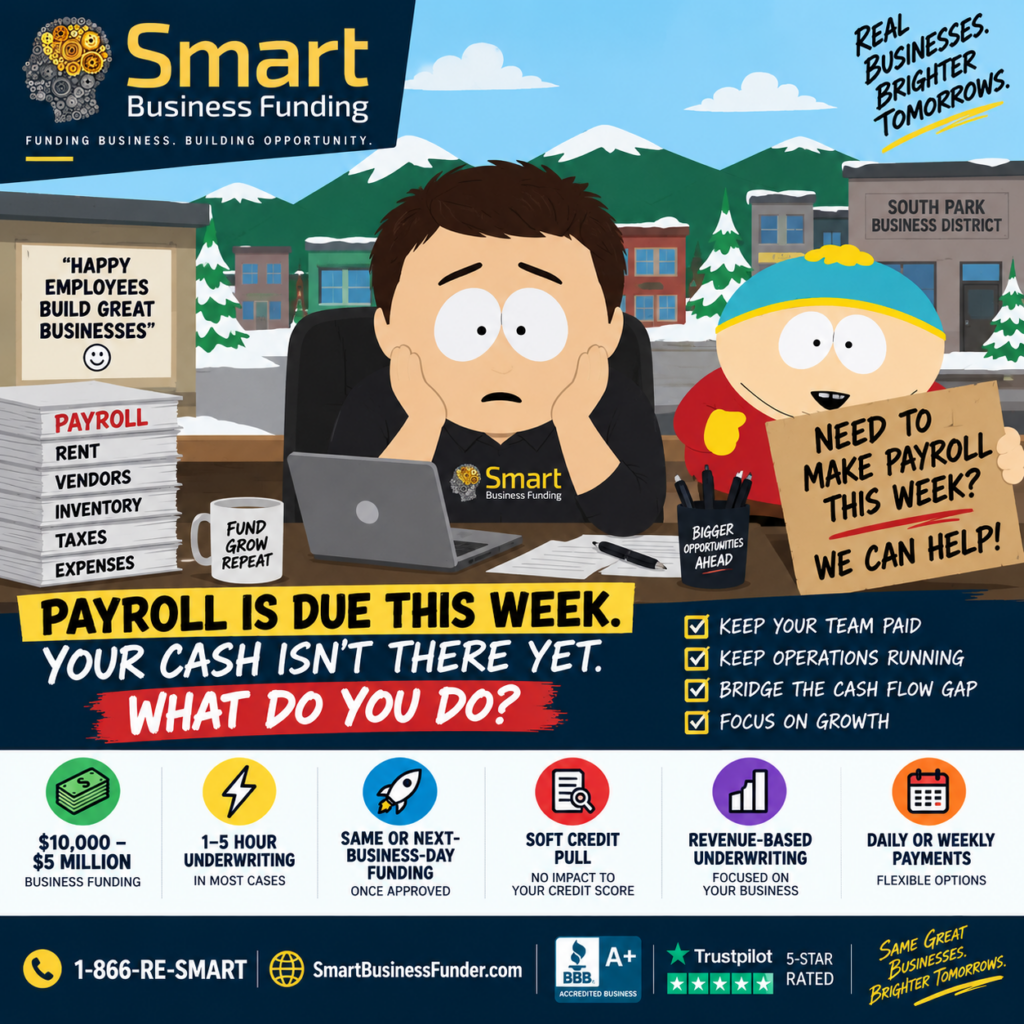
- Speed of underwriting. Smart Business Funding’s Direct Fund Program typically completes underwriting in 1–5 hours with a complete application, and funding can move as soon as the same or next business day.
- What qualifies. $50,000+ in monthly revenue, at least one year in business, and a credit minimum around 500 evaluated with a soft credit pull — so a strong revenue picture matters more than a perfect credit file.
- How repayment works. Repayment is fixed — either daily or weekly — and set before you sign, so you know exactly what comes out and when. There’s no guessing or fluctuating percentage to track.
- Sizing it correctly. The point isn’t to fund the whole month — it’s to close the specific payroll gap without creating a repayment obligation bigger than your business actually needs.
Illustrative Composite Scenario (not an actual client, for explanatory purposes only): A 12-person marketing agency has three client invoices confirmed and in processing, worth more than enough to cover the shortfall — but none will land before Friday’s payroll. Rather than delaying payroll, the owner uses a short-term advance sized specifically to the gap, with a fixed repayment schedule that starts once the funding lands and continues alongside the incoming client payments.
What to Avoid When Payroll Is On the Line
- Don’t skip payroll to “buy time.” Beyond the impact on your team, missed payroll can trigger legal and tax complications that are far more costly than a short-term funding gap.
- Don’t accept terms you don’t fully understand under time pressure. A rushed decision is exactly when unclear terms cause the most damage later. Ask directly: what’s the total repayment amount, what’s the daily or weekly draw, and what happens if revenue dips during the term?
- Don’t assume a low credit score disqualifies you. Revenue-based underwriting, like the soft-pull review used for the Direct Fund Program, weighs your business’s cash flow — not just a credit score — which is often the reason business owners search “business funding for payroll” in the first place.
How Smart Business Funding Approaches Payroll Gaps
Smart Business Funding (Collins Cash Inc.) has funded businesses across all 50 states since 2014, with a Direct Fund Program ranging from $10,000 to $5,000,000 and terms of 2–10 months. Underwriting is built around actual business revenue, and funding can move quickly once documentation is complete — which matters most in exactly this kind of week. You can see the full process on the how it works page, review funding by business type on the industries page, or move straight to the application if payroll is close.
Frequently Asked Questions
How fast can I get emergency payroll funding? With a complete application, underwriting for the Direct Fund Program typically takes 1–5 hours, and funding can arrive as soon as the same or next business day.
Do I need perfect credit to qualify for payroll financing? No — qualification is based primarily on monthly revenue ($50,000+) and time in business (one year minimum), with a soft credit pull and a credit minimum around 500.
Will applying hurt my credit score? No — the qualification review uses a soft credit pull, which doesn’t add a hard inquiry to your credit file.
How much funding should I get to cover a payroll gap? Size it to the actual shortfall plus a reasonable buffer — not the full month’s revenue need. A funding specialist can help you model this against your specific numbers.
What if this keeps happening every payroll cycle? A recurring gap is often better addressed with a standing line of credit rather than repeated one-time advances, since it’s available again the next time the same timing issue comes up.
If payroll is coming up and the numbers are tight, apply now or call 1-866-Re-Smart to talk through your options before the deadline — not after. You can also reach the team at contact us or Info@SmartBusinessFunder.com.