Equipment Breaks Down at the Worst Possible Time — Here’s What That Actually Costs You
By Anthony Collin, CEO of Smart Business Funding
A press seizes mid-run. A CNC spindle fails on a job with a delivery date already committed to a client. A conveyor motor burns out on the line that’s carrying your busiest week of the quarter. Equipment doesn’t fail on a convenient schedule — it fails in the middle of production, on the order that matters most, at the moment you have the least slack to absorb it.
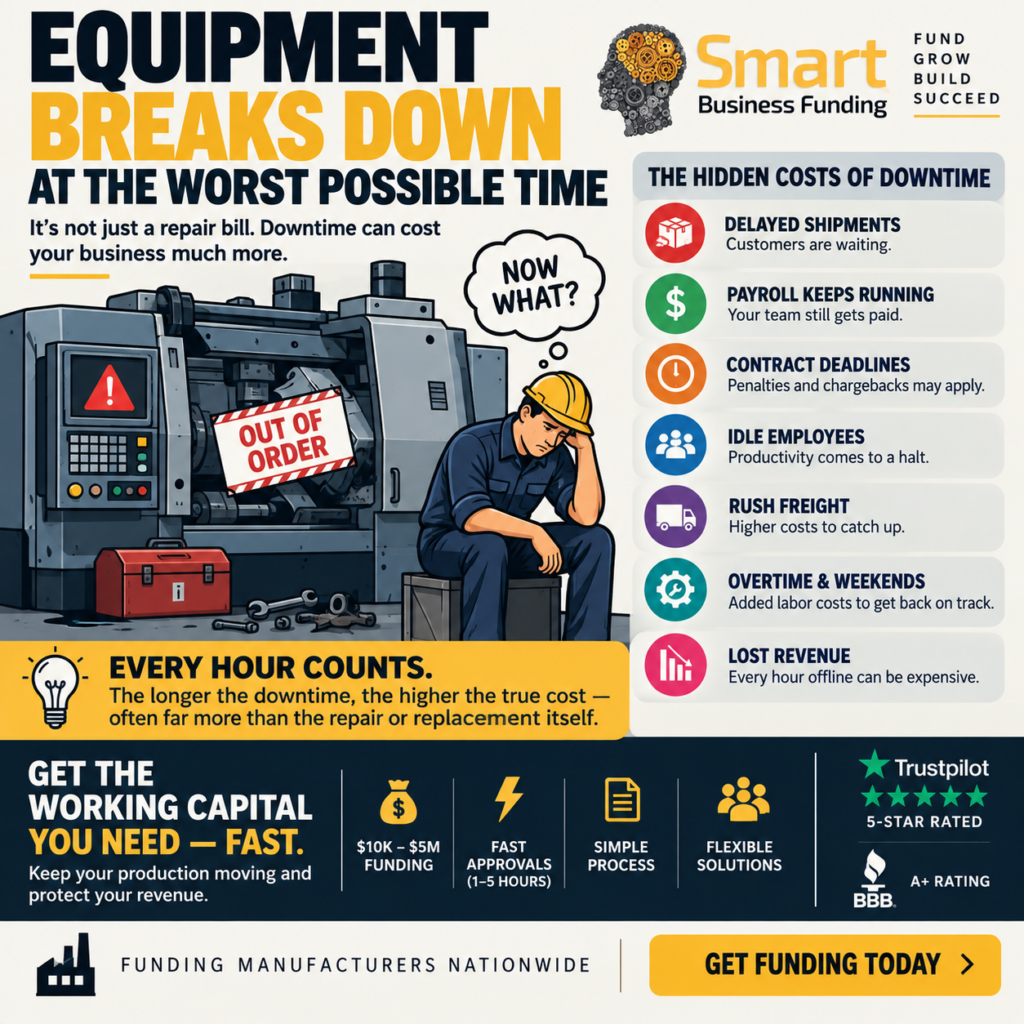
I’ve spent over a decade working with manufacturing and production business owners, and the pattern with equipment downtime is remarkably consistent: the repair bill is rarely the real cost. The real cost is everything downtime does to revenue that was already in motion — shipments that don’t go out, labor that’s paid but idle, and client relationships that get strained by a delay nobody could have scheduled around.
This guide walks through how to actually price out a breakdown, and why fast access to capital in that moment is about protecting revenue you’ve already earned, not just buying a replacement machine.
Why Downtime Is Different From a Routine Repair Bill
When a piece of equipment goes down, the instinct is to focus on the repair or replacement cost: parts, a technician, maybe a rental unit. But that number, on its own, dramatically understates what a breakdown actually costs a production business. The real number includes everything that stops moving while the equipment is down — and everything that has to happen afterward to catch back up.
What a Breakdown Actually Costs
1. Missed and Delayed Shipments
If the down equipment is in the direct path of an order with a committed ship date, every hour of downtime pushes that date further out. For clients running their own tight schedules — retailers, OEMs, distributors — a late shipment doesn’t just delay one invoice; it can cascade into their own downstream delays, which is exactly the kind of disruption that damages a relationship regardless of how understandable the cause was.
2. Contractual Penalties and Chargebacks
Many manufacturing contracts, especially with larger clients, include penalty clauses or chargebacks for late delivery. Depending on the contract, this can mean a percentage deduction from the invoice, a flat penalty fee, or in more severe or repeated cases, a client reconsidering the relationship for future work. Whatever the exact mechanism in your contracts, it’s worth reviewing what your specific agreements say before an outage happens — because during the outage itself is the worst time to be reading the fine print for the first time.
3. Idle Labor
Payroll doesn’t pause because a machine did. Operators, line workers, and support staff scheduled around the down equipment are often still being paid whether or not they’re productive — either because there’s no other work to shift them to, or because reassigning them disrupts other parts of the schedule. That’s a direct, calculable cost that starts accruing the moment the equipment stops, independent of the repair cost itself.
4. The Catch-Up Cost After the Fix
Downtime rarely ends when the repair is finished. Getting back to the original schedule often means overtime, weekend shifts, or rush freight to make up for lost time — all of which cost more per unit than the same work done on the original timeline. The total cost of a breakdown includes not just the hours the equipment was down, but the premium paid afterward to recover the lost ground.
A Practical Framework for Pricing Out Your Own Downtime Risk
Before the next breakdown happens, it’s worth having a rough number in mind rather than discovering the real cost in the moment:
- Calculate your revenue-per-hour on the affected line — what does an hour of normal production on that equipment typically generate or protect in committed orders?
- Add idle labor cost — what’s the fully loaded hourly cost of the staff who’d be sidelined if this specific piece of equipment went down?
- Review your client contracts for penalty language — do any of your standing agreements include late-delivery penalties or chargebacks, and what triggers them?
- Estimate a realistic repair-or-replace timeline — for your most critical equipment, how long would parts, a technician, or a rental unit realistically take to source?
Multiplying a realistic downtime window against these categories gives you an actual number for what a breakdown costs — one that almost always dwarfs the repair bill itself, and one that makes the case for fast access to capital much more concrete than “equipment might break someday.”
Fast Capital as Revenue Protection, Not Just a New Machine Purchase
It’s worth reframing what emergency capital is actually doing in this scenario. This isn’t primarily about financing the purchase of new equipment — it’s about moving fast enough to protect revenue that’s already committed: the shipment already promised, the labor already scheduled, the contract already signed. The faster a repair, rental, or replacement can happen, the smaller the gap between “equipment went down” and “production is back on schedule” — and that gap is where the real cost of downtime accumulates.
How the Direct Fund Program Fits
Smart Business Funding’s Direct Fund Program is built for exactly this kind of time-sensitive moment. Manufacturing and production businesses can access funding from $10,000 to $5,000,000, with underwriting typically completed in one to five hours and funding available as fast as the same or next business day — timing that matters when every hour of downtime is compounding cost against a committed shipment.
Repayment is structured as a fixed daily or weekly remittance — a known, set amount rather than a shifting percentage — so the cost of moving quickly is clear upfront rather than adding another layer of uncertainty on top of an already disrupted week. Full program details are available on the Merchant Cash Advance page.
Businesses with at least one year in operation, $50,000 or more in monthly revenue, and a credit score around 500 or higher (soft pull only, so checking eligibility doesn’t affect your credit) can typically get a straightforward answer on qualification.
If the breakdown points to a pattern of aging equipment rather than a one-off failure, it’s worth separately reviewing equipment financing for a planned replacement, rather than relying on emergency working capital every time something fails. And for businesses that experience recurring, unpredictable downtime risk across multiple machines, a line of credit can provide standing access to capital rather than starting the funding conversation fresh after every breakdown.
This Pattern Shows Up Across Manufacturing and Production Sectors
Metal stamping and fabrication shops depending on a single press for a critical run, CNC machine shops working tight-tolerance contracts with committed delivery windows, and packaging or food production lines running near-continuous shifts all carry significant downtime exposure by the nature of the equipment they depend on. You can review how funding applies to your specific sector on the Industries page.
Why Manufacturers Work With Smart Business Funding
Smart Business Funding (Collins Cash Inc. d/b/a Smart Business Funding) has funded businesses across all 50 states since December 2014 and holds an A+ rating with the Better Business Bureau, a five-star average on Trustpilot, and was named to the Inc. 5000 list of fastest-growing private companies in 2020. The company has funded more than $500 million to businesses nationwide, including manufacturers responding to unplanned equipment downtime.
Ready to Protect Revenue Already in Motion?
If equipment failure is threatening a shipment, a contract deadline, or a full production schedule, apply now to see what you qualify for — with no impact to your credit to check.
Want to talk through how fast funding could work for your specific equipment and contract situation? Contact us or call 1-866-Re-Smart to walk through it with our team.
Frequently Asked Questions
What does equipment downtime actually cost, beyond the repair bill? Missed or delayed shipments, potential contractual penalties or chargebacks for late delivery, idle labor that’s still being paid, and the overtime or rush costs needed to catch back up afterward are all part of the real cost — usually far more than the repair or replacement bill itself.
Is emergency funding for equipment downtime the same as financing a new machine purchase? Not necessarily. Working capital through the Direct Fund Program is often used to cover repair costs, rental equipment, idle labor, and rush logistics to protect revenue already committed, while equipment financing is structured specifically around acquiring or upgrading machinery long-term.
How fast can a manufacturer get funded after an equipment breakdown? Underwriting typically takes one to five hours, with funding available same-day or next-day in many cases — timing built around exactly this kind of urgent, revenue-protecting decision.
What does repayment look like on funding used for an equipment breakdown? Repayment runs as a fixed daily or weekly remittance amount, agreed to upfront, so the cost of moving quickly is clear from the start.
Should I get a line of credit instead of applying for funding after each breakdown? If downtime risk is a recurring issue across multiple machines, a line of credit can provide standing access to capital rather than starting a new funding conversation every time equipment fails.
About the Author
Anthony Collin is the CEO of Smart Business Funding (Collins Cash Inc.), a direct funding provider that has worked with manufacturing, production, and small business owners across all 50 states since December 2014. Smart Business Funding holds an A+ Better Business Bureau rating and a five-star Trustpilot average, and was named to the Inc. 5000 in 2020.