5 Business Assets You Didn’t Know Could Unlock Funding
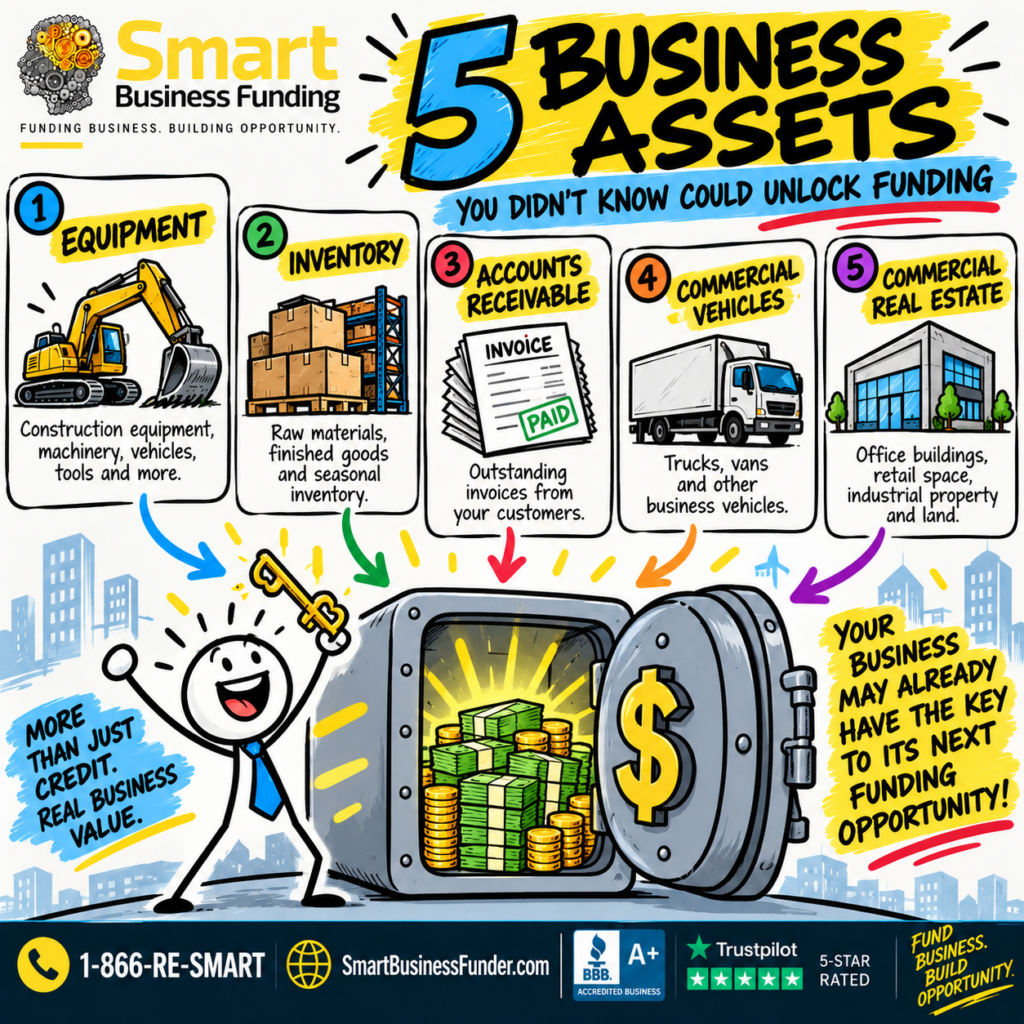
Most business owners think about financing in terms of what they qualify for based on credit and revenue. Fewer stop to consider what they already own that could open up additional options. If your business has any of the five assets below, it’s worth understanding how each one can factor into a funding decision — even if you ultimately choose a different path.
1. Equipment You Already Own (or Are About to Buy)
Vehicles, machinery, kitchen equipment, industrial tools — any significant piece of equipment your business owns or is planning to purchase can serve as the basis for equipment-specific financing. Because the equipment itself has an identifiable resale value, underwriting can often move faster than a purely unsecured product, since the lender has a concrete asset to evaluate alongside your business’s overall profile. Smart Business Funding’s own equipment financing option is structured around exactly this kind of purchase.
2. Inventory Sitting in Your Warehouse or Storefront
If your business carries meaningful inventory between sales cycles — common in retail, distribution, and wholesale businesses — that inventory itself can factor into certain financing structures, since it represents real, sellable value even before it converts to revenue. This category has grown substantially as automated inventory tracking has made it easier for lenders to assess real-time inventory value rather than relying on periodic manual counts. If seasonal inventory timing is part of what’s driving your funding need, our guide on types of business funding ranked by speed covers how to weigh an inventory-specific approach against a more general working capital option.
3. Outstanding Invoices From Slow-Paying Clients
A confirmed but unpaid invoice is a real, quantifiable asset, even though the cash hasn’t landed yet. This is exactly why receivables-based financing has become the largest single category within asset-based lending — it’s a direct answer to one of the most common cash flow problems businesses face. If a specific slow-paying client is the actual situation you’re dealing with right now, our piece on Your Biggest Customer Is Late Paying: How Do You Cover the Gap? walks through how to size a solution to the exact shortfall rather than the full invoice amount.
4. Home Equity (With a Critical Caveat)
If you own your home and have built up equity, a HELOC uses that equity as collateral for a credit line that can be applied to business needs. This is a meaningfully different exposure than the other assets on this list, since it secures the credit line against your personal residence specifically rather than a business asset. Before considering this route, our piece on the real risk of using a HELOC to fund your business covers exactly what’s at stake, and HELOC vs. Business Line of Credit compares it directly against a business-specific alternative.
5. Your Business’s Overall Revenue Stream
This last one isn’t a traditional “asset” in the collateral sense, but it functions as one in revenue-based underwriting: consistent, verifiable monthly deposits are themselves the basis for qualification with a product like Smart Business Funding’s Direct Fund Program. Rather than evaluating a specific piece of equipment or a pile of inventory, this approach evaluates the pattern of money moving through your business — often the fastest path to funding when the need doesn’t map cleanly onto any of the first four categories. Our complete guide to business funding qualification covers exactly what this kind of underwriting looks for.
How to Figure Out Which of These Actually Applies to You
Walk through your own situation against this list honestly:
- Do you own equipment tied directly to the funding need? → Equipment financing is worth evaluating first.
- Do you carry significant inventory and need capital tied to that cycle? → Inventory-based options are worth researching, though this is a more specialized category worth discussing directly with a qualified lender.
- Is a specific unpaid invoice the actual problem? → Size the funding to the shortfall, not the full invoice, as covered in our late-invoice guide linked above.
- Are you considering your home equity? → Read the risk breakdown first, since this is a fundamentally different exposure than the other options on this list.
- None of the above, and you just need working capital fast? → Revenue-based funding, evaluated against your actual deposit history, is likely your most direct path — see our best business funding options for companies that can’t wait on a bank for a fuller comparison across products.
Illustrative Composite Scenario (not an actual client, for explanatory purposes only): A small bakery owns a commercial oven worth a meaningful amount, carries modest ingredient inventory, and is also waiting on payment from a catering client. Rather than treating all three as one funding problem, the owner evaluates equipment financing for a planned second oven purchase separately from a revenue-based advance sized specifically to bridge the catering invoice gap — matching each need to the asset or revenue pattern that actually applies to it.
Why Matching the Asset to the Right Product Matters
Forcing an equipment-specific need into a revenue-based product, or vice versa, often means either paying for a structure that doesn’t fit your situation or missing out on more favorable terms available through the option actually built around your specific asset. Taking the time to identify which category genuinely applies — using the checklist above — is worth doing before applying to any single option.
How Smart Business Funding Approaches These Different Asset Types
Smart Business Funding offers equipment financing for asset-specific purchases, ongoing lines of credit, and the revenue-based Direct Fund Program for a defined, urgent gap. See the full process on the how it works page, review funding by business type on the industries page, or apply now to see which of your business’s assets actually points toward the best fit.
Frequently Asked Questions
Can inventory really be used to get business funding? Yes — inventory-based financing is a recognized category, particularly in retail and distribution, where automated tracking has made real-time inventory valuation more accessible to lenders.
Is an unpaid invoice actually worth anything before it’s paid? Yes — a confirmed, outstanding invoice represents real, quantifiable value, which is why receivables-based financing is the largest single category within asset-based lending.
Is using home equity for business funding the same risk as other assets on this list? No — a HELOC secures the credit line against your personal home specifically, a meaningfully different exposure than business-asset-based financing options.
What if I don’t have any specific assets to leverage? Revenue-based funding, which qualifies you based on your business’s actual cash flow rather than a specific owned asset, is likely your most direct path.
How do I know which asset category actually fits my situation? Match your specific funding need to the asset it’s tied to — an equipment purchase points toward equipment financing, a slow-paying invoice points toward sizing funding to that specific gap, and a general working capital need points toward revenue-based funding.
Curious which of your business’s assets could open up funding options? Apply now or call 1-866-Re-Smart. You can also reach the team at contact us.