Asset-Based Financing vs. Revenue-Based Funding: Which One Actually Fits Your Business?
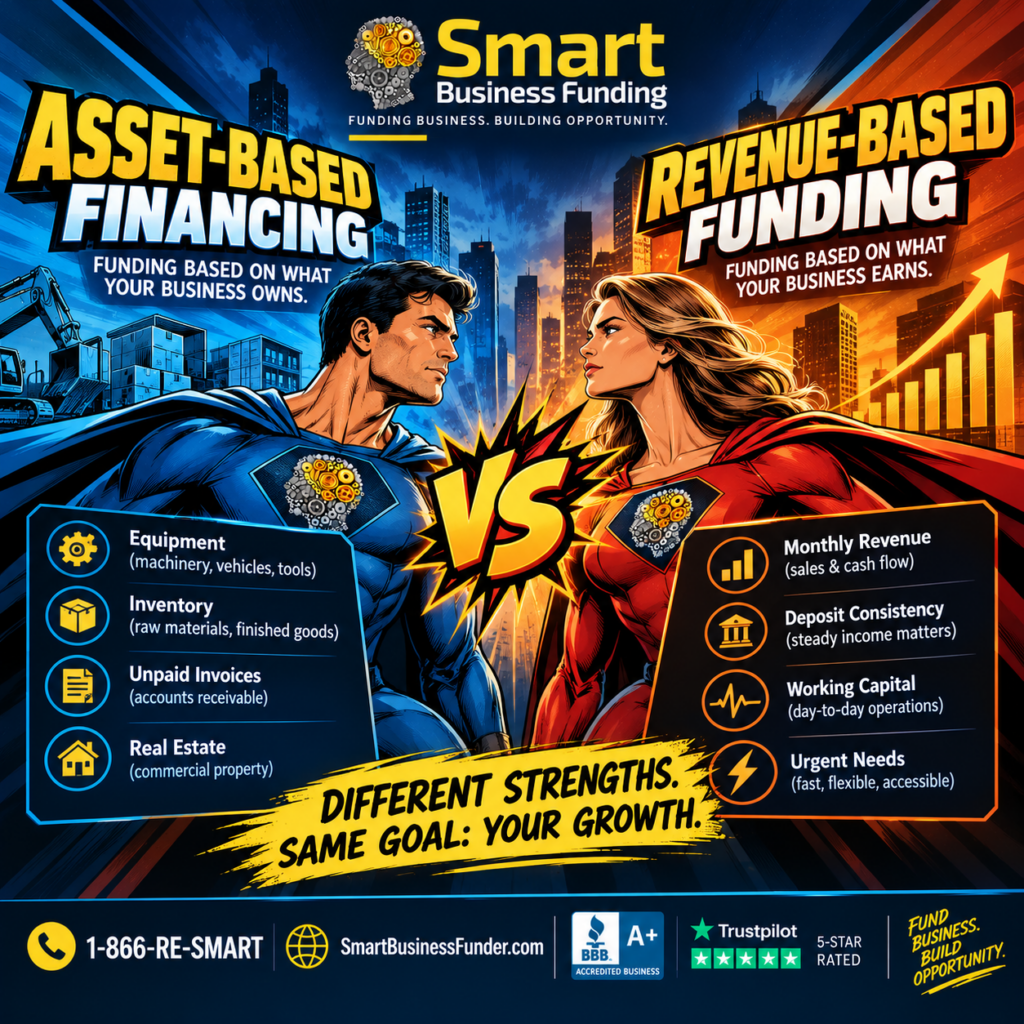
Two of the fastest-growing categories in small business financing work on almost opposite logic. Asset-based financing qualifies you based on something you already own — equipment, inventory, real estate, or unpaid invoices. Revenue-based funding qualifies you based on what your business actually earns, month over month, regardless of what’s sitting on your balance sheet. Understanding which logic actually matches your business’s situation is often more useful than comparing headline rates between the two.
The Core Difference in How Each One Underwrites
Asset-based financing centers underwriting on a specific, identifiable asset — its value, its condition, and how easily it could be liquidated if needed. A lender evaluating equipment financing, for instance, is assessing the equipment itself nearly as much as the business borrowing against it.
Revenue-based funding, like Smart Business Funding’s Direct Fund Program, centers underwriting on deposit consistency and monthly revenue instead. It typically still involves a personal guarantee and a UCC-1 filing against general business assets, but qualification itself doesn’t depend on owning any specific, identifiable asset the way equipment or inventory financing does. Our complete guide to business funding qualification breaks down exactly what underwriters weigh across both approaches in more detail.
Where Asset-Based Financing Tends to Win
- You have a specific, valuable asset and the funding need is directly tied to it — a piece of equipment you’re purchasing, inventory you’re carrying, or invoices you’re waiting on.
- Your business is asset-heavy but revenue is less consistent — a business with significant equipment or inventory value but seasonal or lumpy cash flow may qualify more easily through an asset-based structure than a purely revenue-based one.
- You want the underlying asset itself to be the primary basis of the lender’s confidence, rather than your overall business trajectory.
Our guide to what asset-based financing actually is covers the specific categories — equipment, inventory, invoices, and real estate-based options like a HELOC — in more depth if you’re still narrowing down which asset type applies to your situation.
Where Revenue-Based Funding Tends to Win
- Your business doesn’t have a specific asset to leverage, or the funding need isn’t tied to one — a payroll gap, a slow-paying client, or general working capital rather than an equipment purchase.
- Speed matters more than anything else. With a complete application, Direct Fund Program underwriting typically takes 1–5 hours, with funding as soon as the same or next business day — often faster than the appraisal or asset-valuation process many asset-based products require. Our breakdown of same-day business funding covers exactly what drives that speed.
- Your credit isn’t ideal, but your revenue is strong. Revenue-based underwriting evaluates cash flow directly rather than leaning primarily on credit history — see Emergency Business Funding With Bad Credit for how that qualification actually works.
A Direct Comparison
| Asset-Based Financing | Revenue-Based Funding | |
|---|---|---|
| Primary qualification basis | A specific owned asset | Monthly revenue and deposit consistency |
| Typical speed | Varies by asset and appraisal process | Often hours to next business day |
| Best fit | Equipment purchases, inventory-heavy businesses, outstanding invoices | Urgent, one-time gaps not tied to a specific asset |
| Collateral | The specific asset itself | Personal guarantee and UCC-1 against general business assets |
What About a Business That Fits Both?
Many businesses genuinely have a foot in both categories — a distribution business, for example, might carry significant inventory (an asset-based case) while also facing a specific, short-term cash flow gap unrelated to that inventory (a revenue-based case). In situations like this, the right move often isn’t picking one category exclusively, but matching each specific need to the structure built for it. Our guide to types of business funding ranked by speed covers how to think through multiple financing needs side by side rather than forcing everything into a single product.
Illustrative Composite Scenario (not an actual client, for explanatory purposes only): A regional equipment rental company owns a substantial fleet of machinery and also faces a short-term payroll gap caused by a delayed client payment. Rather than trying to solve both problems with the same product, the business pursues equipment financing for a planned fleet expansion — leveraging the value of the machinery itself — while separately using a Direct Fund Program advance, sized specifically to the payroll gap and evaluated against the business’s actual revenue rather than the fleet’s asset value.
Questions to Ask Yourself Before Choosing
- Is my funding need tied to a specific asset, or is it a general cash flow issue? This single question does more to point you toward the right category than any rate comparison.
- How fast do I actually need this? If the answer is “this week,” revenue-based funding is worth evaluating directly, since many asset-based products involve an appraisal or valuation step that adds time.
- What am I comfortable putting up as collateral? A specific asset, or a personal guarantee against general business assets — these carry different risk profiles worth understanding clearly, similar to the distinction covered in HELOC vs. Business Line of Credit for real-estate-based financing specifically.
- Is my industry a natural fit for asset-based structures? Retail, distribution, and equipment-heavy industries tend to have more to leverage in this category than service-based businesses with fewer tangible assets.
How Smart Business Funding Approaches Both Categories
Smart Business Funding offers equipment financing for asset-specific purchases alongside the revenue-based Direct Fund Program and ongoing lines of credit, so your specific need can be matched to the right structure rather than forced into whichever product you happened to hear about first. See the full process on the how it works page, review funding by business type on the industries page, or apply now.
Frequently Asked Questions
Is asset-based financing better than revenue-based funding? Neither is universally better — it depends on whether your funding need is tied to a specific owned asset or is a general cash flow issue best evaluated against your business’s revenue.
Can I use both types of financing at the same time? Yes — many businesses use asset-based financing for asset-specific needs (like equipment) alongside revenue-based funding for unrelated, general cash flow gaps.
Which one is faster? Revenue-based funding is often faster, since it typically avoids the appraisal or asset-valuation step many asset-based products require, though this varies by specific lender and asset type.
Does my credit matter more for one than the other? Revenue-based underwriting generally weighs credit less heavily relative to cash flow, while asset-based financing’s underwriting focus depends more on the specific asset’s value and condition.
How do I know which one my business actually needs? Start by asking whether your funding need is tied to a specific asset you own — if yes, asset-based financing is worth evaluating; if the need is general working capital or an urgent gap, revenue-based funding is often the more direct fit.
Not sure which structure fits your specific situation? Apply now or call 1-866-Re-Smart to talk it through. You can also reach the team at contact us.