Why Rigid Monthly Payments Are Dying: Inside the Flexible Equipment Financing Trend Reshaping 2026
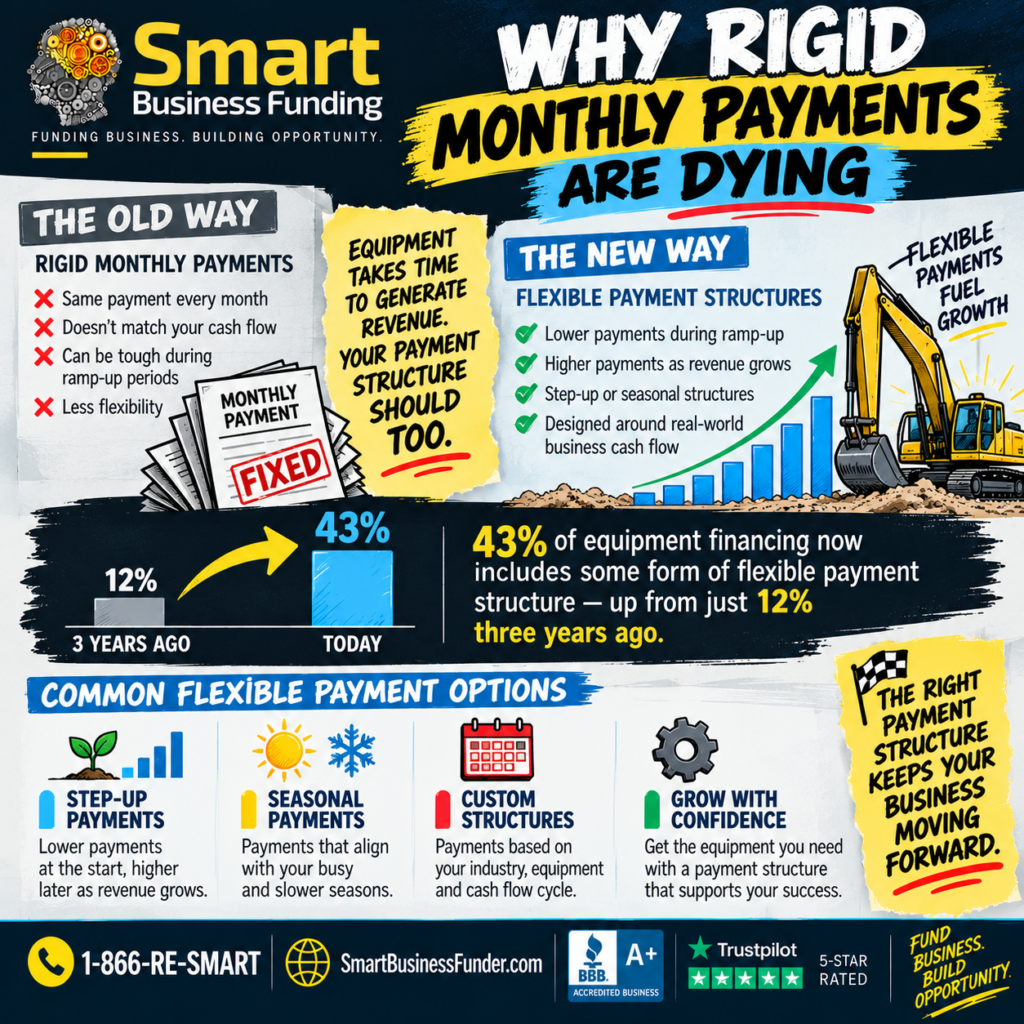
For decades, equipment financing followed a simple, unbending pattern: borrow a fixed amount, pay a fixed amount every month, for a fixed number of months, regardless of whether your business was actually generating revenue from that equipment yet. That pattern is changing fast. Industry data now shows roughly 43% of equipment financing includes some form of flexible payment structure, up from just 12% only three years ago, a genuine shift in how lenders are thinking about the relationship between a payment schedule and a business’s actual cash flow.
What “Flexible” Actually Means in Practice
The shift isn’t toward vague or unpredictable payments, it’s toward structures that are still fixed and disclosed upfront, but designed around a business’s realistic revenue ramp-up rather than a flat schedule starting on day one. A common example: a step-up structure where payments start lower during an equipment’s first year, while a business builds the client base or operational capacity to use it fully, and increase in later years once the equipment is generating its full expected value. One documented case in current industry reporting describes a catering business structuring payments starting at $800 a month in year one, stepping up to $1,400 a month in years two and three, reducing first-year cash flow pressure by roughly $7,200 during the critical ramp-up period.
This is a meaningfully different idea than “flexible” in the sense of unpredictable or revenue-percentage-based repayment. It’s still a defined, disclosed schedule, just one shaped around when a business realistically expects to benefit from the equipment, rather than assuming full utilization from month one.
Why Lenders Are Making This Shift
The stated logic behind the trend is straightforward: rigid monthly payments don’t match business reality, particularly for equipment that takes time to reach full operational use, a new production line that needs staff training, a piece of machinery tied to a seasonal business cycle, or new capabilities a business hasn’t fully marketed yet. A payment structure that assumes instant full utilization creates unnecessary cash flow pressure during exactly the period a business can least afford it, and lenders adapting to this reality are seeing better outcomes as a result.
This connects to a broader theme we’ve covered elsewhere: cash flow timing, not total cost, is often the actual constraint businesses are managing day to day. Our piece on what to do when your business can’t make payroll this week covers the same underlying principle in a different context, the problem is rarely “we can’t afford this eventually,” it’s “we can’t afford this exact structure on this exact timeline.”
The Related Trend: Bundled “Total Solution” Financing
Alongside flexible payment structures, bundled equipment financing, combining the equipment itself with installation, training, and maintenance into a single financed package, has grown 67% year-over-year. Industry data associates this approach with a meaningfully lower total cost of ownership compared to financing each piece separately, faster time to full operational capability, and fewer implementation issues requiring additional troubleshooting. The logic mirrors the flexible-payment trend: financing structured around how a business actually gets equipment fully operational, not just around the sale of the equipment itself.
What This Means If You’re Financing Equipment Right Now
- Ask directly whether a step-up or seasonal structure is available, rather than assuming a flat monthly payment is the only option. This is increasingly a standard offering rather than a special accommodation.
- Consider whether a bundled approach reduces your total risk, not just your sticker price, a lower total cost of ownership and faster time to full capability can matter more than the headline financing rate.
- Model your actual expected ramp-up honestly before agreeing to any structure, flexible or otherwise, the value of a step-up payment only holds if your revenue timeline assumptions are realistic. Our complete guide to business funding qualification covers the broader discipline of matching financing structure to actual, honest business timelines rather than best-case assumptions.
Where This Trend Doesn’t Apply: and What to Use Instead
It’s worth being clear that this flexible-structure trend is specific to traditional equipment loans and leases, a different product category than a revenue-based advance like Smart Business Funding’s Direct Fund Program, which uses a fixed factor rate and a fixed daily or weekly repayment schedule disclosed at signing rather than a stepped or seasonal structure. If your actual need is equipment-specific and long-horizon, a flexible traditional equipment financing structure, like Smart Business Funding’s own equipment financing option, may be the better fit than a revenue-based product. Our broader comparison of asset-based financing vs. revenue-based funding covers exactly this kind of decision in more depth.
Illustrative Composite Scenario (not an actual client, for explanatory purposes only): A boutique fitness studio finances new equipment for an expanded class offering, structuring payments to start lower during the first six months while building membership around the new capability, then stepping up once the classes reach expected enrollment. This structure avoids the cash flow strain a flat payment from day one would have created during the studio’s ramp-up period.
Why This Trend Reflects a Broader Shift in Lending
This move toward flexible, realistic payment structures is part of a broader pattern across small business financing generally, a recognition that rigid, one-size-fits-all products often mismatch how businesses actually operate. Our piece on why 76% of small businesses are now bypassing traditional banks for financing covers a related version of this same shift, where speed and structural fit have become as important to business owners as headline cost.
How Smart Business Funding Approaches Equipment Financing
Smart Business Funding’s equipment financing option is built around the specific equipment your business is purchasing, alongside the revenue-based Direct Fund Program for needs that aren’t equipment-specific. See the full process on the how it works page, review funding by business type on the industries page, or apply now to discuss what payment structure actually fits your equipment purchase.
Frequently Asked Questions
What is a flexible equipment financing structure? It’s a disclosed, defined payment schedule designed around a business’s realistic revenue ramp-up, such as lower payments in the first year and higher payments in later years, rather than a flat payment starting on day one.
Why has flexible equipment financing grown so quickly? Lenders have recognized that rigid monthly payments create unnecessary cash flow pressure during a business’s ramp-up period, and flexible structures better match how businesses actually generate value from new equipment over time.
Is bundled equipment financing the same as flexible payments? They’re related but distinct trends, bundled financing combines equipment with installation, training, and maintenance into one package, while flexible payments adjust the schedule itself; the two are often offered together.
Does Smart Business Funding’s Direct Fund Program offer this kind of flexible structure? No, the Direct Fund Program uses a fixed factor rate and fixed daily or weekly repayment schedule; flexible, stepped payment structures are specific to traditional equipment financing products.
How do I know if a flexible structure is right for my equipment purchase? It depends on how quickly you realistically expect to generate revenue from the equipment, if there’s a genuine ramp-up period before full utilization, a flexible structure may better match your cash flow than a flat payment from day one.
Considering equipment financing structured around your actual ramp-up timeline? Apply now or call 1-866-Re-Smart. You can also reach the team at contact us.