What Is Asset-Based Financing? A Plain-English Guide for Business Owners Sitting on Equipment, Inventory, or Unpaid Invoices
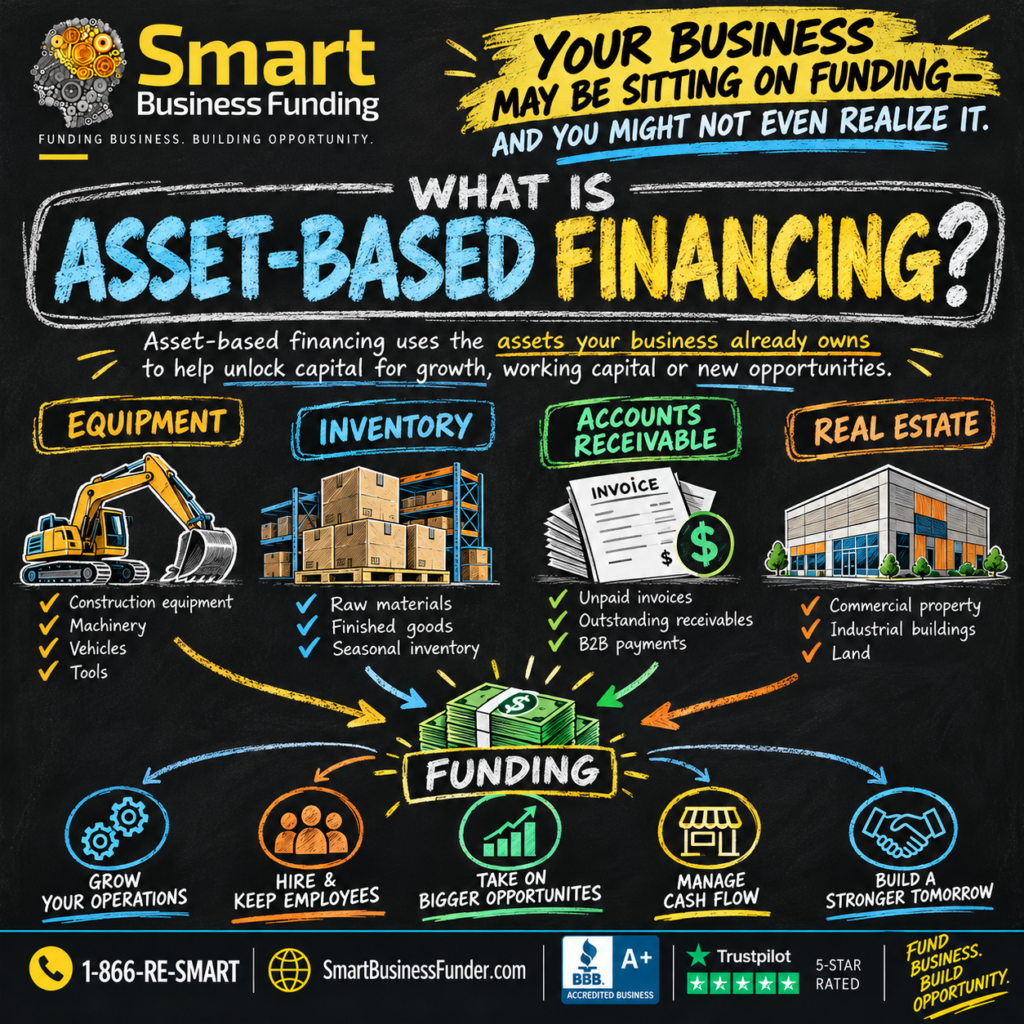
If your business owns valuable equipment, holds significant inventory, or is waiting on a stack of unpaid invoices, you may be sitting on financing leverage you haven’t fully considered. Asset-based financing is a broad category of business funding that uses something your business already owns — rather than just your credit history or a personal guarantee alone — as the basis for qualification and, often, as collateral. It’s one of the fastest-growing segments of small business financing, and understanding how it actually works can open up options a purely credit-based application wouldn’t.
The Core Idea Behind Asset-Based Financing
Traditional lending decisions often center on two things: your credit history and your revenue trend. Asset-based financing shifts part of that equation toward something more concrete — a specific, valuable asset the business already owns. Because the lender has a tangible asset backing the arrangement, underwriting can sometimes move faster and qualification criteria can look different than a purely credit-based product. Our complete guide to business funding qualification covers the broader set of factors — revenue, time in business, credit, and collateral — that underwriters weigh across financing types generally, which is useful context before diving into any one category specifically.
The Major Categories of Asset-Based Financing
Equipment financing uses the equipment being purchased or already owned as the underlying collateral. Because the asset itself has an identifiable resale value, underwriting can often move faster than an unsecured product. Smart Business Funding’s own equipment financing option is built around exactly this structure for businesses purchasing vehicles, machinery, or similar equipment.
Inventory financing uses a business’s existing inventory as collateral, common in retail and distribution businesses that carry significant stock between sales cycles. This category has grown substantially as automated inventory tracking and valuation tools have made it easier for lenders to assess inventory value in real time.
Invoice financing or factoring uses outstanding, unpaid invoices as the basis for an advance — a business receives a portion of an invoice’s value upfront rather than waiting for a slow-paying client to settle it. This is currently the single largest segment of the asset-based lending market by volume, reflecting how common the receivables-timing problem is across industries. If a specific slow-paying invoice is your actual situation right now, our piece on covering the gap from a late-paying client walks through how to size that kind of need directly.
Real estate and home-equity-based financing uses property value as collateral, most commonly through a HELOC. This structure secures the credit line against real estate specifically rather than business assets — a distinction covered in depth in our piece on the real risk of using a HELOC to fund your business, including how it compares structurally to a business-specific line of credit in HELOC vs. Business Line of Credit.
Why This Category of Financing Has Grown So Much
A few structural trends have driven substantial growth in asset-based financing recently. Non-bank lenders have expanded significantly into this space, offering more flexible underwriting than traditional banks are typically willing to provide for mid-sized and smaller businesses. AI-driven credit decisioning and automated valuation tools have also made it faster and more precise to assess collateral value in real time, rather than relying on slower, manual appraisal processes. And broader small business survey data shows a majority of small businesses now bypass traditional banks entirely for financing, favoring more flexible alternative structures — a trend that’s helped fuel demand across the entire asset-based financing category.
How Asset-Based Financing Differs From Revenue-Based Funding
It’s worth being clear about a distinction that gets blurred often: asset-based financing qualifies you based primarily on a specific owned asset, while revenue-based funding — like Smart Business Funding’s Direct Fund Program — qualifies you based primarily on your business’s cash flow and deposit consistency. The Direct Fund Program isn’t asset-secured in the traditional sense; it typically involves a personal guarantee and a UCC-1 filing against general business assets rather than a specific piece of equipment or inventory serving as the collateral basis for qualification itself. We cover this distinction in full in Asset-Based Financing vs. Revenue-Based Funding: Which One Actually Fits Your Business?
Which Type of Business Tends to Benefit Most
Businesses with meaningful, identifiable assets — significant equipment, substantial inventory, or a steady stream of invoiced receivables — are generally the strongest candidates for asset-based financing specifically. A service business with few tangible assets but strong, consistent monthly deposits is often a better fit for revenue-based underwriting instead. Our breakdown of types of business funding ranked by speed covers how asset-based options compare on timeline against revenue-based and traditional bank products across a range of business situations.
Illustrative Composite Scenario (not an actual client, for explanatory purposes only): A wholesale distribution business holds substantial seasonal inventory but has irregular cash flow between restocking cycles. Rather than pursuing a purely credit-based bank product, the business considers financing structured around its inventory value, while separately evaluating a Direct Fund Program advance sized against its actual revenue for a shorter-term, specific cash flow gap unrelated to the inventory itself.
What to Ask Before Pursuing Any Asset-Based Option
- What specifically qualifies as the underlying asset, and how is its value being assessed?
- What happens to that specific asset if the business can’t repay — is it repossessed, sold, or handled some other way?
- How does the total cost compare to a revenue-based alternative, given your actual usage pattern rather than just the advertised terms?
- Is speed a factor in your decision? Our guide to same-day business funding covers what genuinely fast funding looks like if your asset-based option’s timeline doesn’t match your actual need.
How Smart Business Funding Fits Into This Category
Smart Business Funding offers equipment financing for asset-specific purchases, lines of credit for ongoing needs, and the revenue-based Direct Fund Program for a defined, urgent gap. See the full process on the how it works page, review funding by business type on the industries page, or apply now to see which structure fits your specific assets and needs.
Frequently Asked Questions
What is asset-based financing? It’s a category of business funding where a specific owned asset — equipment, inventory, real estate, or unpaid invoices — serves as the basis for qualification and often as collateral, rather than credit history or revenue alone.
Is asset-based financing the same as a merchant cash advance? No — an MCA like the Direct Fund Program is revenue-based, qualifying primarily on cash flow rather than a specific asset, though it typically still involves a personal guarantee and UCC-1 filing.
Which businesses benefit most from asset-based financing? Businesses with significant equipment, inventory, or steady invoiced receivables tend to be the strongest candidates, since the underlying asset gives the lender a concrete basis for underwriting.
Is asset-based financing faster than a bank loan? Often yes, since a tangible asset can simplify underwriting compared to a purely credit-based review, though speed varies by lender and asset type.
What happens if I can’t repay an asset-based financing arrangement? This depends on the specific structure and asset involved — it’s important to understand exactly what happens to the underlying collateral before signing any agreement.
Curious which of your business’s assets could unlock funding? Apply now or call 1-866-Re-Smart. You can also reach the team at contact us.