Line of Credit Is the #1 Financing Request in America — So Why Do Half of Applicants Get Denied?
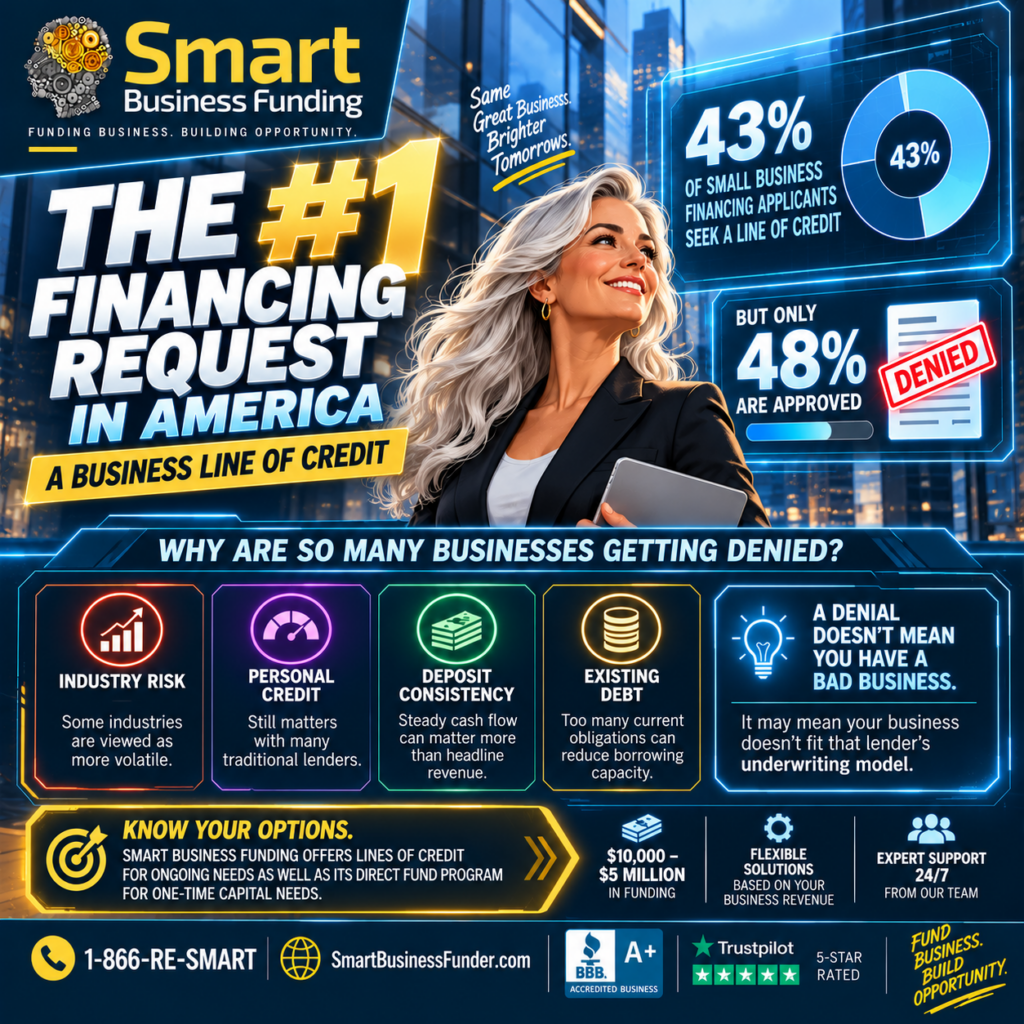
A business line of credit is the single most requested type of financing among small businesses in the United States, according to data cited from the Federal Reserve’s Small Business Credit Survey — roughly 43% of financing applicants name it as their primary request, ahead of term loans, credit cards, and every other product category. And yet the overall approval rate for these applications sits at only around 48%, meaning roughly half of all applicants who go looking for a line of credit come away without one.
That gap — overwhelming demand paired with a coin-flip approval rate — is worth understanding in detail, especially if you’re about to apply yourself. If you’d rather start with the fuller picture of how business funding qualification works across product types before narrowing in on lines of credit specifically, our complete guide to business funding qualification is a useful companion piece to this one.
Why Demand for Lines of Credit Is So High
It’s not hard to see why this product tops the list. A business line of credit gives you revolving access to capital — draw what you need, repay it, and the available balance replenishes, similar in spirit to a credit card but usually with substantially higher limits. For a small business managing seasonal swings, a slow-paying client, or simply the unpredictability of day-to-day operations, that flexibility is exactly what’s needed more often than a lump-sum term loan. Our breakdown of what a business line of credit is actually built for, versus other financing types, covers where it fits relative to options like equipment financing or a one-time advance.
Why Approval Rates Still Lag So Far Behind Demand
Despite the demand, a large share of applicants don’t clear underwriting. A few structural reasons show up consistently:
1. Industry risk classification varies enormously. Approval rates differ dramatically by sector — professional services and healthcare businesses, with stable and predictable recurring revenue, tend to see meaningfully higher approval rates than construction or trucking businesses, where project-based or fuel-cost-exposed cash flow is viewed as more volatile by traditional underwriters.
2. Personal credit still carries significant weight, especially for smaller businesses and LLCs where owners typically sign a personal guarantee. A business with genuinely strong revenue can still be denied if the owner’s personal credit history doesn’t meet a bank’s threshold.
3. Deposit consistency matters more than total revenue. Underwriters increasingly look past the headline revenue number to the pattern underneath it — consistent deposits without overdrafts or non-sufficient-funds fees read as a much lower-risk profile than the same total revenue arriving erratically.
4. Existing debt load reduces how much new credit a business can realistically take on, even if the business otherwise qualifies — a heavily leveraged business can be denied additional credit specifically because of obligations it’s already carrying.
What Underwriters Are Actually Weighing
Put together, these factors mean a “denial” often isn’t really about whether a business is healthy — it’s about whether a specific underwriting model, built around specific risk assumptions, can confidently evaluate that business’s particular combination of industry, credit profile, and cash flow pattern. A construction business with excellent revenue can be denied by a traditional bank for reasons that have nothing to do with whether the business is actually a good credit risk in practice — it’s a mismatch between the business’s profile and that specific underwriting model, not necessarily a verdict on the business itself.
This is exactly why revenue-based underwriting, which evaluates cash flow directly rather than leaning primarily on industry classification and personal credit history, produces meaningfully different outcomes for the same business. Our piece on Emergency Business Funding With Bad Credit covers how that underwriting approach works when credit specifically is the sticking point.
How to Actually Improve Your Odds Before You Apply
- Know your industry’s general risk classification going in. If you’re in a sector that traditionally sees lower approval rates from banks, that’s useful information for deciding which type of financing to pursue rather than a reason to assume you won’t qualify anywhere.
- Clean up deposit consistency where you can. Reducing overdrafts and smoothing out erratic deposit patterns, even modestly, can meaningfully change how an underwriter reads your cash flow.
- Understand your existing debt load from a lender’s perspective, not just your own — what looks manageable to you day-to-day can still read as over-leveraged to an underwriter evaluating additional capacity.
- Match the product to the actual need. If what you need is genuinely a one-time, urgent gap rather than ongoing access, a revenue-based advance like the Direct Fund Program may both fit better and qualify more easily than a revolving line, since it’s evaluated primarily against current revenue rather than the same industry and personal-credit factors driving bank approval rates.
Illustrative Composite Scenario (not an actual client, for explanatory purposes only): A construction business with $70,000+ in average monthly revenue applies for a bank line of credit and is denied, largely due to the industry’s project-based cash flow volatility and the owner’s personal credit sitting below the bank’s threshold. The same business, evaluated under revenue-based underwriting against actual monthly deposits rather than industry classification and personal credit alone, qualifies for a Direct Fund Program advance sized to its specific working capital need.
What This Means If You’ve Already Been Denied
A denial from one lender, or even from the specific product category of “line of credit” generally, isn’t the end of the road — it reflects that particular underwriting model’s assumptions, not necessarily your business’s actual health. Our guide to the best business funding options for companies that can’t wait on a bank walks through several alternatives worth evaluating if a traditional line of credit hasn’t worked out.
How Smart Business Funding Approaches This
Smart Business Funding offers lines of credit for ongoing needs alongside the one-time Direct Fund Program, with underwriting built around business revenue rather than the industry-and-personal-credit model driving much of the approval gap described above. See the full process on the how it works page, review funding by business type on the industries page, or apply now.
Frequently Asked Questions
Why is a business line of credit the most requested financing product? Its revolving structure — drawing only what you need and replenishing as you repay — fits the day-to-day unpredictability of small business cash flow better than a lump-sum term loan for many owners.
Why do so many line of credit applications get denied? Industry risk classification, personal credit history, deposit consistency, and existing debt load all factor into underwriting, and a mismatch on any of these can result in denial even for an otherwise healthy business.
Does my industry affect my approval odds? Yes — sectors with more predictable, recurring cash flow (professional services, healthcare) generally see higher approval rates than project-based or cyclical industries (construction, trucking).
What can I do if I’ve been denied a line of credit? Consider whether a revenue-based product, evaluated against actual cash flow rather than industry classification and personal credit alone, might better fit your situation.
Is a denial a sign my business is unhealthy? Not necessarily — a denial often reflects a mismatch with a specific lender’s underwriting model rather than an accurate verdict on your business’s actual financial health.
Wondering whether your business is a stronger fit for a line of credit or a one-time advance? Apply now or call 1-866-Re-Smart. You can also reach the team at contact us.