Business Line of Credit Approval Rates by Industry in 2026 — Where Does Your Business Stand?
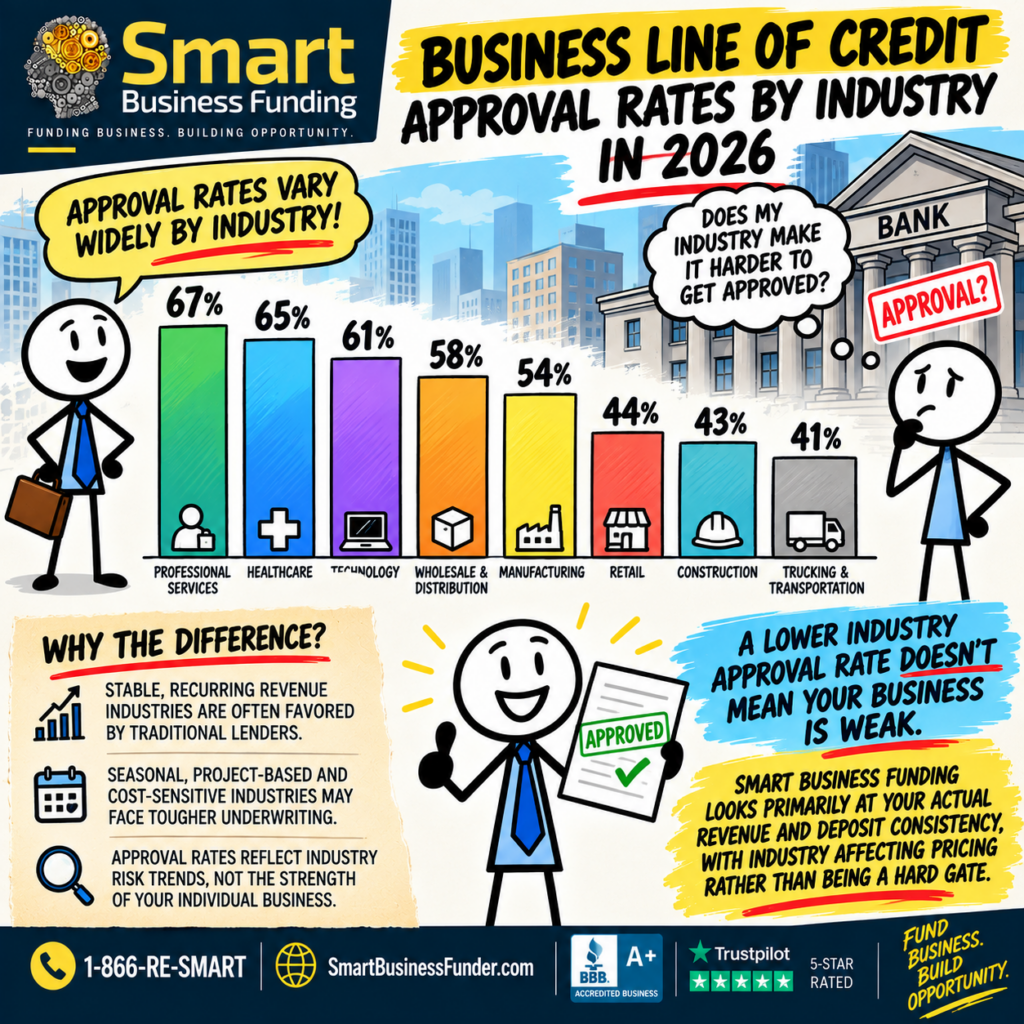
Not all industries are evaluated the same way when a bank underwrites a business line of credit application — and the gap between the easiest and hardest sectors to get approved in is large enough that it’s worth knowing where your industry sits before you apply. Reported approval rates for 2026 range from roughly 67% for professional services down to around 41% for trucking and transportation — a difference of more than 25 percentage points driven almost entirely by how lenders assess industry-level risk, cyclicality, and cash flow predictability.
The Approval Rate Breakdown by Industry
Based on current industry reporting citing Federal Reserve Small Business Credit Survey data, here’s roughly how major sectors compare:
- Professional services (law, accounting, consulting): approval rates around 67%, the highest of any major category, reflecting stable and predictable recurring revenue.
- Healthcare and medical: approval rates around 65%, similarly benefiting from stable, recurring revenue patterns.
- Technology: approval rates around 61%, with SaaS and recurring-revenue business models generally favored by underwriters.
- Wholesale and distribution: approval rates around 58%, supported by asset-backed structures and generally predictable order patterns.
- Manufacturing: approval rates around 54%, a moderate risk classification where equipment collateral often helps offset cyclicality concerns.
- Retail: approval rates around 44%, reflecting seasonal volatility as a significant underwriting factor.
- Construction: approval rates around 43%, driven largely by project-based cash flow variation.
- Trucking and transportation: approval rates around 41%, the lowest of the major categories, reflecting fuel cost exposure and regulatory risk factors.
Why Industry Alone Drives Such a Large Gap
The pattern across this data is consistent: industries with stable, recurring, and predictable revenue streams get approved at meaningfully higher rates than industries with project-based, seasonal, or input-cost-exposed revenue — regardless of how strong any individual business’s actual performance is within that category. A traditional underwriting model is built to assess risk at the category level first, and an individual business’s specific track record often has to work harder to overcome an unfavorable industry classification than it would in a sector already viewed as lower-risk.
This is worth understanding not as a judgment about any specific business, but as a structural feature of how conventional lending underwriting works — a distinction covered in more depth in our piece on why so many line of credit applicants get denied despite strong overall demand.
What This Means If Your Industry Sits on the Harder End
If your business operates in construction, trucking, retail, or another sector with a lower reported approval rate, that doesn’t mean your specific business is a poor credit risk — it means a traditional line of credit underwriting model may not be well-suited to evaluating your particular cash flow pattern. A few things worth doing differently if this applies to you:
- Understand that your industry classification is working against you before you even apply, so a denial doesn’t come as a surprise or read as a verdict on your business specifically.
- Consider whether your actual need fits a line of credit’s revolving structure in the first place, or whether a different product — a one-time advance, or equipment financing if the need is asset-specific — might both fit better and face a more favorable underwriting model.
- Look at revenue-based underwriting as an alternative, since it evaluates your actual deposit and cash flow pattern directly rather than leaning primarily on your industry’s category-level risk profile. Our guide on emergency business funding with bad credit covers a similar dynamic in the context of personal credit specifically, and the same underlying principle — evaluating the business directly rather than a proxy classification — applies here too.
What This Means If Your Industry Sits on the Easier End
Even a favorable industry classification doesn’t guarantee approval — personal credit, deposit consistency, and existing debt load still factor in regardless of sector. But if you’re in professional services, healthcare, or technology, it’s worth actually pursuing a traditional line of credit application rather than assuming a faster, revenue-based product is your only option, since you may be a strong candidate for the traditional product’s typically lower cost structure.
Illustrative Composite Scenario (not an actual client, for explanatory purposes only): A regional trucking company with consistent $90,000+ in monthly revenue applies for a bank line of credit and is denied, largely due to the industry’s fuel-cost exposure and regulatory risk classification rather than any specific issue with the business’s own financials. Reviewing options against types of business funding ranked by speed, the business instead pursues a revenue-based Direct Fund Program advance, evaluated directly against its actual deposit history rather than its industry’s category-level risk profile.
How to Use This Data Practically
Knowing your industry’s general approval-rate range before applying helps you do two things: set realistic expectations for a traditional bank product, and decide earlier whether it’s worth pursuing that route at all versus moving directly to a revenue-based alternative. Our broader comparison of types of business funding ranked by speed is a useful next step once you’ve placed your own industry on this spectrum.
How Smart Business Funding Approaches Industry Risk
Smart Business Funding’s Direct Fund Program evaluates businesses primarily against actual revenue and deposit consistency, with industry classification factoring into pricing rather than functioning as a hard gate the way it often does in traditional line of credit underwriting. See the full process on the how it works page, review funding by business type on the industries page, or apply now regardless of where your industry falls on this list.
Frequently Asked Questions
Which industries have the highest line of credit approval rates? Professional services and healthcare currently report the highest approval rates, largely due to stable, predictable, recurring revenue patterns.
Which industries have the lowest approval rates? Trucking, transportation, and construction currently report the lowest approval rates, driven by cyclical, project-based, or input-cost-exposed cash flow.
Does a low approval rate for my industry mean my specific business won’t qualify? Not necessarily — it reflects how traditional underwriting models assess category-level risk, not a verdict on your individual business’s actual financial health.
Is there a way around a challenging industry classification? Revenue-based underwriting, which evaluates your actual deposit and cash flow pattern directly, can produce a different outcome than a traditional model that leans heavily on industry classification.
Should businesses in favorable industries still consider alternatives to a traditional line of credit? It depends on the actual need — a favorable industry classification is a real advantage for a traditional product, but the underlying need (urgent vs. ongoing, one-time vs. recurring) still matters more than industry alone in choosing the right structure.
Curious how your specific industry and revenue profile stack up? Apply now or call 1-866-Re-Smart. You can also reach the team at contact us.