Line of Credit vs. Term Loan: What 2026 Data Says Business Owners Actually Choose (And When)
Ask a bank what financing options are available and you’ll usually hear the same two names first: a line of credit or a term loan. They’re the two most familiar products in small business lending, and they work in fundamentally different ways — yet a lot of business owners apply for whichever one they’ve heard of first, rather than the one that actually matches their situation. Current usage data offers a clearer picture of how businesses are actually choosing between the two, and what tends to separate a good fit from a mismatch.
The Basic Structural Difference
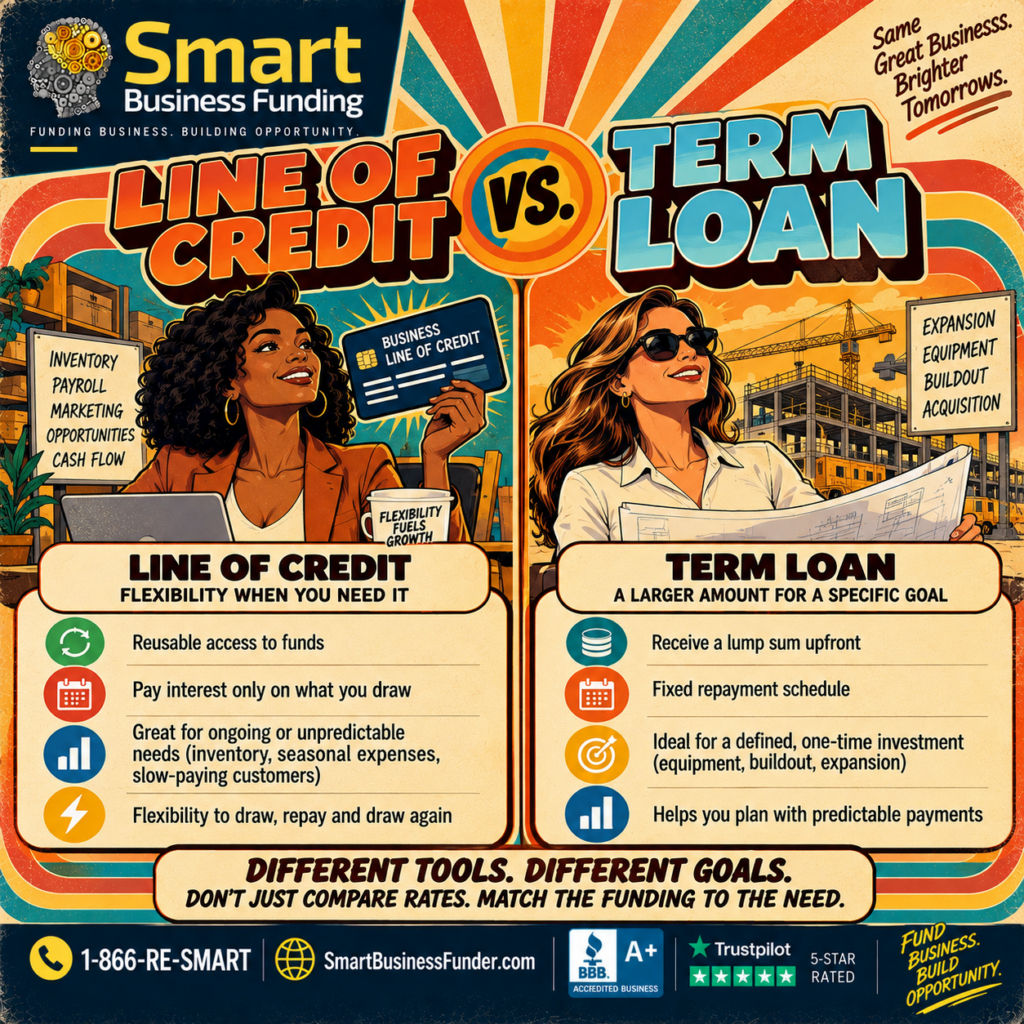
A term loan is a lump-sum disbursement, repaid on a fixed schedule — weekly, biweekly, or monthly — with interest applied to the full amount from day one. A line of credit is a revolving facility: you draw only what you need, pay interest only on the amount actually drawn, and the available balance replenishes as you repay. That structural difference is the reason the two products get used so differently in practice, and it’s worth understanding clearly before applying for either — our complete guide to business funding qualification covers the broader qualification picture across financing types if you’re still narrowing down which category fits your need.
What the Usage Data Actually Shows
Term loans tend to get used for defined, one-time capital needs with a clear return horizon — equipment purchases, facility improvements, and expansion projects where the business can point to a specific investment and a specific payback timeline. Lines of credit, by contrast, get used overwhelmingly for managing cash flow variability — seasonal inventory needs, unexpected opportunities, and emergency expenses, where the amount and timing of the need isn’t fully predictable in advance.
This pattern lines up with the products’ underlying structure: a term loan’s fixed repayment schedule makes sense when you know exactly how much you need and when you’ll see a return; a line of credit’s flexibility makes sense when the actual need is uncertain in size or timing, and you want to avoid paying interest on capital sitting unused.
Where the Real Cost Comparison Gets Misunderstood
A common mistake is comparing the two purely on advertised interest rate, without accounting for how each product’s structure actually affects total cost in practice. A term loan’s interest applies to the full principal from the start, even if you don’t need the full amount immediately. A line of credit’s interest applies only to what’s drawn — meaning a lower utilization rate can make an apparently higher-rate line of credit cheaper in practice than a lower-rate term loan, depending on how the funds are actually used over time.
This is exactly the kind of nuance that gets lost when businesses default to whichever product they’re more familiar with, rather than modeling their actual expected usage pattern against each structure. If your need doesn’t cleanly fit either of these traditional structures — for instance, a specific, urgent, one-time gap rather than an ongoing need or a long-horizon investment — a revenue-based advance like the Direct Fund Program is worth evaluating alongside both, since it’s structured differently from either traditional product.
When a Term Loan Is Genuinely the Better Fit
- You know the exact amount you need, with no expectation of drawing more later.
- The funded purchase has a clear, definable return — a piece of equipment, a buildout, a specific expansion cost.
- You want the predictability of a single fixed payment schedule rather than managing an ongoing revolving balance.
When a Line of Credit Is Genuinely the Better Fit
- Your need is recurring or unpredictable in size and timing — seasonal swings, a slow-paying client, an emergency repair.
- You want to pay for capital only when you’re actually using it, rather than carrying interest on funds sitting idle.
- You expect to need access again in the future, and want to avoid reapplying from scratch each time. Our lines of credit page covers how this kind of ongoing access is structured.
What Neither Product Is Necessarily Built For
Both products assume some amount of lead time — underwriting for a term loan or an initial line of credit typically takes days to weeks, even at a fast-moving lender. If your actual situation is an urgent, quantified gap that needs to close within the week — payroll, a specific slow-paying invoice, an unexpected repair — neither traditional product may move fast enough on its own. Our breakdown of what to do when your business can’t make payroll this week and how to cover a gap from a slow-paying client both cover situations where a one-time, revenue-based advance is often the more direct fit than either a term loan or a new line of credit application.
Illustrative Composite Scenario (not an actual client, for explanatory purposes only): A landscaping business is weighing a term loan against a line of credit to handle two separate goals: purchasing a new truck outright, and covering the seasonal cash flow dip between its winter off-season and spring ramp-up. Rather than forcing both needs into one product, the business uses a term loan for the truck — a defined, one-time cost — and a line of credit for the seasonal gap, drawing only what’s needed each winter and repaying as spring revenue picks back up.
How to Decide for Your Own Situation
Ask yourself honestly: is this a single, definable need with a clear payback timeline, or an ongoing, unpredictable pattern? The answer to that one question does more to point you toward the right product than comparing advertised rates ever will. If the honest answer is “neither — this is urgent and one-time,” a revenue-based advance is worth evaluating directly rather than forcing the decision into one of these two traditional categories.
How Smart Business Funding Approaches This Decision
Smart Business Funding offers lines of credit for ongoing, recurring needs and the one-time Direct Fund Program for a defined, urgent gap — funding $10,000 to $5,000,000 with underwriting built around business revenue. See the full process on the how it works page, review funding by business type on the industries page, or apply now to see which structure fits.
Frequently Asked Questions
What’s the main difference between a line of credit and a term loan? A term loan is a lump-sum disbursement repaid on a fixed schedule with interest on the full amount; a line of credit is revolving, with interest charged only on the amount actually drawn.
Which one is cheaper? It depends on your usage pattern, not just the advertised rate — a lower-utilization line of credit can end up cheaper in practice than a term loan with a lower advertised rate but interest applied to the full principal from day one.
Can I use both at the same time? Yes — many businesses use a term loan for a defined, one-time investment and a line of credit for ongoing, unpredictable cash flow needs simultaneously.
What if my need doesn’t fit either product cleanly? A revenue-based advance, structured differently from both traditional products, may be a better fit for an urgent, one-time gap that doesn’t match a term loan’s long-horizon investment framing or a line of credit’s ongoing-access model.
How fast can I actually get either of these? Both traditional products typically take days to weeks for underwriting, even at a fast-moving lender — if your timeline is measured in days rather than weeks, it’s worth evaluating faster, revenue-based alternatives directly.
Not sure which structure actually fits your specific need? Apply now or call 1-866-Re-Smart to talk it through. You can also reach the team at contact us.