Why the Merchant Cash Advance Market Is Booming in 2026 — And What It Means for Business Owners
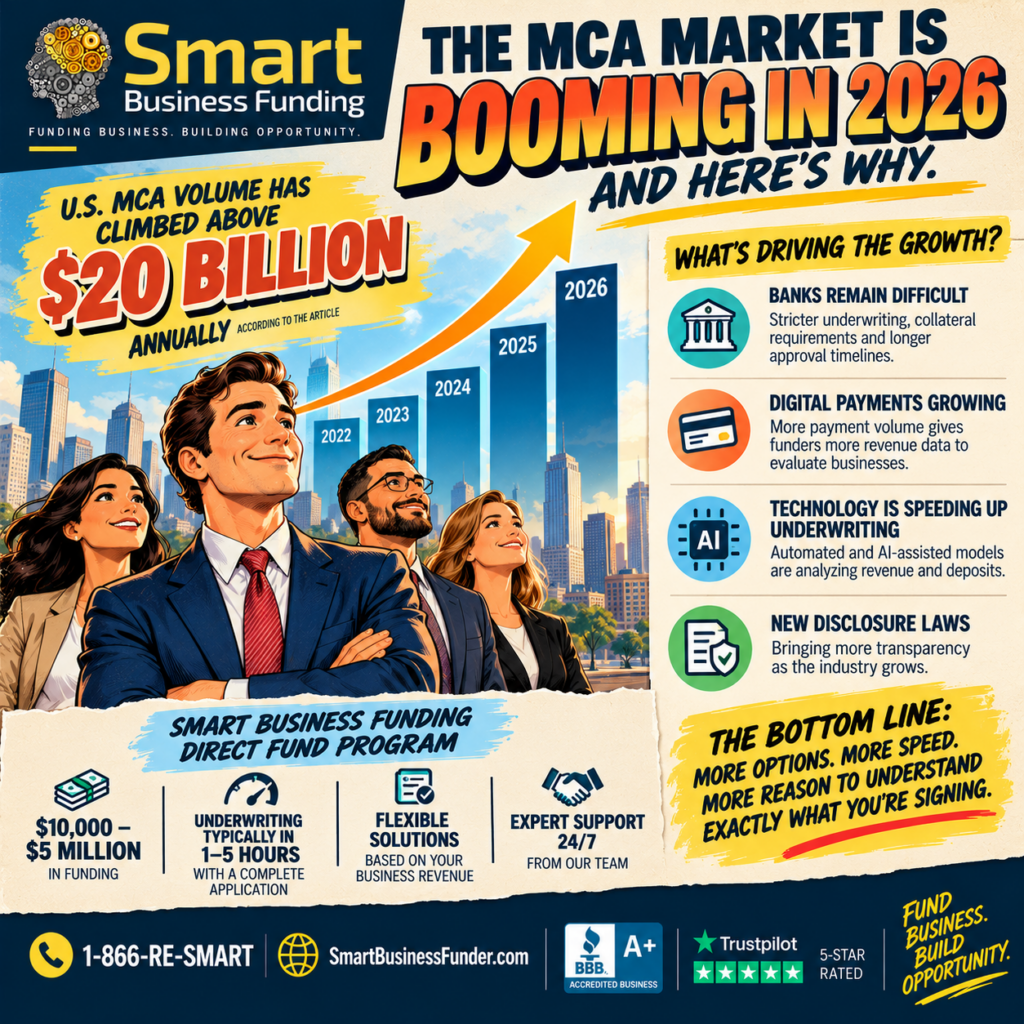
The merchant cash advance market has passed $20 billion in annual U.S. volume in 2026, with most industry forecasts projecting continued growth toward the high-$20-billions or beyond by the early 2030s. That growth isn’t happening in a vacuum — it reflects a handful of specific, structural shifts in how small businesses access capital, and understanding those shifts helps explain both why MCAs have become so widely used and what to actually watch for if you’re considering one.
If you’re trying to figure out whether an MCA is the right fit for your specific situation rather than just understanding the industry trend, our complete guide to business funding qualification is a more practical starting point — but the trend itself is worth understanding either way.
The Core Driver: A Persistent Gap in Traditional Bank Lending
The single biggest factor behind MCA market growth is one that hasn’t gone away in over a decade: a substantial share of small businesses simply don’t fit what traditional banks are willing to underwrite. Federal Reserve small business credit survey data has consistently shown a meaningful share of business owners turning to online lenders — a category that includes MCA providers — rather than banks, and that share has grown for several consecutive years running. Tighter bank underwriting standards, longer approval timelines, and stricter credit and collateral requirements all push businesses that need capital on a shorter timeline toward alternative options.
Rising Digital Payment Volume Is Expanding the Product’s Natural Fit
MCAs are structurally built around card-based sales — the product emerged from and continues to scale alongside the growth of digital and card payment volume. As point-of-sale and digital commerce transaction volumes have continued climbing globally, the underlying data MCA providers use to evaluate and structure advances has become both more abundant and more precise, which has supported the product’s expansion into a wider range of business types beyond its original base in restaurants and retail.
Technology Is Changing How Fast and How Precisely Providers Can Underwrite
A significant share of current market growth is tied to the increasing use of automated, revenue-based underwriting models and AI-assisted risk scoring. Rather than relying primarily on a lengthy manual credit review, modern MCA underwriting increasingly evaluates real-time deposit and revenue data directly, which is part of why qualification decisions that once took days or weeks can now often be completed in hours. Smart Business Funding’s own Direct Fund Program reflects this shift directly — underwriting typically completed in 1–5 hours, based on $50,000+ in monthly revenue and a soft credit pull, rather than a lengthy traditional credit process.
Growing Regulatory Attention Is a Sign of the Market’s Maturity, Not a Warning Sign Against It
As the MCA market has grown, it’s also drawn increasing regulatory attention — a growing number of states now require standardized commercial financing disclosures before a business signs an MCA agreement, part of a broader trend toward more transparency in a product category that was historically less standardized than traditional lending. This kind of scrutiny is a fairly typical pattern for any financial product category as it matures and scales — new car financing, buy-now-pay-later products, and even early credit cards all went through similar waves of regulatory attention as they grew. It reflects a maturing market working through standardization, not necessarily a signal that the underlying product is inherently unsound.
Which Industries Are Driving the Most Demand
MCA usage has historically concentrated in industries with strong day-to-day card transaction volume and recurring, predictable-but-tight cash flow cycles — restaurants, retail, and construction have consistently represented some of the largest shares of overall MCA volume, driven by the operational reality that these businesses often need speed and flexibility more than the lowest possible headline cost. As underwriting has become more sophisticated, the product has also expanded into service-oriented businesses more broadly, reflecting demand from sectors beyond its traditional base.
What This Growth Means If You’re Considering an MCA
A larger, more mature market generally means more competition among providers, more standardized disclosure, and more sophisticated underwriting — all generally positive developments for business owners evaluating their options. It also means it’s more important than ever to understand exactly what you’re being offered, since a larger market includes a wider range of providers with meaningfully different practices. Our guide on choosing the best business funding options when you can’t wait on a bank walks through how to evaluate speed, structure, and fit across the broader landscape this growth has created — and if credit history is part of what’s pushing you toward this category of financing, Emergency Business Funding With Bad Credit covers how revenue-based qualification actually works.
What to Watch as the Market Continues to Grow
A few trends worth watching as this market continues expanding: further state-by-state disclosure legislation is likely, given the current pace of adoption; underwriting is likely to continue becoming faster and more automated as more providers adopt AI-based risk scoring; and continued growth in digital payment volume will likely keep expanding the range of business types for which this financing structure is a natural fit.
How Smart Business Funding Fits Into This Growing Market
Smart Business Funding has funded businesses across all 50 states since December 2014 through the Direct Fund Program, funding $10,000 to $5,000,000 with underwriting built around business revenue rather than a lengthy traditional credit process. See the full process on the how it works page, review funding by business type on the industries page, or apply now.
Frequently Asked Questions
How big is the merchant cash advance market in 2026? Current estimates put U.S. annual MCA volume above $20 billion, with most industry forecasts projecting continued growth over the next several years.
Why has the MCA market grown so much in recent years? A persistent gap in traditional bank lending for small businesses, rising digital payment volume, and increasingly sophisticated underwriting technology have all contributed to sustained growth.
Does growing regulatory attention mean MCAs are becoming less safe? Not necessarily — increased disclosure requirements generally reflect a maturing market moving toward more standardization, a pattern seen in many financial product categories as they scale.
Which industries use MCAs the most? Restaurants, retail, and construction have historically represented some of the largest shares of MCA volume, though usage has expanded into a broader range of service-oriented businesses as underwriting has evolved.
Does a larger market mean better terms for business owners? Generally, a larger and more competitive market tends to support more standardized disclosure and more sophisticated underwriting, though terms still vary meaningfully by provider — it’s worth evaluating any specific offer on its own terms.
Curious what your business specifically qualifies for in today’s market? Apply now or call 1-866-Re-Smart. You can also reach the team at contact us.