
The Manufacturing Gender Gap Is Real, But the Data on Who Actually Owns These Businesses Doesn’t Exist Yet — Here’s What We Do Know
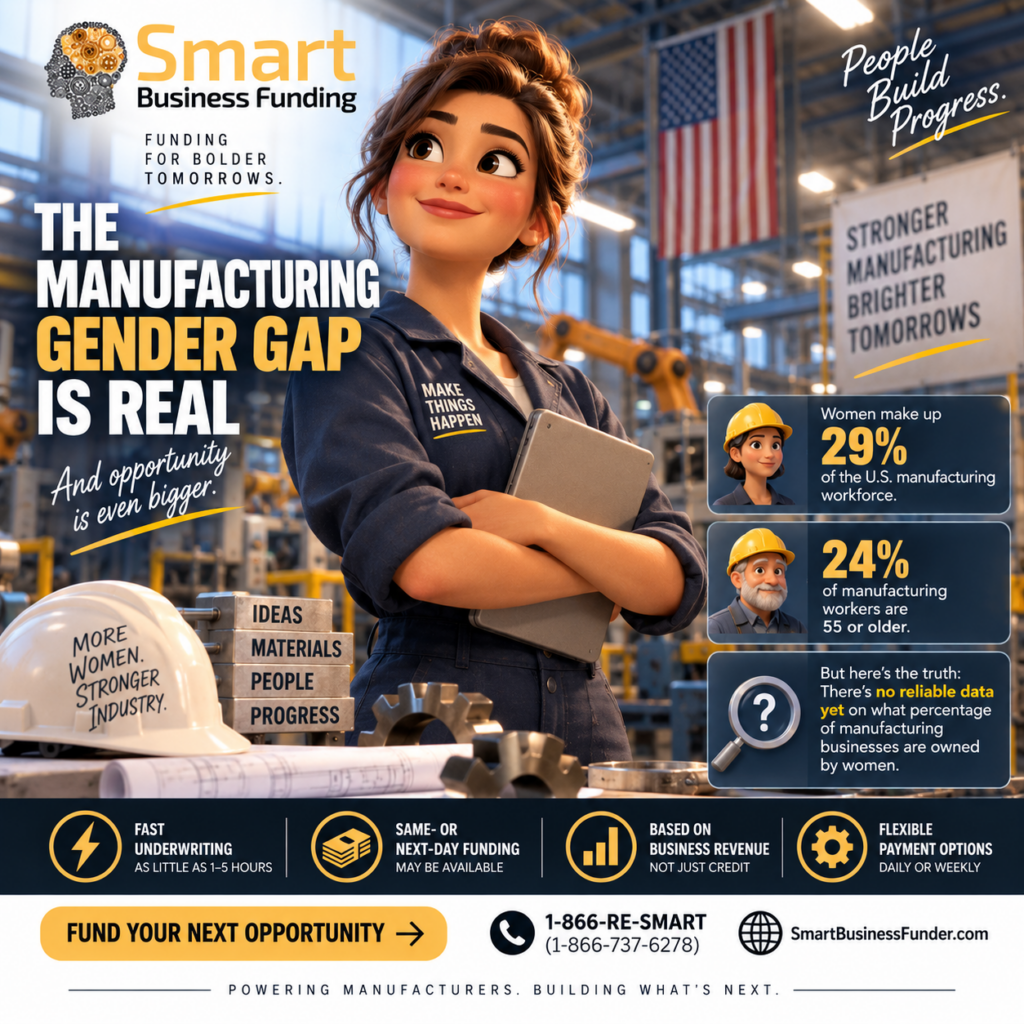
Here’s a claim you’ll see repeated across manufacturing industry content, usually stated with more confidence than the underlying data supports: that manufacturing has a gender gap not just in its workforce, but in who owns manufacturing businesses. The workforce part is real and measurable. The ownership part, as far as we can find, has never actually been studied at a level that lets anyone state a credible number.
That’s worth being honest about, because most of the content you’ll read on this topic isn’t.
What the Data Actually Shows
Women make up roughly 29% of the manufacturing workforce in the United States. That’s a real, documented figure, and it reflects a genuine underrepresentation relative to women’s roughly 47% share of the overall U.S. labor force. Separately, about 24% of manufacturing workers are 55 or older — a meaningful aging signal for the industry’s labor pipeline.
Both of those numbers describe the manufacturing workforce: the people clocking in on the floor, in the front office, and in management. Neither number describes who owns manufacturing businesses. Workforce composition and ownership composition are different questions, measured by different surveys, and conflating them produces a number that sounds precise but isn’t actually answering the question it’s being used to answer.
Why This Distinction Matters
It would be easy to take the 29% workforce figure, assume it roughly tracks ownership too, and build a piece around “only 29% of manufacturing business owners are women.” We’re not going to do that, for a simple reason: we don’t have a source that actually measured it, and inventing precision where none exists is exactly the kind of thing that erodes trust once someone checks the citation.
Compare manufacturing to construction, where the Census Bureau’s Annual Business Survey — compiled in CPWR’s Construction Chart Book — gives a clean, owner-level breakdown by age and gender: 85.3% of construction firms are male-owned, and just over half of construction owners are 55 or older. That data exists because someone specifically surveyed business owners, not just employees, and published the results at the ownership level.
No equivalent survey appears to exist for manufacturing ownership specifically. The Annual Business Survey covers manufacturing as an industry code, but published breakdowns at the level of detail available for construction — owner age and gender cross-tabulated by industry — aren’t publicly available for manufacturing in the same way, at least not from any source we could verify. If that data exists somewhere and simply isn’t published in an accessible form, we’d genuinely like to know — but we’re not going to present a guess as a fact in the meantime.
Why This Data Gap Is Itself a Story
The absence of owner-level manufacturing demographic data isn’t just a footnote. It says something real about how the industry gets studied. Construction, medicine, dentistry, and real estate all have active professional associations, licensing bodies, or research institutions that track ownership demographics as part of their core mission — the ADA tracks dentist ownership because practice ownership is central to how the profession understands itself, and CPWR tracks construction ownership because labor and safety research in that industry depends on knowing who’s making decisions on job sites.
Manufacturing doesn’t have an equivalent institutional structure focused specifically on ownership demographics. Trade associations like the National Association of Manufacturers focus heavily on workforce, policy, and economic output — valuable work, but not the same as an owner-level demographic census. The result is an information asymmetry: plenty of solid workforce data, almost nothing solid at the ownership level.
That gap matters for anyone trying to build funding products, marketing, or policy around manufacturing business owners. Without real ownership data, decisions about who to target, how to message, and what barriers actually exist get made on assumption rather than evidence — and assumptions dressed up as statistics tend to be wrong in ways that are hard to catch until someone asks for the source.
What This Means for Manufacturing Businesses Seeking Funding
Whether or not the ownership demographic data exists, the businesses themselves have real, well-documented funding needs — and those needs don’t require a demographic breakdown to understand or address.
Working capital tied to production cycles. Manufacturing businesses often carry significant costs — raw materials, labor, energy — well before finished goods convert to revenue. That gap between spending and collecting is a cash flow reality regardless of who owns the business.
Equipment and machinery needs that outpace financing timelines. A production line breakdown, same as a dental chair or a paving crew’s equipment, doesn’t wait for a multi-week loan approval process. Downtime on a manufacturing floor has an immediate, measurable cost in lost output.
Distribution and wholesale timing gaps. Businesses in this category frequently extend credit terms to retail or business customers — net-30, net-60, sometimes longer — while their own suppliers expect faster payment. That mismatch creates a working capital need that has nothing to do with the business’s underlying health and everything to do with the timing of cash moving through the supply chain.
Seasonal and order-cycle volatility. Many manufacturers and distributors see demand cluster around specific seasons or contract cycles, creating uneven cash flow that a fixed monthly loan payment doesn’t always accommodate well.
What This Looks Like in Practice
The following is an illustrative composite scenario built to demonstrate a common situation — it does not represent an actual funded client, and figures are illustrative only, not a guarantee of terms, approval, or outcome for any specific business.
Consider a small metal fabrication shop that just landed a larger order than usual from a new distribution partner. Filling the order means buying more raw steel up front, running extra shifts, and covering payroll for those shifts — all before the customer’s net-45 payment terms bring any of that revenue back in. The shop’s existing bank line was sized for its normal order volume, not this one-time surge, and asking the bank to increase it takes longer than the production timeline allows.
That’s not a story about who owns the shop or what their background is. It’s a straightforward cash flow timing problem that shows up across manufacturing regardless of ownership demographics — and it’s exactly the kind of gap that fast, revenue-based funding is built to bridge.
Where Alternative Funding Fits — and Where It Doesn’t
For manufacturing businesses with larger, planned capital needs — a major equipment purchase, a facility expansion — traditional equipment financing, SBA loans, or a properly sized bank line remain worth pursuing first, since they can offer better long-term terms when the timeline allows for their longer underwriting process.
Where a product like Smart Business Funding’s Direct Fund Program fits is the shorter-term, time-sensitive gap: covering a raw materials purchase ahead of a big order, bridging payroll during a production surge, or smoothing out the timing mismatch between supplier payment terms and customer payment terms. For a manufacturing, wholesale, or distribution business with at least a year of operating history and $50,000 or more in monthly revenue, funding can move in hours, not weeks, with repayment structured as a fixed daily or weekly remittance.
What Manufacturing Business Owners Should Take From This
If you’re a manufacturing business owner: your funding needs — production timing, equipment downtime, supplier-versus-customer payment mismatches — are well understood and well documented, even if the demographic data about who owns businesses like yours isn’t.
If you’re researching this industry for any purpose: be skeptical of any source citing precise ownership demographic figures for manufacturing. Ask where the number comes from. If it can’t be traced to a specific owner-level survey, treat it as an estimate at best.
If you’re an industry association or research body: there’s a genuine, publishable gap here. A real owner-level demographic survey of manufacturing business owners — the kind CPWR has done for construction and the ADA has done for dentistry — would be a meaningful contribution that doesn’t currently exist.
What We’re Willing to Say, and What We’re Not
The manufacturing workforce gender gap is real: roughly 29% of manufacturing workers are women, well below women’s overall share of the labor force. The workforce aging trend is also real: about 24% of manufacturing workers are 55 or older. What isn’t real — or at least isn’t verifiable — is any specific claim about who owns manufacturing businesses by gender or age. We’d rather tell you that plainly than hand you a number we can’t back up.
What we can say with confidence is this: manufacturing, wholesale, and distribution businesses have real, recurring funding needs tied to production cycles, equipment reliability, and payment-term mismatches, and those needs are worth addressing on their own terms — no demographic assumption required.
Need working capital to cover a production surge, equipment repair, or payment-timing gap? Apply now or call 1-866-Re-Smart to speak with our team.
FAQs
Q: Is there reliable data on who owns manufacturing businesses by gender or age? A: Not that we could verify. Workforce-level data exists (roughly 29% of the manufacturing workforce is women, and about 24% is 55 or older), but no equivalent owner-level survey appears to be publicly available for manufacturing, unlike construction or dentistry.
Q: Does a manufacturing business need a demographic profile to qualify for funding? A: No. Funding decisions for the Direct Fund Program are based on business revenue, time in business, and cash flow — not owner demographics.
Q: What’s the most common funding need for manufacturing and distribution businesses? A: Working capital tied to timing gaps — covering raw materials or payroll ahead of a large order, or bridging the difference between what a business owes suppliers and what it’s owed by customers on longer payment terms.
Q: Is fast funding a substitute for equipment financing or an SBA loan? A: Not for planned, larger purchases where time allows for their longer underwriting process. Fast, revenue-based funding is best suited to shorter-term, time-sensitive gaps.