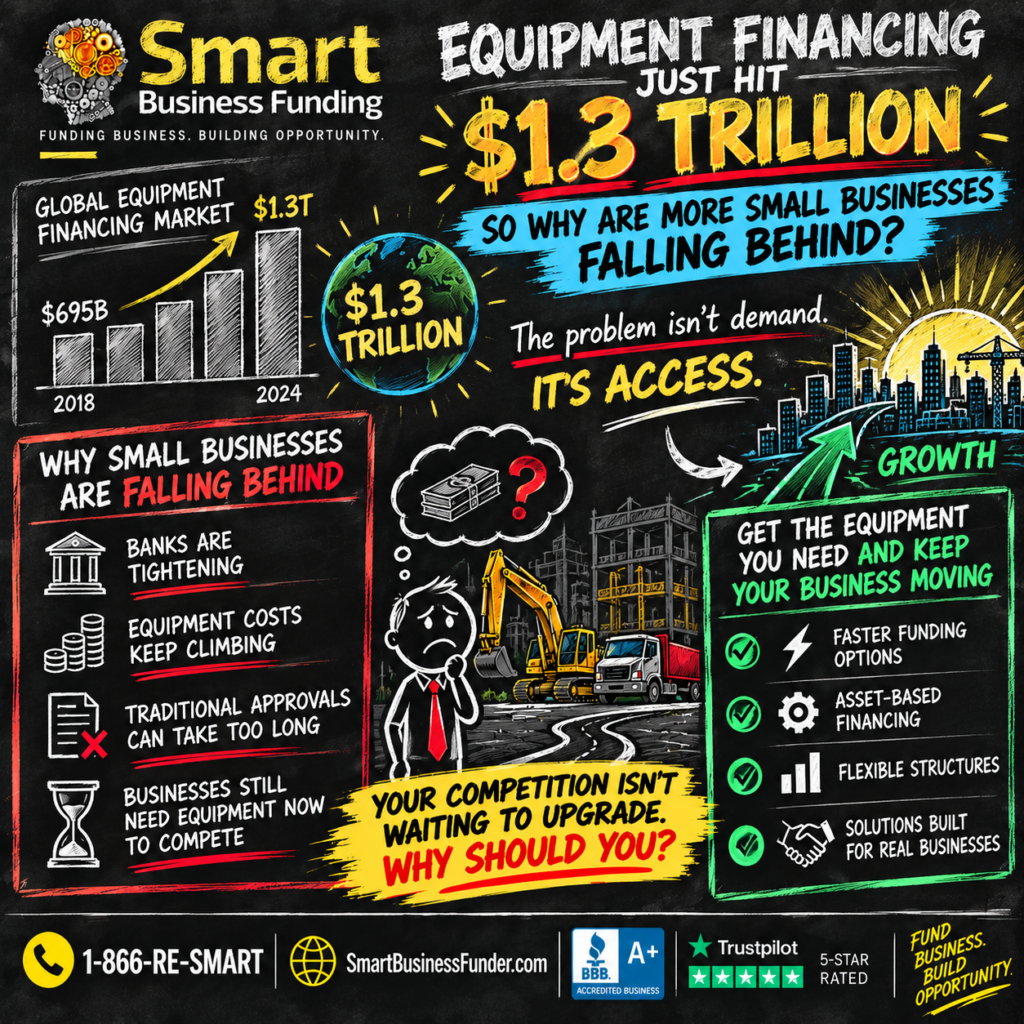
Equipment Financing Just Hit $1.3 Trillion: So Why Are More Small Businesses Falling Behind?
The equipment financing industry enters 2026 as a $1.3 trillion market, coming off a record-setting 2025. On its face, that’s an unambiguously strong headline. But industry executives closer to the underwriting side of this market are describing a more complicated picture underneath that number, one where overall volume and performance remain strong even as small businesses specifically are showing clear signs of financial stress.
What the Data Actually Shows
Industry leaders in equipment finance have pointed directly to rising Chapter 11 bankruptcy filings among small businesses, alongside slight but measurable increases in delinquency and credit losses concentrated in that same segment. One senior equipment finance executive described the pattern plainly: strong overall volume and reasonable yields industry-wide, alongside small businesses specifically showing stress, a trend expected to continue through much of 2026.
Separately, another equipment finance executive pointed to a very specific compounding factor: disruption affecting a key global shipping route has been driving up fuel costs, and small and mid-sized businesses without the pricing power to pass those higher costs on to customers are facing the greatest cash flow challenge as a result.
Why Strong Industry Numbers and Small Business Stress Can Coexist
This isn’t actually a contradiction, even though it can read as one. A $1.3 trillion industry figure aggregates transactions across businesses of every size, including large enterprises with far more pricing power, more diversified revenue, and more capital cushion to absorb cost shocks. Small businesses, operating with thinner margins and less ability to pass through rising input costs, can be under real and growing stress at the exact same time the broader market posts record volume, the aggregate simply doesn’t reveal what’s happening at the smaller end of the distribution.
This directly connects to a broader pattern we’ve covered in detail: small businesses currently navigating tariffs, elevated fuel costs, and rising rates squeezing margins simultaneously. The fuel-cost pressure flagged by equipment finance industry executives is the same dynamic driving that broader squeeze, and equipment-financed small businesses are feeling it acutely, since a fixed equipment payment doesn’t flex downward when fuel and input costs eat into the margin meant to cover it.
What This Means If You’re a Small Business With Equipment Financing Payments
If your business has equipment financing payments and is also managing rising fuel or input costs, it’s worth taking this industry signal seriously rather than assuming it applies only to other businesses. A few things worth doing directly:
- Model your equipment payment against your current, actual margin, not the margin you had when you first financed the equipment, since fuel and input cost increases may have meaningfully changed that picture since then.
- Understand whether your specific financing structure offers any flexibility. Our piece on the flexible payment structures reshaping equipment financing in 2026 covers how some lenders are building in ramp-up or seasonal structures precisely to reduce this kind of strain, worth asking your current lender about directly if you’re feeling squeezed.
- Don’t let a fixed equipment payment become the reason a separate cash flow gap turns into a missed payment. If rising costs elsewhere are creating pressure on your ability to make an existing equipment payment, addressing that gap directly and quickly matters more than waiting to see if the pressure eases on its own, our guide on what to do when your business can’t make payroll this week covers the same urgency principle in a different but related context.
Why Revenue-Based Underwriting Reads This Kind of Stress Differently
A structural point worth understanding: traditional equipment financing underwriting typically evaluates a business at the point of the equipment purchase, with less ongoing visibility into how the business’s margin and cash flow evolve afterward. Revenue-based underwriting, by contrast, the model behind Smart Business Funding’s Direct Fund Program, evaluates a business’s actual, current deposit and revenue pattern directly at the time of any new funding decision, which can better reflect a business’s real, present-day financial picture rather than its position months or years earlier when equipment financing was first arranged. Our complete guide to business funding qualification covers this distinction across underwriting models in more depth.
Illustrative Composite Scenario (not an actual client, for explanatory purposes only): A regional delivery business financed a fleet upgrade two years ago under stable fuel cost assumptions. A subsequent spike in fuel prices compresses the margin the business had planned to use for the fixed equipment payment. Rather than falling behind on the equipment payment, the business evaluates a separate, short-term Direct Fund Program advance sized specifically to bridge the current fuel-cost gap, keeping the existing equipment obligation current while addressing the new pressure directly rather than letting it compound.
What This Signal Means Going Forward
If the fuel-cost and margin pressure described by equipment finance industry executives continues through 2026 as expected, small businesses carrying equipment financing payments should treat this as an ongoing risk to actively manage, not a one-time shock to wait out. Businesses that proactively address margin compression, rather than assuming it will resolve on its own, are in a meaningfully stronger position than those that wait until a payment is actually missed.
How Smart Business Funding Approaches This Environment
Whether your business is managing a fixed equipment payment against rising input costs or considering new equipment financing altogether, Smart Business Funding offers both equipment financing for new asset-specific purchases and the revenue-based Direct Fund Program for addressing a separate, current cash flow gap. See the full process on the how it works page, review funding by business type on the industries page, or apply now.
Frequently Asked Questions
Is the equipment financing industry actually struggling despite the $1.3 trillion figure? The industry-wide headline number remains strong, but equipment finance executives have specifically flagged rising stress, increased Chapter 11 filings and delinquencies, concentrated in the small business segment rather than the market overall.
Why are small businesses specifically under more pressure right now? Thinner margins and less ability to pass through rising fuel and input costs to customers leave small businesses more exposed to cost shocks than larger, more diversified businesses within the same aggregate industry data.
What should I do if rising costs are straining my ability to make an equipment payment? Model your current, actual margin against the payment honestly, ask your lender directly about any available flexible structure, and address any separate cash flow gap quickly rather than waiting for pressure to ease on its own.
Does this mean I shouldn’t finance equipment right now? Not necessarily, it means understanding your current margin picture honestly before committing to a new fixed payment, and considering whether a flexible structure or a different financing approach better fits your specific situation.
How is revenue-based funding different from traditional equipment financing in this context? Revenue-based underwriting evaluates your business’s current, actual cash flow at the time of the funding decision, rather than relying primarily on your financial picture from when a separate equipment financing arrangement was first made.
Managing pressure on an existing equipment payment, or considering new equipment financing? Apply now or call 1-866-Re-Smart to talk through your options. You can also reach the team at contact us.