Confessions of Judgment in Merchant Cash Advances: What Every Business Owner Should Know Before Signing
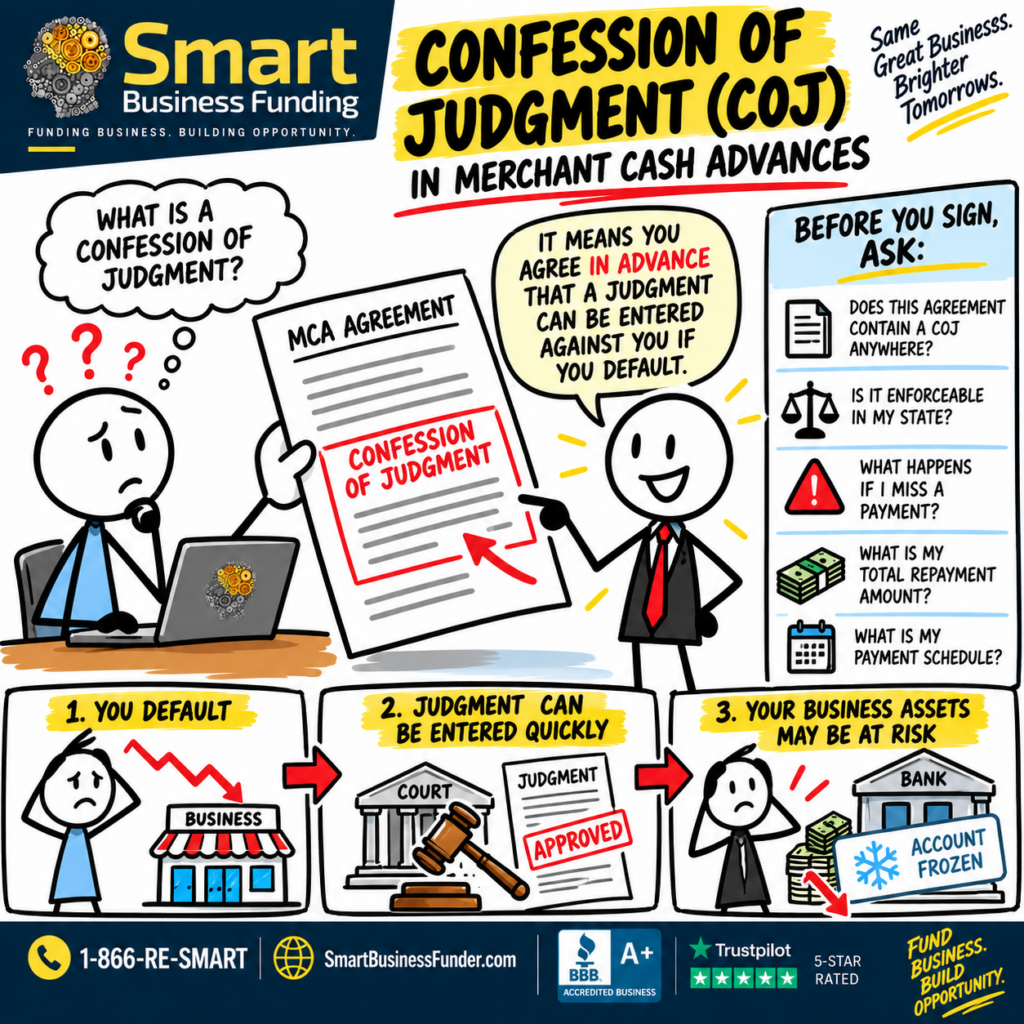
A confession of judgment, often abbreviated COJ, is a clause that some commercial financing agreements have historically included, under which a business owner agrees in advance to waive their right to defend themselves in court if the provider claims a default has occurred. In practice, this has allowed some funders to obtain a court judgment — and in some cases move to freeze a business’s bank account — without the business ever having the opportunity to appear and contest the claim.
This is a legal mechanism worth understanding clearly before signing any commercial financing agreement, not because it’s used universally, but because the consequences for a business that encounters one and doesn’t understand it can be severe. If you’re earlier in the process of evaluating funding options generally, our complete guide to business funding qualification is a useful starting point before you get to contract-specific details like this one.
What a Confession of Judgment Actually Does
In a standard legal dispute, both parties have the right to appear in court, present their case, and have a judge or jury evaluate the facts before a judgment is entered. A confession of judgment clause changes that dynamic: by signing it, a business owner pre-authorizes a judgment to be entered against them — often without notice — if the other party asserts that a default has occurred, regardless of whether the business owner agrees that a default actually happened.
Because the clause is signed before any dispute arises, the business owner has effectively waived the ability to contest the claim at the moment it matters most. This has drawn significant scrutiny because it can be used based solely on the claiming party’s assertion, with limited or no independent verification before a judgment — and the resulting account freezes — take effect.
Where This Stands Legally, State by State
The legal landscape around COJs has shifted substantially in recent years, with several states moving to restrict or ban their use in commercial financing contracts specifically:
- Some states have banned confession of judgment clauses in business financing contracts outright, with meaningful civil penalties for violations.
- Other states have barred out-of-state enforcement of COJs against their own in-state businesses, while still allowing the clause to bind a business’s own contracts signed elsewhere.
- Several additional states have moved to ban or void COJ clauses in commercial contracts more broadly.
Because this legal landscape varies significantly by state and continues to evolve, and because enforceability can also depend on where a lender is based rather than only where a business operates, this is an area where a business owner should get case-specific legal guidance rather than relying on general information — including this article — as a substitute for that advice.
Why This Matters Even If You Never Encounter One
Even if a specific agreement doesn’t include a COJ clause, understanding that the mechanism exists — and that it has historically been used by some providers in this industry — is valuable context for reading any commercial financing contract carefully rather than treating it as boilerplate. A clause like this is sometimes located in an appendix or a separately signed document rather than prominently in the main contract body, which is part of why it can go unnoticed by a business owner signing under time pressure.
What to Ask Before Signing Any Commercial Financing Agreement
Regardless of which provider you’re working with, it’s worth asking directly:
- Does this agreement include a confession of judgment clause, in the main contract or in any appendix or separately signed document?
- If so, is it enforceable in my state, given the specific and evolving state-by-state legal landscape around this clause?
- What does the default and collections process actually look like if a payment is missed, independent of whether a COJ is involved?
If a provider is unwilling to answer these questions plainly, or if you’re unsure how to evaluate the answer, having an attorney review any commercial financing agreement before signing is a reasonable and often worthwhile step, particularly for a larger funding amount.
What This Means for How You Evaluate Any Offer
The presence or absence of a COJ clause is one of several structural details — alongside the factor rate, total repayment amount, and payment schedule — that are worth understanding completely before signing anything. Our broader guide on choosing between business funding options when you can’t wait on a bank covers the fuller set of questions worth asking of any fast-funding provider.
Frequently Asked Questions
What is a confession of judgment in a commercial financing contract? It’s a clause under which a business owner agrees in advance to waive their right to a court hearing if the financing provider claims a default has occurred, allowing a judgment to be entered without the business owner contesting the claim in real time.
Are confessions of judgment legal? It depends on the state — several states have banned or restricted their use in commercial financing contracts, while they may remain enforceable in others depending on where the business and the lender are located.
How would I know if my contract has a COJ clause? It can appear in the main contract body or in an appendix or separately signed document, so it’s worth asking directly and reviewing the full agreement carefully, ideally with legal counsel.
What should I do if I think I’ve already signed an agreement with a COJ clause? Consult an attorney with experience in commercial financing to understand your specific state’s law and your options.
Does every merchant cash advance agreement include a confession of judgment clause? No — this varies by provider and by contract, which is exactly why it’s worth asking directly rather than assuming either way.