The Complete Guide to Business Funding: How to Know What You Actually Qualify For
Most confusion about business funding doesn’t come from the products themselves — it comes from not knowing, before you apply, whether you’re actually a realistic candidate for what you’re looking at. This guide walks through exactly what underwriters look at, what the real qualification thresholds tend to look like, and how to size up your own situation honestly before you spend time on an application.
The Four Things Almost Every Funder Evaluates
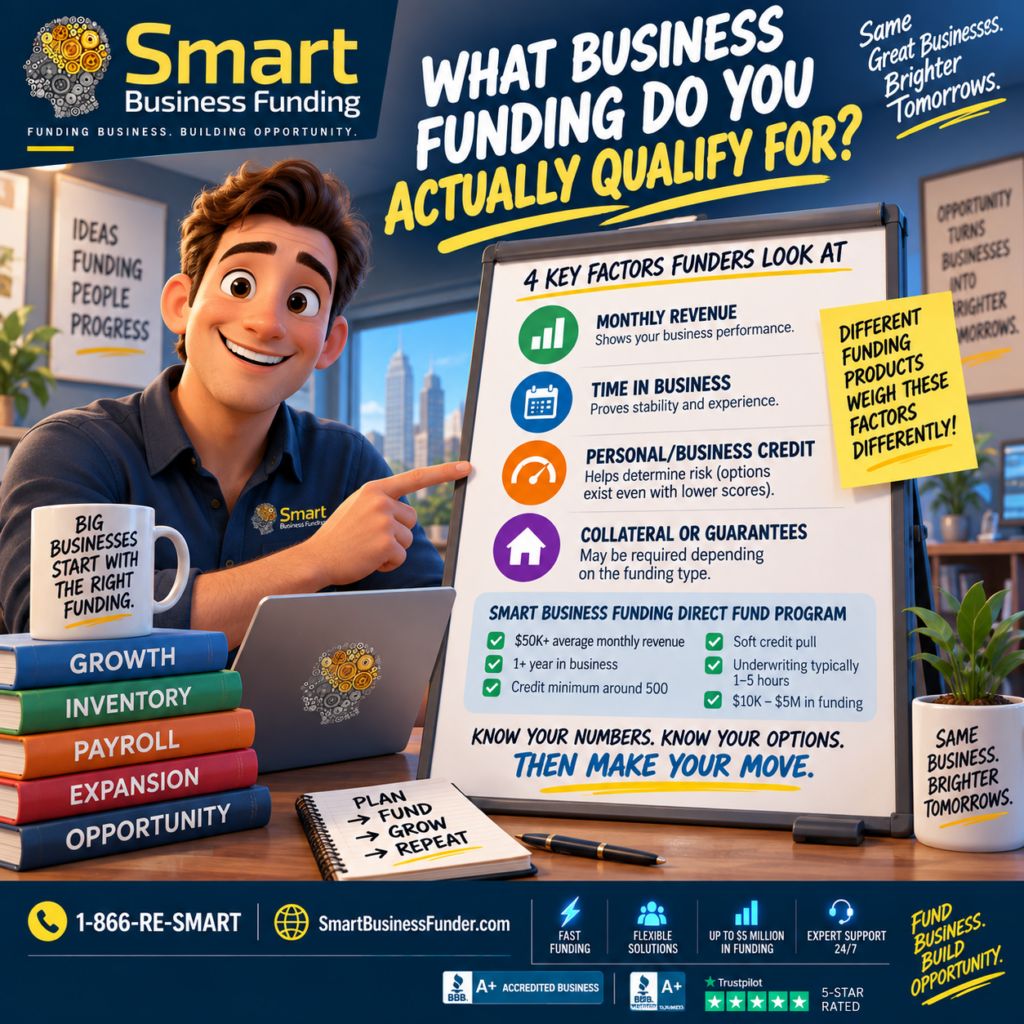
Regardless of which type of business funding you’re considering, underwriting generally comes down to some combination of these four factors:
1. Monthly revenue. How much money is actually moving through the business, and how consistently. This is the single most heavily weighted factor for revenue-based products.
2. Time in business. How long the business has been operating, which underwriters use as a proxy for stability and survivability.
3. Personal and/or business credit. How your credit history reflects on repayment reliability — though how heavily this factors in varies enormously by product type.
4. Collateral or guarantee. What’s backing the funding if the business can’t repay — a home (as with a HELOC), specific equipment, general business assets with a personal guarantee, or in rare cases, nothing beyond the underwriting itself.
Every funding type weighs these four differently, which is exactly why the same business can be a strong candidate for one product and a poor fit for another.
What Qualification Actually Looks Like for Revenue-Based Funding
For a revenue-based product like Smart Business Funding’s Direct Fund Program, the baseline qualification is:
- $50,000 or more in average monthly revenue
- At least one year in business
- A credit minimum around 500, evaluated with a soft credit pull that doesn’t add a hard inquiry to your credit file
Funding ranges from $10,000 to $5,000,000, across terms of 2–10 months, with a fixed factor rate — 1.25–1.49 for standard-risk businesses, 1.359–1.499 for higher-risk industries — that produces a disclosed, fixed total repayment amount. Repayment runs on a fixed daily or weekly schedule set before you sign. Underwriting typically takes 1–5 hours with a complete application, and funding can arrive as soon as the same or next business day.
The industry your business operates in can factor into where you land within that factor rate range — certain industries carry a different risk classification based on historical performance data for that category as a whole, which is a pricing input rather than a judgment about your specific business.
Why Your Credit Score Might Matter Less Than You Think
A lot of business owners assume a low personal credit score automatically disqualifies them from funding altogether. That assumption comes from experience with traditional bank lending, where credit history carries enormous weight. Revenue-based underwriting works differently — it evaluates whether your business is generating consistent cash flow right now, with credit as one input rather than the deciding factor. If credit specifically is your concern, Emergency Business Funding With Bad Credit: What Are Your Options? covers this distinction in more depth.
Why Collateral Questions Matter More Than People Expect
“Do I need collateral?” is one of the most common questions business owners ask, and the honest answer depends heavily on which product you’re evaluating. A HELOC secures funding against your home specifically. Equipment financing secures against the equipment being purchased. A business line of credit or the Direct Fund Program typically avoids requiring your home or personal real estate, but usually still involves a personal guarantee and a UCC-1 filing against business assets — a meaningfully different exposure than putting your house directly on the line, and worth understanding clearly before signing anything, regardless of which funder you work with.
A Practical Self-Assessment Before You Apply
Before applying to any product, walk through these questions honestly:
- What’s my actual average monthly revenue over the past 3–6 months, not my best month or my target?
- How long has the business actually been operating, under its current structure and ownership?
- What’s my approximate credit score, and is it closer to a revenue-based threshold (around 500) or a traditional bank threshold (often well above that)?
- What am I actually comfortable putting behind this — my home, specific equipment, general business assets with a personal guarantee, or nothing beyond the underwriting itself?
- How fast do I actually need this, and does that timeline rule out slower options like SBA loans or bank term loans regardless of their terms?
Answering these five questions honestly typically narrows your realistic options down to one or two products before you’ve submitted a single application.
Common Qualification Mistakes to Avoid
Applying for far more than you need. Qualifying for a larger amount doesn’t mean you should take it — size any funding to your actual, quantified need rather than the maximum available.
Assuming your industry disqualifies you. Certain industries carry a different risk classification that affects pricing, but that’s a different thing than being categorically ineligible — many industries considered higher-risk by traditional lenders can still qualify for revenue-based funding.
Not having documentation ready. The single biggest source of delay in almost any funding process is incomplete paperwork, not the underwriting decision itself — our breakdown in Same-Day Business Funding: How Fast Can You Actually Get Funded? covers exactly what to have prepared.
Confusing “qualified” with “the right fit.” Just because you qualify for a product doesn’t mean it’s structurally right for your situation — a HELOC and a business line of credit might both be technically available to you, but they carry very different risk, as covered in HELOC vs. Business Line of Credit: Which One Actually Makes Sense for Your Business?
Illustrative Composite Scenario (not an actual client, for explanatory purposes only): A boutique retail business, two years in operation with average monthly revenue of $62,000, assumes a credit score in the mid-500s disqualifies it from any funding beyond a personal credit card. After reviewing actual qualification criteria for revenue-based underwriting, the business finds it comfortably meets the Direct Fund Program’s revenue and time-in-business thresholds, with the credit minimum well within range via a soft-pull review.
What to Do Once You’ve Assessed Your Situation
If your self-assessment points toward a revenue-based product, the next step is simply gathering your last 3–6 months of bank statements and basic business details before applying — that alone accounts for most of the difference in how quickly an application moves. If it points toward a different type of funding — equipment-specific, recurring access, or a longer-horizon need — our guide to types of business funding ranked by speed breaks down how each option compares.
How Smart Business Funding Approaches Qualification
Smart Business Funding’s Direct Fund Program qualifies businesses with $50,000+ in monthly revenue, one year in operation, and a credit minimum around 500 via soft pull — funding $10,000 to $5,000,000 across all 50 states since 2014. See the full process on the how it works page, review funding by business type on the industries page, or apply now to see your specific qualification.
Frequently Asked Questions
What’s the minimum revenue needed to qualify for business funding? For the Direct Fund Program, $50,000 or more in average monthly revenue is the baseline threshold.
Do I need good personal credit to qualify? Not necessarily — revenue-based underwriting weighs monthly revenue and time in business more heavily, with a credit minimum around 500 evaluated via a soft credit pull.
Will checking my qualification hurt my credit score? No — qualification review for the Direct Fund Program uses a soft credit pull, which doesn’t add a hard inquiry to your credit file.
Does my industry affect whether I qualify? It can affect where you land within the factor rate range, since certain industries carry a different risk classification based on category-level historical data — but it’s a pricing input, not an automatic disqualifier.
How long does it take to find out if I qualify? With a complete application, underwriting for the Direct Fund Program typically takes 1–5 hours, with funding arriving as soon as the same or next business day.