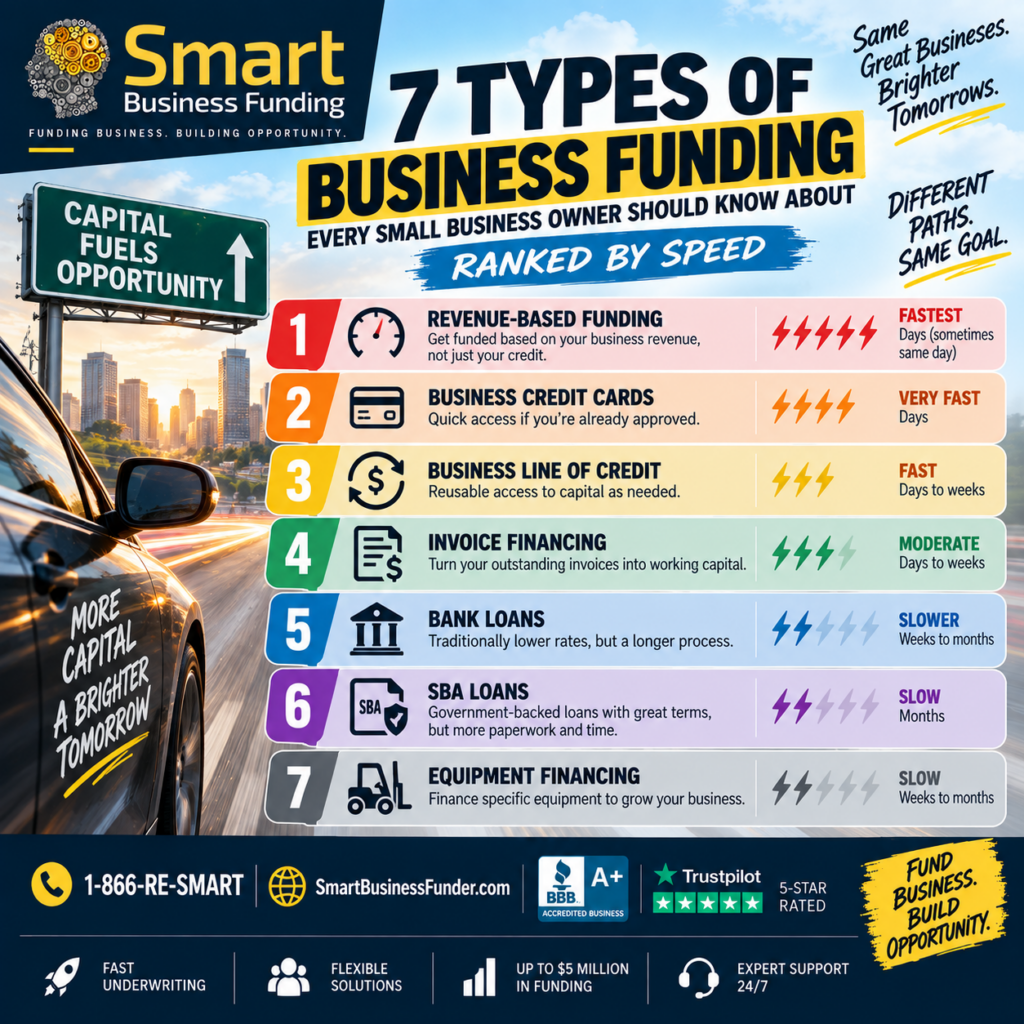
7 Types of Business Funding Every Small Business Owner Should Know About (Ranked by Speed)
Ask ten business owners what “business funding” means and you’ll get ten different answers — a bank loan, a credit card, an SBA program, something they saw advertised online. The truth is there isn’t one product called “business funding.” There’s a whole category of financing types, each built for a different situation, timeline, and risk profile. Understanding the differences — especially how fast each one actually moves — makes it much easier to pick the right tool instead of applying for whatever came up first in a search.
Here are seven of the most common types, ranked from slowest to fastest.
1. SBA Loans (Slowest)
SBA loans — backed by the U.S. Small Business Administration but issued through partner banks — typically offer some of the lowest rates available to small businesses, but they come with a lengthy application and underwriting process. Extensive documentation, a detailed business plan, and multiple rounds of review are standard, and funding can take anywhere from several weeks to a few months depending on the lender and loan type.
Best for: Long-term, large-scale needs (real estate, major expansion) where speed isn’t the priority and the business can wait for the most favorable long-term terms.
2. Traditional Bank Term Loans
Bank term loans sit close to SBA loans on the timeline, often requiring strong personal and business credit, multiple years of financial statements, and a formal underwriting process through a loan committee. Approval and funding can take several weeks even for an established business with clean financials.
Best for: Predictable, long-horizon capital needs from a business with an established banking relationship and strong credit history.
3. Home Equity Line of Credit (HELOC)
A HELOC uses your home’s equity as collateral and can offer competitive rates, but the process involves an appraisal, title work, and a closing period that typically takes several weeks. It’s also worth understanding that a HELOC secures the credit line against your home specifically, not your business — a distinction we cover in detail in Should You Use a HELOC to Fund Your Business? The Real Risk Nobody Mentions.
Best for: Business owners with substantial, well-established home equity and a long, predictable repayment horizon who’ve fully priced in that risk.
4. Equipment Financing
Equipment financing is secured by the equipment itself, which tends to simplify underwriting compared to unsecured products — the lender has a clear asset to evaluate. Depending on the lender and the equipment involved, funding can move in days rather than weeks. Smart Business Funding’s equipment financing option is built around exactly this kind of purchase.
Best for: A specific piece of equipment or machinery purchase where the asset itself can help secure the funding.
5. Business Line of Credit
A business line of credit gives you revolving access to funds you draw against as needed, typically underwritten against business revenue and credit history rather than a specific piece of collateral like a HELOC. Once approved, ongoing access is usually much faster than the initial underwriting, since you’re drawing against an already-established line. Smart Business Funding’s lines of credit are structured for exactly this kind of recurring need.
Best for: Recurring or unpredictable cash flow needs where you want capital available on demand rather than applying fresh each time.
6. Business Credit Cards
Business credit cards are among the fastest financing types to access for smaller amounts, often approved within days and usable immediately once issued. The tradeoff is a typically lower credit limit relative to other options and a variable APR that moves with the broader rate environment — worth watching closely in a period like the current one, where the Fed has just raised rates and signaled more increases may follow.
Best for: Smaller, everyday purchases and short-term float rather than larger funding needs.
7. Revenue-Based Funding, Like the Direct Fund Program (Fastest)
Revenue-based funding evaluates a business’s actual cash flow and deposit history rather than leading with a lengthy credit and collateral review. Smart Business Funding’s Direct Fund Program typically completes underwriting in 1–5 hours with a complete application, with funding arriving as soon as the same or next business day. Funding ranges from $10,000 to $5,000,000, with a fixed factor rate (1.25–1.49 for standard-risk businesses, 1.359–1.499 for higher-risk industries) that produces a fixed total repayment amount, repaid on a fixed daily or weekly schedule. Qualification is based on $50,000+ in monthly revenue, one year in business, and a credit minimum around 500 evaluated with a soft credit pull.
Best for: Urgent, timing-specific needs — payroll, a slow-paying client, an unexpected repair — where speed and revenue-based qualification matter more than the lowest possible headline rate.
How to Actually Choose Between These
Speed isn’t the only factor, but it’s often the one that eliminates options fastest. Start by asking:
- How soon do I actually need the funds? A same-week need rules out SBA loans, bank term loans, and HELOCs almost immediately, regardless of how attractive their terms look on paper.
- Is this a one-time need or an ongoing one? A single, defined gap points toward a one-time product like the Direct Fund Program or equipment financing; a recurring pattern points toward a line of credit.
- What am I actually willing to put up as collateral? A HELOC secures the home directly; a business line of credit or the Direct Fund Program typically involves business assets and a personal guarantee rather than the home itself.
- Does my credit profile match what each option requires? If credit is a concern, revenue-based underwriting weighs cash flow more heavily — see Emergency Business Funding With Bad Credit for how that works in practice.
- How fast can I realistically move on my own paperwork? Even the fastest products depend on you having documentation ready — our breakdown of same-day business funding covers exactly what speeds things up and what slows them down.
Illustrative Composite Scenario (not an actual client, for explanatory purposes only): A café owner needs $30,000 to replace a failed walk-in refrigeration unit before spoiled inventory becomes a bigger loss. An SBA loan and bank term loan are both ruled out immediately due to timeline. Equipment financing is considered, but the unit needs to be sourced from a specific vendor on short notice, so the owner instead uses a Direct Fund Program advance sized to the replacement cost, funded the next business day.
How Smart Business Funding Fits Into This Picture
Smart Business Funding offers both the one-time Direct Fund Program and ongoing lines of credit, plus equipment financing for asset-specific purchases — funding businesses across all 50 states since 2014. See the full process on the how it works page, review funding by business type on the industries page, or apply now to see which type fits your timeline.
Frequently Asked Questions
What’s the fastest type of business funding available? Revenue-based products like the Direct Fund Program are typically the fastest, with underwriting often completed in 1–5 hours and funding as soon as the same or next business day.
Why do SBA loans take so much longer than other options? SBA loans involve extensive documentation, a detailed underwriting process through a partner bank, and government-backed program requirements that add review time compared to revenue-based products.
Is a HELOC a type of business funding? It can be used for business purposes, but it’s secured by your home rather than the business itself — a meaningfully different risk than most business-specific funding types.
Do I need strong credit to qualify for any of these? It depends on the type — SBA loans and bank term loans typically require strong personal credit, while revenue-based funding weighs business cash flow more heavily, with a credit minimum around 500 for the Direct Fund Program.
How do I know which type actually fits my situation? Start with your timeline and whether the need is one-time or recurring — those two questions eliminate most of the options that won’t work before you even get to rates and terms.
Not sure which type of funding fits your timeline? Apply now or call 1-866-Re-Smart to talk through your options. You can also reach the team at contact us.