
Private Medical Practice Is Disappearing: Can Independent Doctors Survive?
For generations, one of the defining images of American medicine was the independent doctor’s office.
A physician finished training, joined or opened a practice, built a patient base, hired employees, and eventually became both a doctor and a business owner.
That model hasn’t disappeared.
But it is becoming much less common.
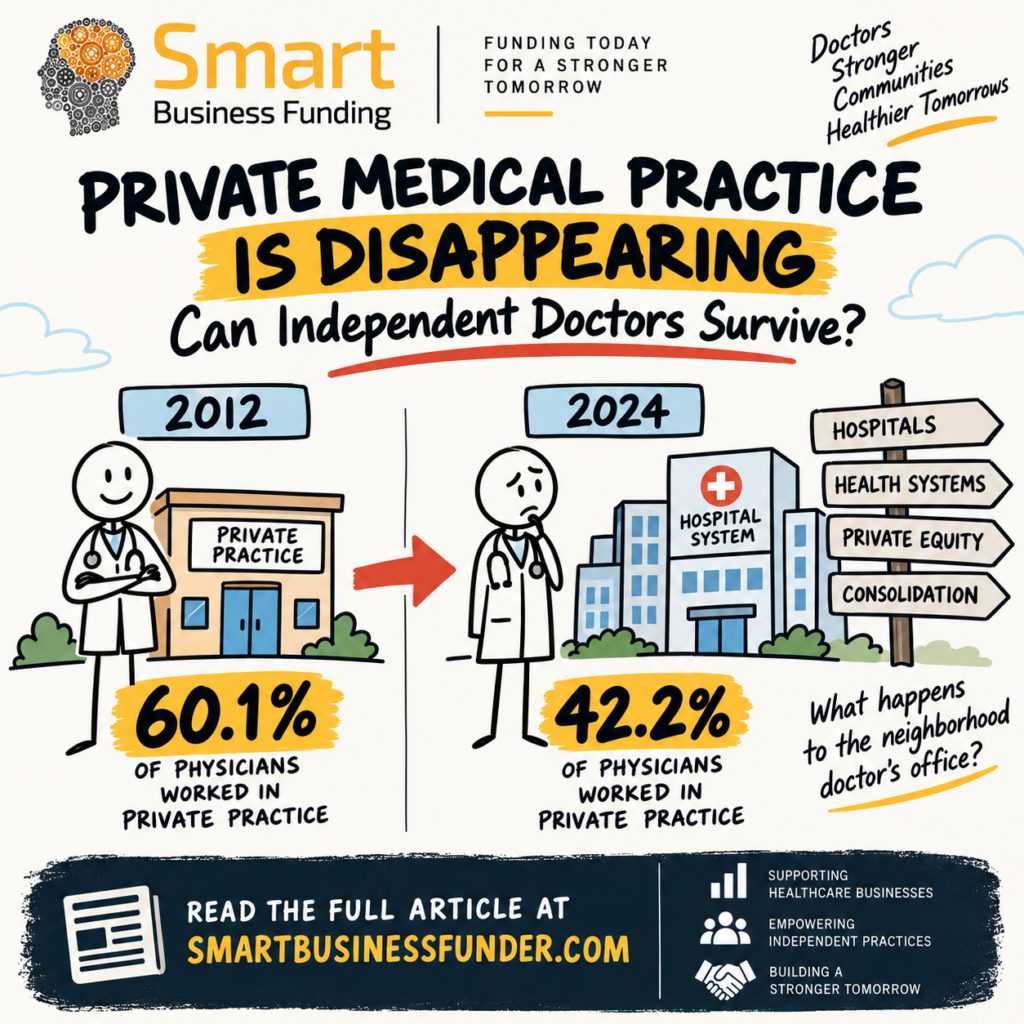
According to the American Medical Association, the percentage of physicians working in private practices fell from 60.1% in 2012 to 42.2% in 2024.
In little more than a decade, private practice went from the setting for a clear majority of physicians to one representing fewer than half.
There is another important divide beneath those numbers.
Physicians age 55 and older are considerably more likely to own their practices than physicians under 40.
AMA data shows a practice ownership rate of 54.3% among physicians age 55 and older, compared with 25.5% among physicians under 40.
These statistics measure different aspects of medical practice and should not be treated as interchangeable. But together they point toward a fundamental question facing American medicine:
What happens to independent medical practices as an older generation of physician-owners eventually retires and younger doctors increasingly practice under different ownership models?
The answer could reshape not only physician entrepreneurship but also who owns America’s medical practices.
Private Medical Practice Has Declined Dramatically
The long-term shift is difficult to ignore.
In 2012, 60.1% of physicians worked in private practices.
By 2024, that figure had fallen to 42.2%, according to the AMA.
That is a decline of 17.9 percentage points.
This doesn’t mean independent medicine is disappearing tomorrow.
Thousands of independent medical practices continue to operate across the United States, from primary care offices to specialty practices.
But the direction of the trend is significant.
The traditional physician-owned practice is competing within a healthcare environment increasingly shaped by larger organizations, hospital systems, medical groups, and other ownership structures.
The doctor’s office may look familiar from the waiting room.
Behind the scenes, however, who owns and operates it may be changing.
Older Physicians Are Much More Likely to Own Their Practices
Age adds another dimension to the private-practice story.
According to AMA data:
- 54.3% of physicians age 55 and older own their practices
- 25.5% of physicians under age 40 own their practices
That doesn’t mean 54.3% of physician practice owners are 55 or older.
It means that among physicians in that age group, 54.3% have an ownership stake in their practice.
The distinction matters.
But so does the gap.
Older physicians are more than twice as likely to be owners under these figures.
As those physician-owners eventually retire, their practices will need to transition somehow.
Some may pass to younger doctors.
Some may be sold.
Some may merge.
Some may become part of larger healthcare organizations.
And some independent practices may close.
Why Are Fewer Physicians in Private Practice?
There probably isn’t one explanation for the decline.
Operating a medical practice requires a physician to manage two very different responsibilities simultaneously.
The physician practices medicine.
The owner operates a business.
That business can involve:
- Recruiting and retaining employees
- Payroll
- Office leases
- Medical equipment
- Technology
- Billing and collections
- Insurance relationships
- Compliance
- Cybersecurity
- Electronic health records
- Marketing
- Vendor management
- Cash flow
- Administrative personnel
For a physician who wants to focus primarily on patient care, employment within a larger organization can offer a fundamentally different career model.
The economics of operating independently can also be challenging.
A practice may generate substantial revenue while simultaneously carrying substantial overhead.
The physician-owner isn’t simply responsible for their own income.
They are responsible for keeping an entire organization functioning.
The Independent Doctor Is Also an Entrepreneur
This aspect of private medicine is sometimes overlooked.
A physician who owns a medical practice isn’t only a healthcare professional.
That physician is also an entrepreneur.
They may have employees.
They negotiate contracts.
They make purchasing decisions.
They invest in technology.
They manage real estate.
They decide when to expand.
They oversee cash flow.
They take financial risk.
They create jobs.
They build an organization around their professional expertise.
For many doctors, ownership can provide something employment cannot:
control.
That can include greater influence over practice culture, staffing, scheduling, growth, technology, patient experience, and long-term strategy.
But control comes with responsibility.
The same independence that gives physician-owners freedom also requires them to assume the risks and obligations of operating a business.
The Economics of Independent Medicine Can Be Complicated
A medical practice can face significant operating expenses before revenue is ultimately collected.
Employees need to be paid on schedule.
Rent is due.
Equipment needs maintenance.
Insurance premiums must be paid.
Technology systems need to operate.
Supplies must be purchased.
Meanwhile, the timing of collections may not perfectly match the timing of expenses.
This creates a familiar small-business challenge:
A profitable business can still experience cash-flow pressure.
For a medical practice, that pressure can become more significant during periods of expansion, hiring, relocation, equipment purchases, or ownership transition.
A practice doesn’t need to be failing to need capital.
Sometimes growth itself creates the need.
Consolidation Is Changing the Physician Ownership Decision
An older physician considering retirement may have more than one potential exit path.
Historically, another physician or group of physicians might have been the obvious successor.
Today, the potential landscape can be broader.
Medical practices may become affiliated with or acquired by larger physician groups, hospital systems, healthcare organizations, and other entities.
That can change the economics of succession.
For some physicians, selling to a larger organization may provide an attractive exit.
For others, preserving an independent practice may be important.
Neither path is automatically superior.
Larger organizations may offer advantages such as administrative resources, purchasing scale, recruiting capabilities, technology, and infrastructure.
Independent practices may offer greater autonomy, local ownership, organizational flexibility, and entrepreneurial control.
The important point is that America’s medical-practice ownership structure is changing.
What Could Be Lost When an Independent Practice Closes?
An independent medical practice can represent decades of accumulated value.
A physician may spend an entire career building:
- Patient relationships
- Referral networks
- An experienced staff
- Local reputation
- Clinical workflows
- Office systems
- Community relationships
- Specialized expertise
- A recognizable practice brand
When the owner retires, those assets do not automatically transfer.
A successful succession can preserve much of what has been built.
An unsuccessful transition can allow it to disappear.
Employees may leave.
Patients may move to other providers.
Referral relationships may dissolve.
Equipment may be sold.
The practice’s identity may disappear.
For the retiring physician, succession is therefore about more than monetizing an asset.
It can also be about preserving a professional legacy.
The Next Owner May Already Work in the Practice
One potential solution is internal succession.
Imagine an established specialty practice with a physician-owner approaching retirement and two younger physicians working alongside them.
Those younger doctors already know the staff.
They understand the patients.
They know the referral network.
They understand how the practice operates.
Rather than selling to an outside organization, the retiring owner could potentially transition ownership to the physicians already inside the practice.
That model can offer continuity.
But willingness isn’t enough.
The next generation must also be prepared for ownership.
That means understanding the business—not just the medicine.
Becoming a Physician-Owner Requires a Different Skill Set
Medical training prepares physicians to care for patients.
It doesn’t necessarily prepare them to run companies.
A physician-owner may suddenly need to understand:
- Financial statements
- Business cash flow
- Employee compensation
- Hiring and firing
- Commercial leases
- Vendor contracts
- Marketing
- Practice valuation
- Technology investments
- Insurance
- Regulatory obligations
- Leadership
- Strategic planning
That can make the jump from employed physician to practice owner intimidating.
The younger physician isn’t simply purchasing an income stream.
They are accepting responsibility for an organization.
For independent medicine to remain viable, future physician-owners may need stronger business preparation alongside their clinical expertise.
Why Younger Doctors May Choose Employment Instead
The lower ownership rate among physicians under 40 should not automatically be interpreted as a lack of entrepreneurial ambition.
Career stage matters.
A younger physician may have only recently completed years of education, residency, fellowship, and training.
Ownership may come later.
Employment can also offer benefits that are attractive at certain stages of life and career.
A physician may prefer predictable compensation, fewer administrative responsibilities, access to established infrastructure, or the ability to concentrate more heavily on clinical work.
Some may eventually pursue ownership.
Others may never want it.
The important structural question is whether enough younger physicians will choose ownership to replace independent practices whose current owners eventually retire.
Could Independent Medical Practices Become Scarcer?
If private-practice participation continues to decline, independent practices could represent a smaller portion of American medicine in the future.
That would not necessarily mean independent medicine disappears.
Scarcity could even make certain independent models more distinctive.
Physicians may develop practices built around specialized care, patient experience, efficiency, technology, concierge models, niche specialties, or other approaches.
The independent medical practice of the future may not look exactly like the traditional doctor’s office of the past.
Survival may depend on adaptation.
The question isn’t necessarily whether independent medicine can return to the structure it had decades ago.
It may be whether independent physicians can develop models that work in today’s healthcare economy.
Technology Can Help Independent Practices Compete—But It Costs Money
Technology can reduce some of the disadvantages traditionally associated with operating a smaller practice.
Modern practices can use digital systems for scheduling, patient communication, billing, records, marketing, analytics, and other functions.
But technology requires investment.
An independent practice may need capital for:
- Electronic health record systems
- Medical equipment
- Diagnostic technology
- Cybersecurity
- Patient communication platforms
- Office renovations
- Telehealth capabilities
- Practice-management software
- Digital marketing
- Automation
A larger healthcare organization may spread those costs across many locations.
An independent owner has to make those investments at the practice level.
That makes capital allocation an important part of remaining competitive.
Growth Can Create Cash-Flow Pressure
Suppose an independent medical practice is doing well.
The physicians want to open another location.
That sounds like a sign of financial strength.
It is.
But expansion can also create immediate expenses.
The practice may need to lease additional space, renovate it, purchase equipment, hire staff, invest in technology, and market the new location before the new office reaches full productivity.
Growth therefore creates a paradox familiar to many business owners:
The more opportunity a company has, the more capital it may need.
Independent medical practices are not exempt from that reality.
Access to working capital can influence how quickly a practice can act when opportunities arise.
Succession Can Create the Same Capital Challenge
Now consider a younger physician buying into an established practice.
The physician may need capital for the ownership transaction itself.
But the practice doesn’t stop operating while ownership changes.
Payroll continues.
Rent continues.
Technology costs continue.
Supplies continue.
Equipment may need replacement.
The new owner may want to renovate, hire, expand, or modernize.
That creates two separate capital questions:
How will the physician acquire the ownership interest?
and
How will the business remain adequately capitalized after the transition?
Focusing only on the purchase price can overlook the second question.
What Independent Physicians Can Do Before Retirement
Physician-owners who expect to retire eventually can begin preparing long before their final year in practice.
Make the Practice Less Dependent on One Doctor
A business that revolves entirely around the founder can be difficult to transfer.
Developing other physicians, managers, and systems can improve continuity.
Organize Financial Records
Potential buyers and partners need to understand the economics of the practice.
Reliable financial statements can make evaluation easier.
Develop Younger Physicians
If internal succession is possible, future owners may need time to develop business and leadership capabilities.
Evaluate Ownership Options Early
Potential successors may include partners, associates, competing practices, larger medical organizations, or other qualified buyers.
Understanding the possibilities before retirement becomes urgent can provide greater flexibility.
Consider the Transition From the Patient’s Perspective
A successful succession isn’t only financial.
Patients need confidence that their care will continue.
Communication and gradual transition can help preserve relationships.
What Younger Physicians Should Consider Before Buying a Practice
Physicians interested in ownership should approach an acquisition as both doctors and business buyers.
Due diligence may include reviewing:
- Historical financial performance
- Revenue sources
- Accounts receivable
- Patient volume
- Referral concentration
- Payer mix
- Employee compensation
- Lease obligations
- Equipment
- Technology
- Compliance matters
- Liabilities
- Contracts
- Staffing
- Seller dependence
- Working-capital requirements
Professional legal, accounting, valuation, healthcare regulatory, and financial guidance may be essential.
A practice can have excellent clinical outcomes and still have business problems.
Likewise, a financially strong practice may require operational improvements.
Understanding both sides is essential.
Is Private Practice Really Disappearing?
The headline is intentionally provocative.
Independent medical practice is not disappearing entirely.
But the traditional private-practice model has clearly lost substantial share.
A decline from 60.1% of physicians in private practice in 2012 to 42.2% in 2024 represents a significant structural change.
The more interesting question is what happens next.
Does the decline continue?
Does private practice stabilize at a lower level?
Do new ownership models emerge?
Will younger physicians rediscover entrepreneurship later in their careers?
Will technology make smaller practices easier to operate?
Will consolidation continue?
No single statistic can answer those questions.
But the decisions made by today’s physicians will.
The Doctor of 2035: Employee, Partner or Entrepreneur?
The medical practice of 2035 may look familiar to patients.
There will still be examination rooms.
There will still be physicians and nurses.
Patients will still schedule appointments.
But the ownership behind the office could look considerably different.
More doctors may work for larger organizations.
Independent physicians may develop increasingly specialized models.
Some younger physicians may purchase practices from retiring doctors.
Others may become partners.
And some established independent practices may disappear when no successor emerges.
That makes physician ownership more than a career decision.
It is part of a larger transformation in American business.
The older generation of physician-owners eventually has to pass the responsibility somewhere.
The defining question for independent medicine may therefore be:
Will the next generation want to own it?
Business Funding for Established Medical Practices
Running an independent medical practice can require significant capital.
Established practices may need funding for equipment, technology, payroll, renovations, staffing, expansion, working capital, additional locations, or other business opportunities.
Smart Business Funding works with established businesses across healthcare and many other industries, providing business funding options of up to $5 million per transaction.
With approximately 11 years in business, Smart Business Funding has experience working with businesses that may not fit neatly within traditional funding requirements and offers a streamlined process for companies that need to move quickly.
Explore business funding options for your medical practice with Smart Business Funding.
Funding is subject to approval and applicable terms. Smart Business Funding does not provide medical, legal, tax, regulatory, valuation, or practice-acquisition advice. Physicians considering an ownership transaction should consult qualified professional advisors.
Sources and Methodology
Physician private-practice and ownership statistics discussed in this article are based on research published by the American Medical Association (AMA).
The figures cited represent different measurements and should not be treated as interchangeable.
The decline from 60.1% in 2012 to 42.2% in 2024 refers to the percentage of physicians working in private practices.
The figures showing 54.3% ownership among physicians age 55 and older and 25.5% among physicians under 40 refer to practice ownership rates within those respective age groups.
They do not mean that 54.3% of all physician practice owners are age 55 or older.
Discussion of succession, consolidation, future ownership, and the medical practice of 2035 represents analysis of current trends rather than a prediction that a specific percentage of practices will be sold, closed, consolidated, or transferred.
Readers should consult the underlying AMA research for definitions, methodology, survey periods, and additional context.