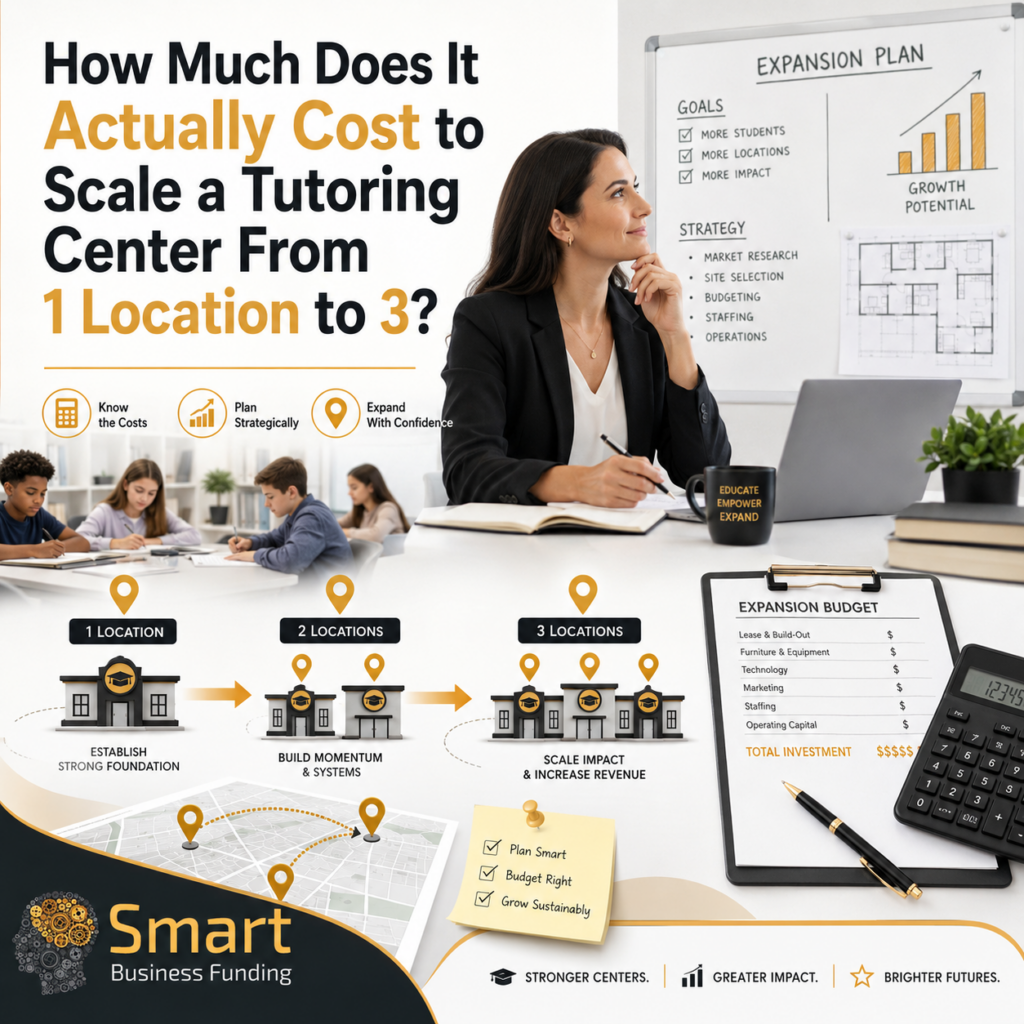
How Much Does It Actually Cost to Scale a Tutoring Center From 1 Location to 3?
Owners of a single successful tutoring center often assume that opening location two and three is just “more of the same, times three.” It isn’t. Each new location carries its own buildout costs, its own hiring curve, and its own multi-month runway before it breaks even — while the original location has to keep funding the business in the meantime.
Here’s a realistic breakdown of what that expansion actually costs, and where the funding gaps tend to show up.
Location Buildout and Lease Costs
Depending on market and square footage, a second tutoring center location typically requires:
- First and last month’s rent plus security deposit
- Buildout or renovation (flooring, tutoring pods, signage)
- Furniture: tables, chairs, whiteboards, storage
- Technology: computers, tablets, Wi-Fi infrastructure, adaptive learning software licenses
These costs are due before a single student walks in — often 60–90 days ahead of any revenue from the new location.
Staffing and Onboarding
A new location needs a center director, front-desk staff, and enough tutors to cover initial demand — hired and trained before enrollment ramps. Background checks, onboarding, and training time all cost money with zero corresponding revenue in the first month or two.
Curriculum and Licensing
Multi-location centers typically need additional seats or licenses for whatever curriculum platform they use, plus enough physical materials (workbooks, test-prep guides) to stock a second site from day one.
Marketing to Establish a New Location
A new location has zero local reputation. Google Business Profile setup, local SEO, signage, community partnerships, and paid local ads all require spend before the location has any organic referral base — the opposite of location one, which likely runs on word-of-mouth by now.
The Real Cost Driver: The Ramp-Up Gap
The line-item costs above are predictable. The part that catches owners off guard is the ramp-up gap — the 3–6 month window where a new location is fully staffed and operating but not yet at breakeven enrollment. During that window, the new location is a net cost, and it’s common for owners to unintentionally pull cash from the profitable original location to cover it.
Scaling from one location to three means running that ramp-up gap twice, potentially overlapping if expansion happens quickly — which is exactly when most owners underestimate total capital needs.
Why Banks Aren’t Built for This Timeline
Bank loans are structured around a single, predictable use of funds and a long approval runway. Multi-location expansion, by contrast, often needs capital in stages — location two’s buildout this quarter, location three’s staffing ramp four months later — with approval timelines that don’t match a bank’s typical four-to-eight-week process.
How SBF’s Direct Fund Program Fits Expansion Funding
- Funding amount: $10,000–$5,000,000
- Terms: 2–10 months
- Credit minimum: ~500, soft pull only
- Time in business: 1 year minimum
- Monthly revenue: $50,000/month minimum (based on existing location revenue)
- Underwriting: 1–5 hours; same-day or next-day funding
- Repayment: Daily or weekly
- Renewal: Available at 50–70% payback — useful for staged, multi-location rollouts
- All 50 states
Because renewal is available once 50–70% of the current advance is paid back, expanding operators can layer funding to match each new location’s timeline rather than raising one large amount up front and carrying the full cost of unused capital.
Industries We Fund
Beyond education, SBF funds fitness studios, beauty and personal services businesses, contractors, and distribution companies — many of which face similar multi-location ramp-up economics.
Frequently Asked Questions
How much funding does a typical second tutoring location need? It varies significantly by market and square footage, but buildout, initial staffing, and a 3–6 month operating cushion are the main components to plan for.
Can I get funding for location three while still paying off funding used for location two? Renewal is available once 50–70% of an existing advance is paid back, which can support staged expansion.
Does SBF require collateral for expansion funding? No specific collateral is required, though a personal guarantee is standard. (Editor note: verify against approved collateral disclosure language before publishing.)
What revenue do you look at — the whole business or just one location? Underwriting is based on the business’s overall monthly revenue, which for multi-location operators typically means combined revenue across existing locations.
Related Reading
Not sure if expansion is the right move yet? 7 Signs Your Tutoring Center Needs Funding Before Back-to-School Rush covers the earlier warning signs.
For details on what expansion funding actually requires (and doesn’t require), see Can a Tutoring Center Get Funding With No Collateral?
Ready to Plan Your Expansion Funding?
Scaling a tutoring center is a math problem before it’s a real estate problem. Get the ramp-up gap funded correctly and location two stops draining location one.
Call 1-866-Re-Smart | Email Info@SmartBusinessFunder.com | 2420 NE 186th Street, Suite 401, North Miami Beach, FL 33160