
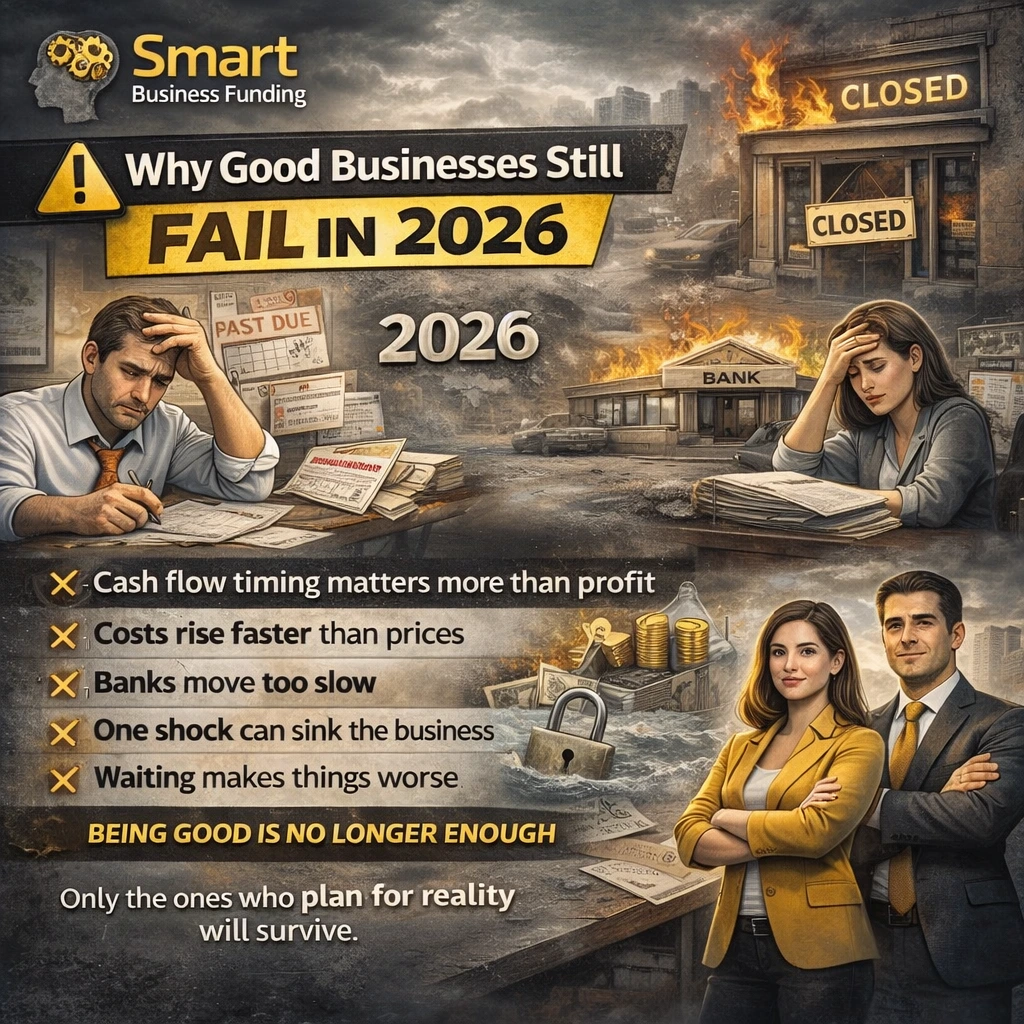
Why Good Businesses Still Fail in 2026
Most businesses that fail in 2026 aren’t bad businesses.
They have customers.
They generate revenue.
They deliver quality products or services.
Yet they still shut their doors.
In today’s economy, being good is no longer enough. Rising costs, tighter lending, faster competition, and cash-flow timing gaps are exposing weaknesses that didn’t matter as much in the past.
This article breaks down why good businesses still fail in 2026, the silent killers most owners overlook, and what separates the businesses that survive from those that don’t.
The Myth: “If the Business Is Good, It Will Survive”
For years, business owners were told:
“Focus on quality and the rest will work itself out.”
In 2026, that advice is outdated.
Good businesses fail not because they lack demand — but because their financial structure can’t support modern operating realities.
1. Cash Flow Timing Kills Otherwise Profitable Businesses
Many good businesses are profitable on paper but fail in real life.
Why?
- Expenses are due weekly or bi-weekly
- Revenue arrives in 30, 60, or 90 days
- Insurance and corporate payments move slowly
When cash flow timing doesn’t line up, even profitable businesses run out of oxygen.
Profit doesn’t pay bills. Timing does.
2. Rising Costs Outpace Pricing Power
In 2026, inflation continues to pressure:
- Labor wages
- Rent and leases
- Insurance premiums
- Fuel, materials, and inventory
Many good businesses hesitate to raise prices out of fear of losing customers.
Margins quietly disappear — until there’s nothing left.
3. Dependence on Banks Becomes a Bottleneck
Banks weren’t built for speed or flexibility.
Good businesses fail while waiting on:
- Slow approvals
- Endless documentation
- Conservative underwriting
- One “no” decision
By the time funding arrives — if it arrives — the opportunity is gone.
4. Growth Becomes Too Risky Without Capital
Expansion should feel exciting.
For many good businesses, it feels terrifying.
Why?
- Growth requires upfront cash
- Hiring comes before revenue
- Equipment costs spike early
- Marketing spend comes before returns
Without access to capital, growth becomes a threat instead of a solution.
5. One Shock Is Enough to Tip the Business Over
In 2026, many businesses operate with no buffer.
One of the following can cause failure:
- A slow-paying client
- A tax bill
- A major repair
- A temporary sales dip
- A key employee leaving
Good businesses don’t fail gradually — they fail suddenly.
6. Being Busy Masks Structural Problems
One of the most dangerous situations is being busy but underfunded.
Good businesses stay:
- Fully booked
- Overworked
- Constantly stressed
But:
- Margins are thin
- Cash flow is fragile
- There’s no room to breathe
Activity hides risk — until it’s too late.
7. Owners Delay Action Hoping Things Will “Stabilize”
Many failures happen because owners wait.
They wait for:
- Costs to come down
- Banks to loosen
- One more good quarter
- Less uncertainty
In 2026, uncertainty is permanent.
Waiting doesn’t reduce risk — it compounds it.
8. Talent Leaves When Businesses Stop Growing
Good employees want:
- Stability
- Growth
- Opportunity
When businesses stall:
- Career paths disappear
- Burnout increases
- Competitors poach talent
Losing key people accelerates decline fast.
9. Pricing Decisions Become Desperation Decisions
Without capital, good businesses:
- Underbid jobs
- Discount too heavily
- Accept bad clients
- Sacrifice quality
This erodes reputation, morale, and profitability all at once.
10. Owners Carry Too Much Stress for Too Long
Finally, many good businesses fail because owners burn out.
Constant pressure leads to:
- Short-term thinking
- Poor decisions
- Missed opportunities
- Emotional exhaustion
A tired owner is a hidden liability.
The Common Thread: Capital Strategy
When you look closely, most failures trace back to one issue:
The business was undercapitalized for the environment it was operating in.
Not badly run.
Not poorly marketed.
Just financially mismatched to modern realities.
Why Some Good Businesses Survive While Others Fail
The survivors in 2026 do a few things differently:
- They plan for timing gaps
- They secure capital before they’re desperate
- They build buffers, not just profits
- They don’t rely on one funding source
- They treat funding as strategy, not emergency
Final Thought: Failure Is Rarely About Quality
Good businesses still fail in 2026 because:
- The economy moves faster
- Costs rise quicker
- Capital access matters more
Quality is necessary — but capital alignment is what keeps the doors open.
The businesses that survive aren’t always the smartest or the cheapest.
They’re the ones that planned for reality.