The Ultimate Guide to Alternative Business Financing for 2025 by Smart Business Funding
Table of Contents
- Introduction
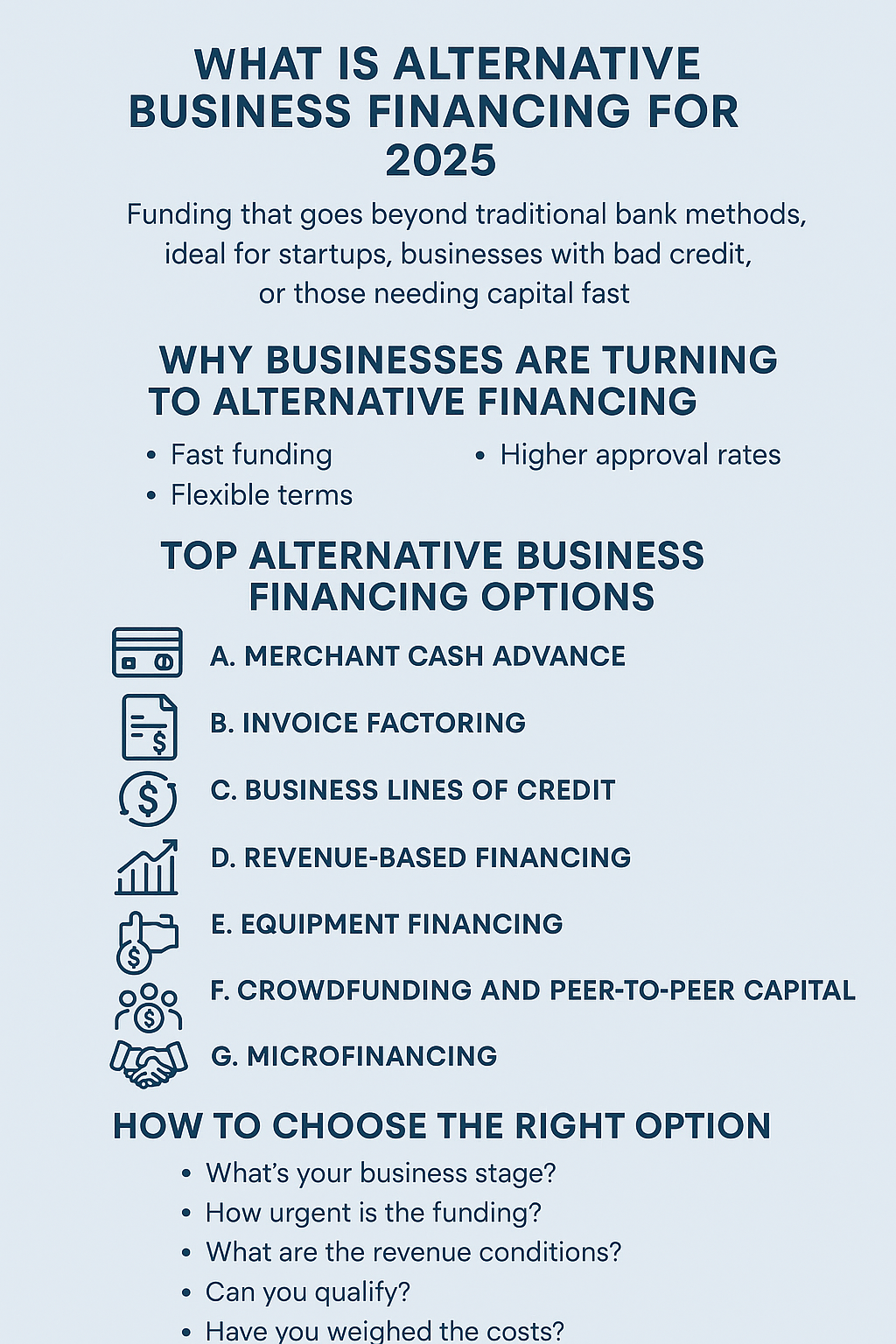
- What Is Alternative Business Financing?
- Why Business Owners Are Choosing Alternative Financing in 2025
- The Top Alternative Business Financing Options in 2025
- Pros and Cons of Alternative Business Financing
- How to Choose the Right Option for Your Business
- How to Qualify and Apply in 2025
- Red Flags to Avoid
- Real Business Case Studies
- The Future of Business Financing Beyond Banks
- Conclusion
Introduction
Business owners today are no longer bound to one-size-fits-all bank products when they need capital. Whether you’re a startup, navigating seasonal dips, or scaling aggressively, the evolution of alternative business financing in 2025 offers more control, flexibility, and speed than ever before.
This guide explores everything you need to know—practical tools, real-world options, and emerging trends—to help you confidently access the funds your business needs.
What Is Alternative Business Financing?
Alternative business financing refers to any method of securing business capital outside of traditional banks. These options are often faster, more flexible, and available to a broader range of businesses—including those with credit challenges or limited collateral.
This includes models like merchant cash advances, invoice factoring, revenue-based funding, and crowdfunding. Fintech platforms have revolutionized how quickly businesses can apply, get approved, and receive funds.
Why Business Owners Are Choosing Alternative Financing in 2025
The appeal of alternative financing has skyrocketed due to:
- Speed: Funds can often be delivered in 24–48 hours.
- Access: Businesses with low credit scores or unconventional models are welcomed.
- Flexibility: Repayment is often based on revenue, not fixed schedules.
- Innovation: AI and automation streamline underwriting and funding.
With these advantages, businesses that once struggled with rigid gatekeepers now thrive with on-demand capital.
The Top Alternative Business Financing Options in 2025
Merchant Cash Advance (MCA)
An MCA provides a lump sum in exchange for a percentage of future credit card sales. It’s ideal for businesses with high transaction volume and seasonal revenue.
- Pros: Fast access, minimal paperwork
- Best for: Retail, restaurants, and service providers
Invoice Factoring
Convert unpaid invoices into immediate capital by selling them to a factoring company. This improves cash flow without taking on new debt.
- Pros: No waiting for net-30 or net-60 terms
- Best for: B2B businesses, manufacturing, agencies
Business Line of Credit (Non-Traditional Providers)
Unlike banks, fintech lines of credit are dynamic and more accessible. Draw only what you need, when you need it.
- Pros: Flexibility, only pay on what you use
- Best for: Ongoing expenses, inventory purchases
Revenue-Based Financing
Businesses repay a percentage of monthly revenue instead of fixed payments. The structure flexes with your income.
- Pros: No pressure in slow months
- Best for: SaaS, ecommerce, and startups with recurring revenue
Equipment Financing (Outside of Banks)
Acquire or upgrade business equipment without heavy upfront costs. These solutions work even with credit imperfections.
- Pros: Keep your cash flow intact
- Best for: Contractors, medical, manufacturing, food services
Crowdfunding and Peer-to-Peer Capital
Tap into communities or investors through digital platforms. Raise capital without interest or equity dilution (depending on the model).
- Pros: Market validation + funding
- Best for: Startups, product launches, niche businesses
Microfinancing & Community Capital Networks
Designed for very small businesses, microfinancing offers funding from nonprofit, community, or government programs.
- Pros: Low thresholds, supportive ecosystems
- Best for: Women- or minority-owned businesses, new startups
Pros and Cons of Alternative Business Financing
Pros:
- Fast approval times
- High approval rates
- Revenue-based repayment
- Access for bad credit
Cons:
- May come with higher costs
- Terms vary widely—due diligence is required
- Not always suited for long-term growth
How to Choose the Right Option for Your Business
Ask yourself:
- How urgent is your need for capital?
- What is your average monthly revenue?
- Do you have consistent sales or seasonal dips?
- Can you repay based on future earnings?
- Do you want to avoid giving up equity?
Use these answers to narrow down the most fitting type of funding.
How to Qualify and Apply in 2025
Qualification is often based on:
- Monthly or annual revenue
- Time in business (often 6+ months)
- Industry type
- Sales history or invoice volume
Documents may include:
- Bank statements
- Sales summaries
- Business identification
Many fintech platforms provide pre-approvals within minutes and funding within 24–48 hours.
Red Flags to Avoid
- Vague repayment terms or hidden fees
- High-pressure sales tactics
- No transparency about the true cost
Tips:
- Always request a full breakdown of fees
- Look for reviews or testimonials
- Check if the provider reports positive repayment to credit bureaus
Real Business Case Studies
- A NYC salon used an MCA to expand to a second location—funded in 48 hours.
- A freight logistics firm sold $150,000 in outstanding invoices and stabilized cash flow in 7 days.
- A SaaS startup chose revenue-based funding, repaid over 6 months as subscriptions scaled.
These real-world cases show how strategic financing can power growth, not just survival.
The Future of Business Financing Beyond Banks
Expect trends like:
- Instant approvals through AI underwriting
- Blockchain-enabled funding transparency
- Integrated business dashboards offering real-time financing suggestions
- Embedded financing within ecommerce and CRM platforms
Innovation will continue empowering small businesses with tools once reserved for enterprise giants.
Conclusion
The world of business funding has changed—and for the better. Alternative financing in 2025 is fast, flexible, and inclusive.
By understanding your options and aligning them with your business model, you can make empowered financial decisions that unlock growth, resilience, and opportunity.
Ready to explore your options? Pre-qualify in minutes and see how much capital your business could access today.