
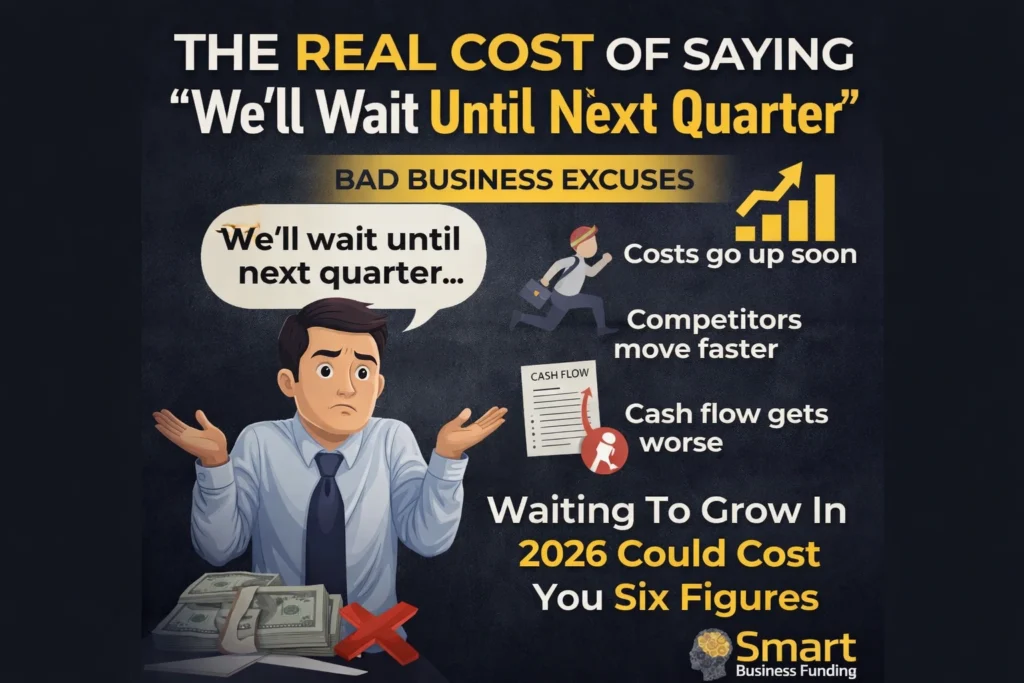
The Real Cost of Saying “We’ll Wait Until Next Quarter”
Many business owners believe waiting feels safe.
“We’ll wait until next quarter.”
“We’ll see how the market looks.”
“Let’s hold off until revenue improves.”
In 2026, that mindset is quietly one of the most expensive decisions a business can make.
Waiting doesn’t freeze your business in place—it often pushes it backward. Below is a clear breakdown of what waiting actually costs, why it’s more dangerous in 2026 than ever before, and how smart businesses are avoiding the trap.
1. Opportunity Cost: The Revenue You Never Recover
When you delay action, you don’t just pause growth—you lose revenue permanently.
Examples:
- A contractor who delays equipment purchases misses larger jobs
- A retailer who waits to restock loses repeat customers
- A trucking company that postpones repairs sits idle instead of hauling freight
Lost revenue doesn’t stack up later.
You don’t “make it back” next quarter—it’s gone.
2026 reality: Customers move faster than ever. They don’t wait for you to catch up.
2. Rising Costs Make Waiting More Expensive
One of the biggest myths is that waiting saves money. In most industries, costs only go up:
- Labor costs increase
- Equipment prices rise
- Materials fluctuate upward
- Marketing costs grow as competition increases
What cost $100,000 this quarter may cost $115,000 next quarter—and require more cash flow to support it.
Waiting often means paying more for the same thing later.
3. Cash Flow Gets Worse, Not Better
Many businesses wait because of cash flow concerns.
Ironically, waiting often creates the cash flow problem.
- Delayed expansion = delayed revenue
- Delayed marketing = fewer leads
- Delayed repairs = unexpected downtime
- Delayed hiring = burnout and inefficiency
In 2026, businesses that don’t proactively fix cash flow gaps tend to fall into reaction mode, relying on emergency decisions instead of strategic growth.
4. Competitors Don’t Wait — They Take Your Market Share
While you’re waiting:
- A competitor upgrades faster
- Another company captures your customer
- Someone else expands into your territory
- Your pricing becomes less competitive
Market share lost is extremely hard to win back.
In saturated industries like construction, trucking, retail, and auto services, waiting often means letting someone else become the default choice.
5. Momentum Is a Real Business Asset
Businesses don’t grow linearly—they grow through momentum.
Momentum looks like:
- Consistent marketing
- Steady upgrades
- Predictable expansion
- Confident decision-making
When you delay, momentum dies. Restarting later takes:
- More money
- More effort
- More risk
In 2026, the fastest-growing companies aren’t the ones with perfect conditions—they’re the ones that keep moving.
6. Inflation Quietly Erodes “Saved” Money
Holding cash feels smart—until inflation eats it.
Every quarter you wait:
- Your purchasing power drops
- Your cash buys less inventory
- Your savings fund fewer upgrades
Waiting doesn’t protect capital—it shrinks its effectiveness.
7. Emotional Cost: Stress, Regret, and Playing Catch-Up
There’s also a hidden human cost:
- Constant second-guessing
- Stress from missed chances
- Regret when competitors surge ahead
- Panic decisions later under pressure
Many business owners look back and say:
“I should’ve moved sooner.”
By then, the cost is much higher.
8. Why 2026 Is Especially Dangerous for Waiting
2026 is not a neutral year:
- Markets are faster
- Competition is tighter
- Customers are less loyal
- Technology gaps widen quickly
The businesses that win in 2026 are decisive, not perfect.
9. What Smart Businesses Do Instead
Smart operators don’t wait for ideal conditions. They:
- Secure funding before they’re desperate
- Invest in revenue-driving assets
- Fix cash flow gaps early
- Expand while others hesitate
They understand one key truth:
Timing beats perfection.
Final Takeaway: Waiting Is a Decision — Just Not a Safe One
Saying “we’ll wait until next quarter” feels cautious, but in reality it’s a strategic decision with real consequences:
- Lost revenue
- Higher costs
- Weaker cash flow
- Lost momentum
- Missed growth windows
In 2026, the real risk isn’t moving too early.
It’s waiting too long.
🔹 Pro Tip for Business Owners
If your business is stable, operating, and generating revenue, the question isn’t whether to move—it’s how fast you can move without breaking cash flow.
The businesses that win don’t wait for the future.
They fund it.