Is a Merchant Cash Advance a Loan?
Byline: Anthony Collin
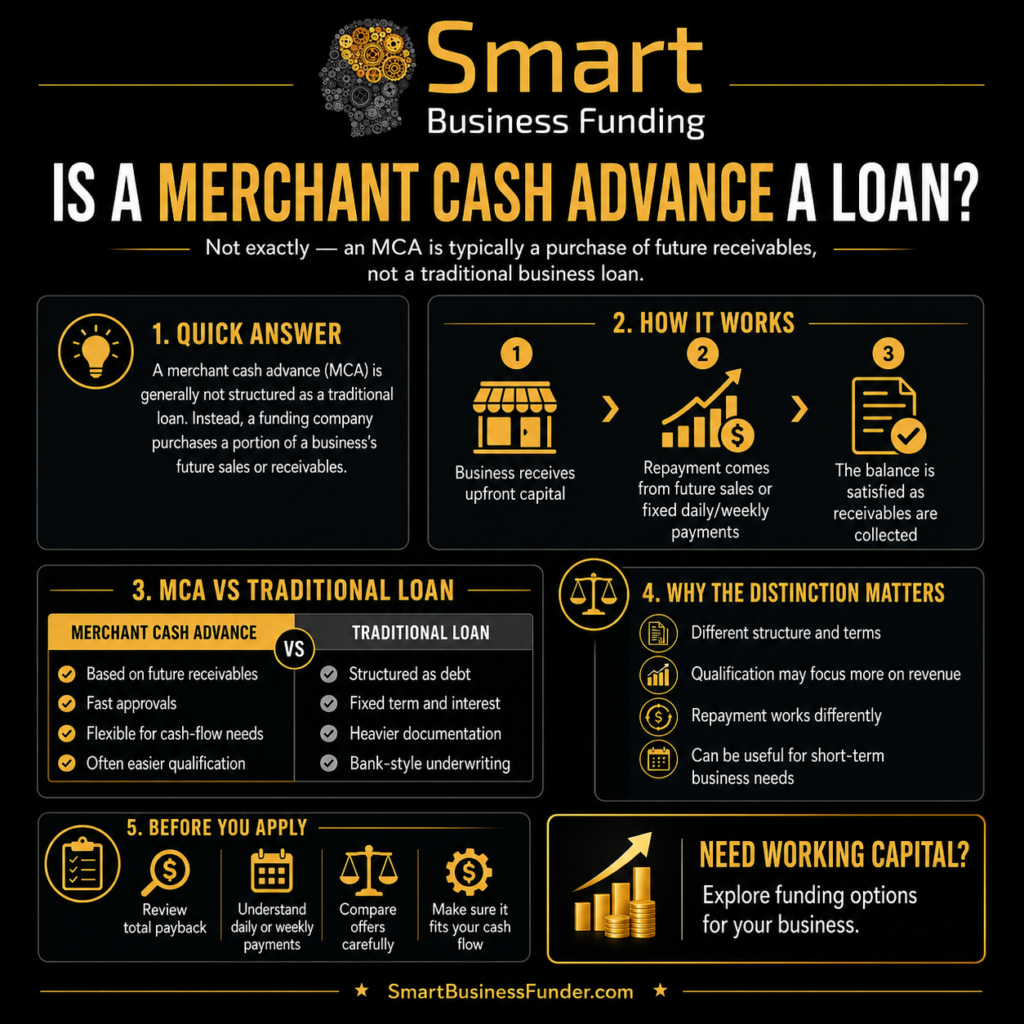
Technically, no. A Merchant Cash Advance (MCA) is structured as a purchase of a business’s future receivables, not a loan in the traditional legal sense. That distinction is why MCA approval criteria, repayment structures, and regulatory treatment differ so much from a conventional bank loan — and it’s worth understanding clearly before comparing the two side by side.
This article is educational and general in nature and isn’t legal or financial advice. MCA regulation varies by state and continues to evolve, so for questions about how a specific agreement is classified or regulated in your state, it’s worth speaking with a qualified attorney or financial advisor.
What “Purchase of Future Receivables” Actually Means
In a traditional loan, a lender extends a fixed principal amount and charges interest over a defined repayment period, with the loan governed by lending laws and interest rate caps that vary by state. In an MCA, a funding provider instead purchases a portion of a business’s future sales — typically a fixed percentage of daily or weekly card or bank deposits — in exchange for an upfront lump sum.
This is a meaningful legal and structural distinction, not just semantics. The provider isn’t lending money that accrues interest over time; it’s purchasing a specified share of revenue the business hasn’t generated yet, at an agreed-upon price (the factor rate). Repayment amounts are typically expressed as a fixed percentage of sales, which is one reason MCA agreements commonly include provisions that adjust repayment if a business’s sales volume changes, rather than a fixed payment schedule that doesn’t move regardless of revenue.
Why This Distinction Matters for Approval Criteria
Because an MCA isn’t a loan in the traditional sense, it isn’t underwritten the same way a loan is. Loan underwriting typically weighs creditworthiness, collateral, and the borrower’s capacity to repay a fixed obligation over time. MCA underwriting instead evaluates a business’s actual sales and cash flow pattern, since repayment is tied directly to future receivables rather than a fixed schedule. This is a large part of why MCA underwriting can move in hours rather than weeks, and why businesses with limited credit history or collateral can still qualify.
Why This Distinction Matters for Regulation
Because MCAs are structured as a purchase of receivables rather than a loan, they have historically fallen outside the scope of certain lending laws, including state usury caps that limit interest rates on loans. This is a real and legally significant distinction — but it’s also an area of active legal and regulatory attention. Several states have passed or proposed commercial financing disclosure laws that apply specifically to MCA-style products, and courts in some jurisdictions have examined individual MCA agreements to determine whether their specific terms functioned more like a loan in substance, regardless of how they were labeled.
This is genuinely a nuanced and evolving area, and any business owner comparing MCA funding to a loan should understand that classification questions exist in the broader industry and can vary by state and by the specific structure of an agreement — which is exactly why the general disclaimer at the top of this article matters.
The Practical Difference for a Business Owner
Setting aside the legal classification question, the practical difference that matters most day-to-day is how repayment behaves relative to revenue:
- Loan repayment is typically a fixed dollar amount due on a fixed schedule, regardless of how the business’s revenue performs that month.
- MCA repayment is typically structured as a percentage of daily or weekly sales, so if revenue dips in a slow week, the dollar amount owed that week can adjust accordingly (depending on the specific agreement’s terms).
This is often the single most relevant difference for a business owner evaluating which structure fits their cash flow pattern, independent of the underlying legal classification.
Understanding the Factor Rate vs. Interest Rate Distinction
This same structural difference is why MCAs use a factor rate instead of an interest rate. A factor rate (commonly 1.25–1.49 for prime-qualified businesses, or 1.359–1.499 for higher-risk profiles) is a fixed multiplier applied to the funded amount to determine the total repayment amount — for example, $50,000 funded at a 1.40 factor rate results in $70,000 total owed, regardless of how long repayment takes. An interest rate, by contrast, accrues over time, meaning the total cost of a loan depends on the exact repayment timeline. Because a factor rate is fixed at the outset rather than time-based, it isn’t directly comparable to an interest rate on an apples-to-apples basis, which is a common point of confusion when business owners compare MCA costs to loan APRs.
Case Study: A Composite Example
The following is an illustrative, composite scenario used to demonstrate this distinction — not an actual client case.
Consider a wholesale distributor comparing two funding options for a $60,000 inventory purchase: a bank term loan at a fixed interest rate over 24 months, and an MCA structured as a receivables purchase over an estimated 6-month term. The bank loan has a fixed monthly payment regardless of the business’s revenue that month. The MCA’s repayment is calculated as a percentage of daily sales, meaning a slower sales month results in a smaller dollar repayment that week, while a stronger month results in faster payoff.
For this particular distributor — a business with seasonal swings in monthly revenue — the receivables-purchase structure meant repayment naturally tracked the business’s own cash flow pattern, rather than requiring a fixed payment during a seasonally slow month. The educational point: the loan-vs-MCA decision isn’t just about total cost — it’s about which repayment structure actually fits how a specific business’s revenue behaves month to month.
Full Eligibility Snapshot for SBF’s Direct Fund Program
- Funding amount: $10,000–$5,000,000
- Terms: 2–10 months
- Factor rates: 1.25–1.49 (prime); 1.359–1.499 (higher-risk)
- Credit minimum: ~500, soft pull only
- Time in business: 1 year minimum
- Monthly revenue: $50,000/month minimum
- Underwriting: 1–5 hours; same-day or next-day funding common
- Repayment: Daily or weekly, structured as a percentage of sales
- Available in all 50 states
Frequently Asked Questions
If an MCA isn’t a loan, does that mean it’s unregulated? No. While MCAs are structured differently from traditional loans and have historically fallen outside certain lending-specific laws, several states have passed or proposed commercial financing disclosure requirements that apply to MCA products, and this area continues to evolve. It’s worth discussing current regulation in your state with a qualified advisor.
Does the “not a loan” classification affect my personal liability? MCA agreements commonly include a personal guarantee regardless of the receivables-purchase classification, meaning the business owner can still hold personal liability under the terms of the agreement. This is a separate question from whether the product is legally classified as a loan.
Why do MCA agreements use a factor rate instead of an APR? Because an MCA’s repayment amount is fixed at the outset (the funded amount multiplied by the factor rate) rather than accruing over time, it isn’t structured the same way a time-based interest rate is, which is why the two aren’t typically expressed the same way.
Is one structure objectively better than the other? Not universally — it depends on a business’s cash flow pattern, how quickly capital is needed, and whether the business has the credit history or collateral a traditional loan would require.
Talk Through What Fits Your Business
Understanding the difference between an MCA and a loan is the first step in deciding which funding structure actually fits your business’s cash flow pattern.
Call 1-866-Re-Smart | Email Info@SmartBusinessFunder.com | 2420 NE 186th Street, Suite 401, North Miami Beach, FL 33160