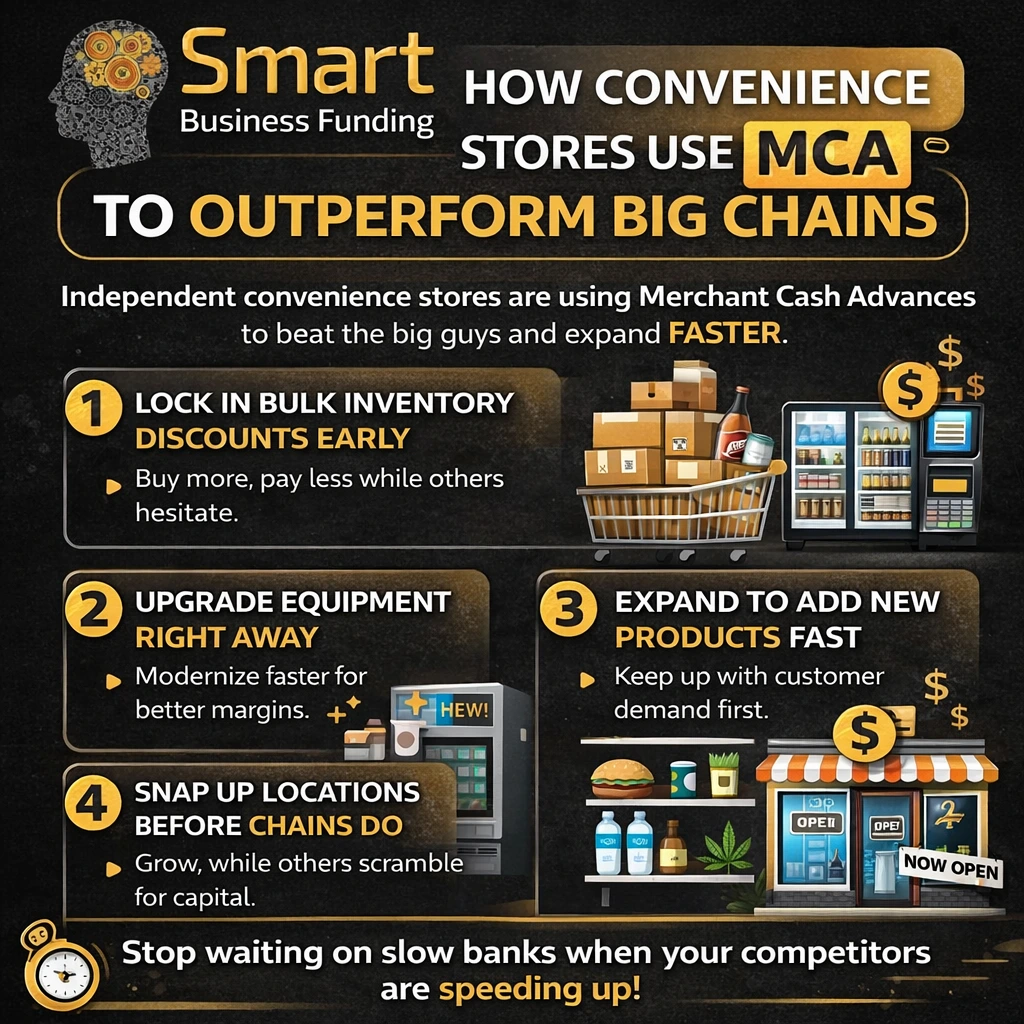
How Convenience Stores Use MCA to Outperform Big Chains
Independent convenience stores are not supposed to win.
At least that’s what the national chains want you to believe.
But across the country, privately owned convenience stores are quietly outperforming major brands — and they’re doing it with speed, inventory leverage, and smart capital strategy.
The tool many of them use?
Merchant Cash Advances (MCA).
If you own a convenience store and want to stop playing defense against national chains, this is the growth strategy you need to understand.
Why Big Chains Move Fast (And Why Most Independent Stores Don’t)
National chains have:
- Corporate credit lines
- Bulk purchasing power
- Dedicated expansion capital
- Immediate access to funding
Independent owners often rely on:
- Traditional bank loans
- Personal credit
- Waiting on cash flow cycles
That delay costs money.
When you wait 30–60 days for a bank approval:
- You miss distributor discounts
- You lose shelf space opportunities
- You delay store upgrades
- You stock less inventory during peak seasons
Speed is no longer optional in retail. It’s survival.
What Is an MCA — And Why It Works for Convenience Stores
A Merchant Cash Advance provides funding based on your store’s revenue performance — not years of paperwork.
At Smart Business Funding, we provide:
- Funding up to $5,000,000
- Approvals often within hours
- Funding in as little as 24 hours
- Soft credit pulls
- Flexible daily or weekly payment options
For convenience stores, this matters because:
- Revenue is consistent
- Card transactions are predictable
- Inventory cycles move fast
Banks move slowly. Retail does not.
7 Ways Convenience Stores Use MCA to Outperform Big Chains
1. Locking in Bulk Inventory Discounts Before Competitors
Distributors offer aggressive pricing for bulk purchases — especially on beverages, tobacco, snacks, and seasonal items.
The stores with capital buy early.
The stores without capital pay more later.
Loss Aversion Principle: Every missed discount directly reduces margin.
With MCA funding, owners can immediately stock high-demand items before price increases or shortages hit.
2. Upgrading Coolers, POS Systems & Displays
Customers notice presentation.
Modern refrigeration units, upgraded POS systems, and cleaner layouts increase:
- Average ticket size
- Checkout speed
- Customer retention
Waiting a year to upgrade equipment often costs more than the investment itself.
3. Securing Fuel Inventory During Price Swings
Gas price volatility can crush unprepared operators.
Stores with capital can:
- Buy fuel inventory strategically
- Hedge short-term price swings
- Maintain margin stability
When fuel spikes, undercapitalized operators suffer.
Prepared operators win.
4. Expanding Product Lines Quickly
The fastest-growing c-stores today offer:
- Fresh food programs
- Local specialty products
- CBD products (where legal)
- Premium beverage sections
Expansion requires upfront capital.
Bandwagon Effect: Stores that evolve with consumer demand grow. Stores that don’t stagnate.
5. Acquiring Nearby Locations Before Chains Do
Opportunity windows are short.
When another store hits the market, corporate buyers move quickly.
With fast access to capital, independent owners can move just as fast.
Funding speed determines who wins acquisitions.
6. Hiring & Retaining Staff During Peak Seasons
Labor shortages affect small stores more than chains.
With capital reserves, owners can:
- Offer competitive wages
- Increase staffing during holidays
- Reduce burnout
Customer experience improves — and repeat traffic increases.
7. Marketing Aggressively at the Right Time
Chains spend heavily on promotions.
Independent stores often cut marketing during slow periods.
The smart move? Market harder.
MCA funding allows:
- Local advertising campaigns
- Grand reopening events
- Seasonal promotions
- Loyalty programs
FOMO Strategy: When customers see activity and promotions, they assume growth and success.
Growth attracts growth.
Why Banks Aren’t Built for Retail Speed
Traditional lenders require:
- Extensive financial documentation
- Long underwriting cycles
- Strict credit standards
- Collateral
Retail operates in weeks — not quarters.
By the time a bank says “yes,” the opportunity is gone.
Merchant Cash Advances are designed for revenue-based businesses that need speed and flexibility.
Authority Matters: Choosing the Right Funding Partner
Not all MCA providers are equal.
Smart Business Funding is a direct funding provider, meaning:
- No middlemen
- Faster decisions
- Clear terms
- Funding up to $5,000,000
- Experience funding high-volume retail businesses
We understand:
- Inventory cycles
- Fuel volatility
- Seasonal spikes
- Distributor pricing leverage
You’re not just getting capital.
You’re getting a growth strategy.
The Real Risk Isn’t Funding — It’s Waiting
Here’s the uncomfortable truth:
The biggest risk isn’t taking capital.
The biggest risk is watching competitors expand while you stay static.
In retail, standing still is moving backward.
Every day you wait:
- Margins shrink
- Opportunities close
- Competitors gain share
Are You Competing — Or Leading?
Big chains rely on corporate systems.
Independent convenience store owners rely on speed, instinct, and strategic capital.
The owners winning in 2026 and beyond are not the biggest.
They’re the fastest.
If you’re ready to:
- Increase inventory
- Upgrade your store
- Expand locations
- Protect margins
Smart Business Funding can help you move now — not months from now.
Apply for Fast Convenience Store Funding Today
Get approved in hours.
Fund in as little as 24 hours.
Access up to $5,000,000.
Because in retail…
The fast don’t just survive.
They dominate.