How to Read the Fine Print: Business Owner’s Guide to Funding Terms
Introduction: Why the Fine Print Matters More Than You Think
When you’re in a rush to secure business funding, that contract you’re handed might feel like just another formality. But the truth? The fine print in a funding agreement can make or break your business’s financial future.
Many business owners sign without reading deeply, assuming all contracts are alike. They’re not. And the difference between a contract that supports your growth and one that sinks your profits often lies in a few carefully hidden sentences.
This guide breaks down exactly how to read, understand, and negotiate your funding terms, so you can confidently sign without worrying about hidden traps.
Chapter 1: The Fine Print Is Where the Real Deal Lives
Why Funding Contracts Have So Much “Legalese”
Funding providers use precise — and sometimes intentionally confusing — language to:
- Comply with regulations
- Protect themselves from risk
- Create leverage in repayment terms
But legal language can also be a shield for:
- Excessive fees
- Automatic renewals
- Restrictive clauses
📌 Red Flag Callout:
If a section of your funding agreement is hard to read without a legal dictionary, that’s a signal to slow down and get clarification.
Chapter 2: The Big 5 Sections Every Business Owner Should Read Twice
1. Total Payback Amount
- What it means: The actual amount you’ll repay — principal + fees + interest.
- Why it matters: Some agreements show only the principal and base rate, hiding processing fees or daily holdbacks.
Example Table: Comparing Total Payback
| Funding Type | Amount Borrowed | Stated Rate | Fees & Costs | Total Payback |
|---|---|---|---|---|
| Bank Loan | $50,000 | 7% APR | $500 | $53,500 |
| MCA (Transparent) | $50,000 | Factor 1.2 | $0 hidden | $60,000 |
| MCA (Hidden Fees) | $50,000 | Factor 1.2 | $2,500 fees | $62,500 |
📌 Red Flag Callout:
If the “total repayment” number is missing from the first page, ask why.
2. Repayment Frequency & Method
- Daily, weekly, or monthly deductions have very different effects on cash flow.
- MCAs often use daily ACH withdrawals, which can be good or bad depending on sales stability.
Example:
A daily repayment of $300 may seem fine until a slow sales week hits — then you’re short on payroll.
📌 Pro Tip:
Match repayment schedules to revenue flow. Seasonal businesses may need flexible structures.
3. Interest Rate vs. Factor Rate
- APR: Annualized percentage rate (used by banks)
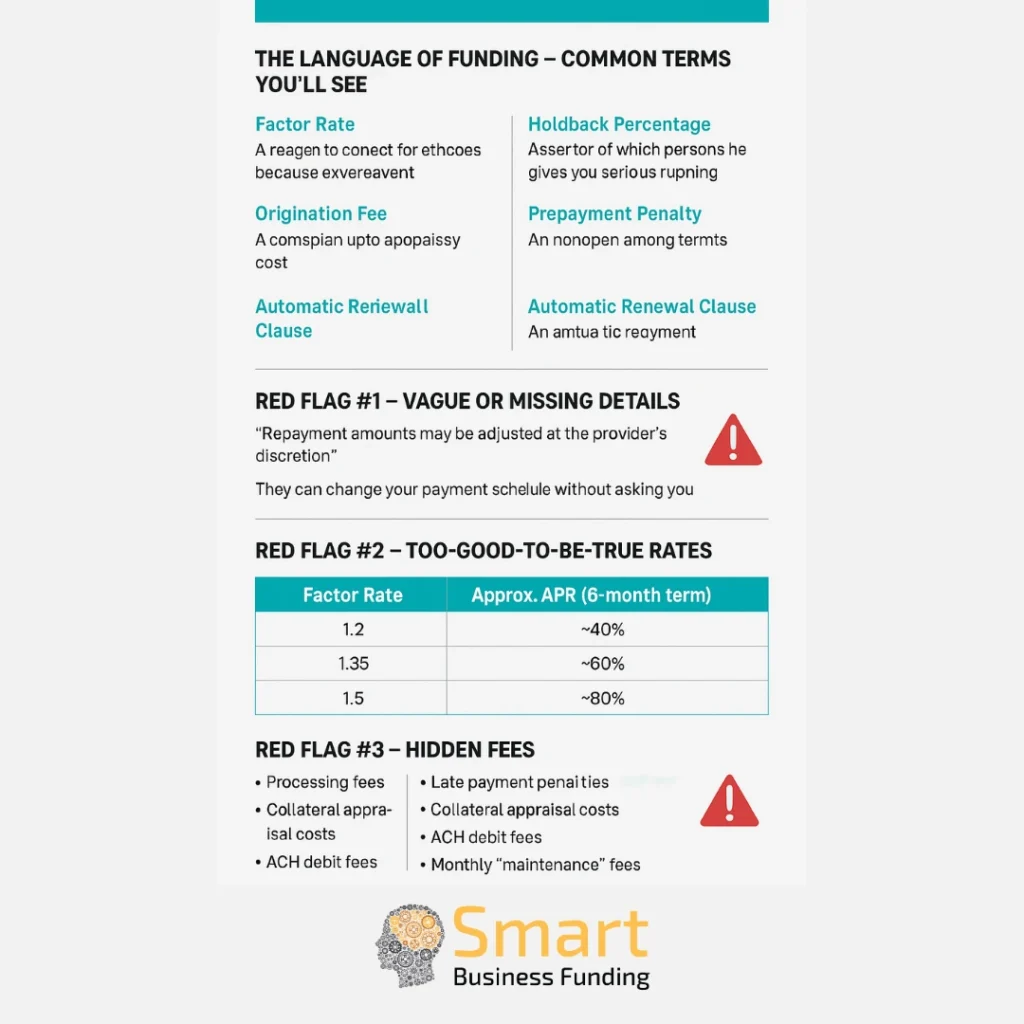
- Factor Rate: A fixed multiplier (common in MCAs)
- Many confuse factor rate with APR — but 1.3 factor rate isn’t 30% APR; it’s more like 35–40% APR depending on repayment speed.
4. Fees, Penalties, & Early Payoff Clauses
- Origination fee
- Processing fee
- Late payment penalties
- Early payoff penalties (yes, some funders penalize you for paying early!)
📌 Red Flag Callout:
If early repayment costs you more, it’s a sign they’re locking in maximum profit — not rewarding you for good management.
5. Default & Collection Clauses
This section tells you what happens if you can’t pay.
- Confession of judgment (COJ) clauses allow lenders to seize assets without court trials.
- Personal guarantees put your personal property on the line.
📌 Red Flag Callout:
If the default section is longer than the repayment section, expect aggressive collection tactics.
Chapter 3: The Hidden Traps You Won’t See in Ads
Automatic Renewal Clauses
Some MCA agreements automatically renew if you don’t give written notice within a short window — trapping you in back-to-back agreements.
Double Dipping
If you refinance or renew early, some funders charge full fees twice.
“Market Rate Adjustments”
Allows the funder to change your repayment terms mid-agreement if interest rates shift — often without your consent.
Chapter 4: How to Compare Contracts Side-by-Side
Create a Contract Comparison Sheet
| Term / Condition | Funder A | Funder B | Funder C |
|---|---|---|---|
| Amount Funded | $50,000 | $50,000 | $50,000 |
| Total Payback | $60,000 | $62,500 | $59,000 |
| Repayment Frequency | Daily | Weekly | Daily |
| Fees | $0 | $2,500 | $1,000 |
| Early Payoff Penalty | None | Yes | None |
| Renewal Clause | No | Yes | No |
📌 Pro Tip for Lead Generation:
Offer a free “Funding Agreement Checklist” PDF in exchange for the reader’s email — this turns educational content into a lead magnet.
Chapter 5: Real-Life Examples of Fine Print Gone Wrong
- The Restaurant That Paid $15K in Hidden Fees
- Agreement showed $100K funding, 1.2 factor rate ($120K payback)
- Hidden: $5K processing + $10K early payoff penalty
- The Retailer Stuck in Auto-Renew
- MCA renewed automatically after 9 months
- Business owner didn’t send a written notice within 5 days of maturity date
Chapter 6: The Smart Business Owner’s Fine Print Checklist
✅ Check total repayment including fees
✅ Understand repayment schedule
✅ Calculate APR if only factor rate is given
✅ Look for early payoff penalties
✅ Scan for auto-renew clauses
✅ Review default provisions carefully
Chapter 7: Why Transparent Funding Is the Future
Smart Business Funding believes business owners should never have to guess what they’ll owe.
We offer:
- Clear contracts
- No hidden fees
- Flexible repayment terms
- No penalties for early payoff
📞 Call-to-Action for Lead Generation:
Ready to fund your business without nasty surprises? Get a free contract review today and see how much you can save.
Conclusion: Read It, Understand It, Own It
The fine print isn’t just filler — it’s the real story of your funding deal. Read it. Question it. Compare it.
When you take the time to understand your funding terms, you don’t just avoid bad deals — you set your business up for financial stability and long-term growth.