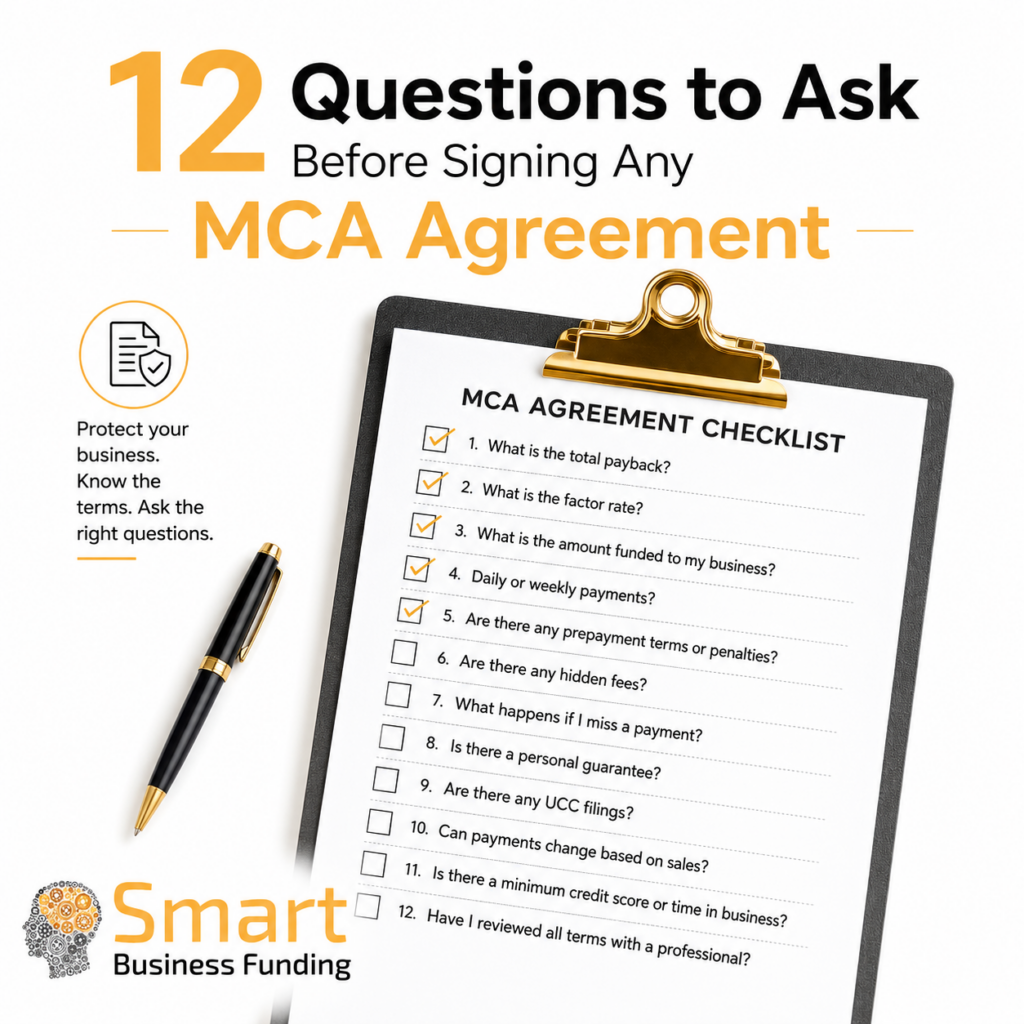
12 Questions to Ask Before Signing Any MCA Agreement (From Someone Who’s Seen Thousands of Deals)
After reviewing thousands of merchant cash advance deals, the good ones and the bad ones start to look the same on paper — until you know exactly which questions to ask. The difference between a fair deal and a costly mistake almost never comes down to the amount you’re approved for. It comes down to a handful of contract details most business owners never think to ask about until it’s too late.
This isn’t a sales pitch. It’s a checklist. If you’re about to sign an MCA agreement — with us or with anyone — these are the questions to ask before signing a merchant cash advance agreement, and what a red-flag answer sounds like for each one.
Why This List Exists
Most business owners don’t sign a bad MCA agreement because they’re careless. They sign it because they’re moving fast, the language is unfamiliar, and the cash need is real and immediate. Funders who count on that urgency rarely volunteer the details below — you have to ask. A little due diligence upfront is the single best way to make sure the offer in front of you is actually a good one, not just a fast one.
The 12 Questions
1. What is the factor rate, and what does that translate to in total dollars owed?
Every MCA has a factor rate — a fixed multiplier applied to the amount you’re advanced. A straightforward funder will tell you the exact total dollar amount you’ll owe before you sign, not just a rate on a page. Red flag: if a funder hedges or won’t give you a plain total dollar figure, that’s a sign the number doesn’t look great once it’s spelled out.
2. What is the holdback percentage, and can it change?
The holdback percentage determines how much of your daily or weekly sales go toward repayment. Red flag: a funder who can’t clearly explain how the holdback is calculated, or who reserves unexplained rights to change it after you’ve signed.
3. Is there a reconciliation clause?
A reconciliation clause lets you request an adjustment to your payment amount if your revenue drops, keeping repayment aligned with what your business is actually making. Red flag: no reconciliation option at all, meaning your payment stays fixed even if a slow month puts real strain on your cash flow.
4. Is there a personal guarantee, and what exactly does it cover?
Many MCA agreements include a personal guarantee, but the scope varies significantly — from a limited guarantee of good faith performance to a broad guarantee of full repayment. Red flag: vague language that doesn’t clearly define what you’re personally on the hook for.
5. Is there a Confession of Judgment (COJ) clause?
A confession of judgment is a clause where you agree in advance to a judgment against you without the standard opportunity to defend yourself in court, should a dispute arise. This is one of the most consequential clauses in the entire agreement, and its enforceability varies by state. Red flag: a funder who glosses over this question or discourages you from asking a lawyer about it.
6. Will this funder allow — or actively prevent — stacking?
Stacking means taking on multiple concurrent MCAs at once, which can quickly spiral into a debt load that’s impossible to service, since several holdback percentages get pulled from the same daily revenue. Red flag: a funder who encourages stacking or shows no concern about your existing positions.
7. Is there a prepayment discount if I pay it off early?
Since a factor rate is fixed regardless of how fast you repay, some funders offer a discount for paying off the balance early — others don’t, meaning there’s no financial benefit to paying ahead of schedule. Red flag: no early payoff option discussed at all, especially if you’re planning to pay it down faster than scheduled.
8. What triggers default, specifically?
Default clauses should spell out precisely what counts as a default — a missed payment, a closed bank account, a certain number of failed ACH attempts. Red flag: broad, vague default language that gives the funder wide discretion to declare default for reasons you can’t predict or control.
9. Is a UCC filing involved, and what does it secure?
A UCC filing secures a funder’s interest in specific business assets or receivables. Understanding exactly what’s being filed against — and confirming it’s released once you’ve paid off the balance — protects you from complications down the road. Red flag: no clear answer on what’s filed or when it gets released.
10. How is my position (1st, 2nd, 3rd+) determined, and does it affect my rate?
If you already have an existing MCA, a new advance is considered a 2nd, 3rd, or later position, which affects both approval and pricing. A transparent funder will explain exactly how your position was determined and how it factors into your rate.
11. What does underwriting actually check, and how long does it take?
Underwriting timelines and criteria vary widely between funders. Red flag: vague timelines or unclear criteria — a straightforward answer here is a good proxy for how straightforward the rest of the agreement will be.
12. Can I talk to a real person before I sign, and will they walk me through every clause?
The best test of a funder’s transparency is simple: will they get on a call and walk through every clause in plain language before you sign anything? Red flag: pressure to sign quickly without that conversation happening first.
What a Transparent Funder’s Answers Should Sound Like
Run through these 12 questions like a scorecard. A funder with nothing to hide will answer every one of them clearly, specifically, and without hesitation — total dollar amounts, plain-language clause explanations, and a real person on the phone before you sign anything. If you’re getting vague answers, deflection, or pressure to sign before you’ve asked, that tells you as much as any answer would.
Common Questions
Is my merchant cash advance agreement fair? A fair MCA agreement clearly discloses the factor rate, total repayment amount, holdback percentage, and any clauses like reconciliation, personal guarantee, or confession of judgment — without vague or hidden terms.
What should be in an MCA contract? At minimum: the factor rate and total amount owed, the holdback percentage, repayment schedule, any personal guarantee terms, default triggers, and disclosure of any UCC filing.
How do I know if an MCA is a good deal? Compare the total dollar cost, not just the factor rate, against your cash flow needs and timeline — and confirm the funder answers all 12 questions above clearly and without hesitation.
What questions should I ask an MCA funder? At a minimum, ask about the factor rate, holdback percentage, reconciliation clause, personal guarantee, confession of judgment clause, stacking policy, and default triggers — all covered above.
The Bottom Line
None of these questions should feel like an interrogation, and a reputable MCA funder won’t treat them like one. Asking them is exactly how you separate a fast, fair deal from a costly mistake — and any funder worth working with should welcome every one of them.
Ready to see what your business qualifies for?
Apply in minutes → Get Qualified in hours → Get Funded as soon as the same day.
📞 1-866-Re-Smart ✉️ Info@SmartBusinessFunder.com 📍 2420 NE 186th Street, Suite 401, North Miami Beach, FL 33160