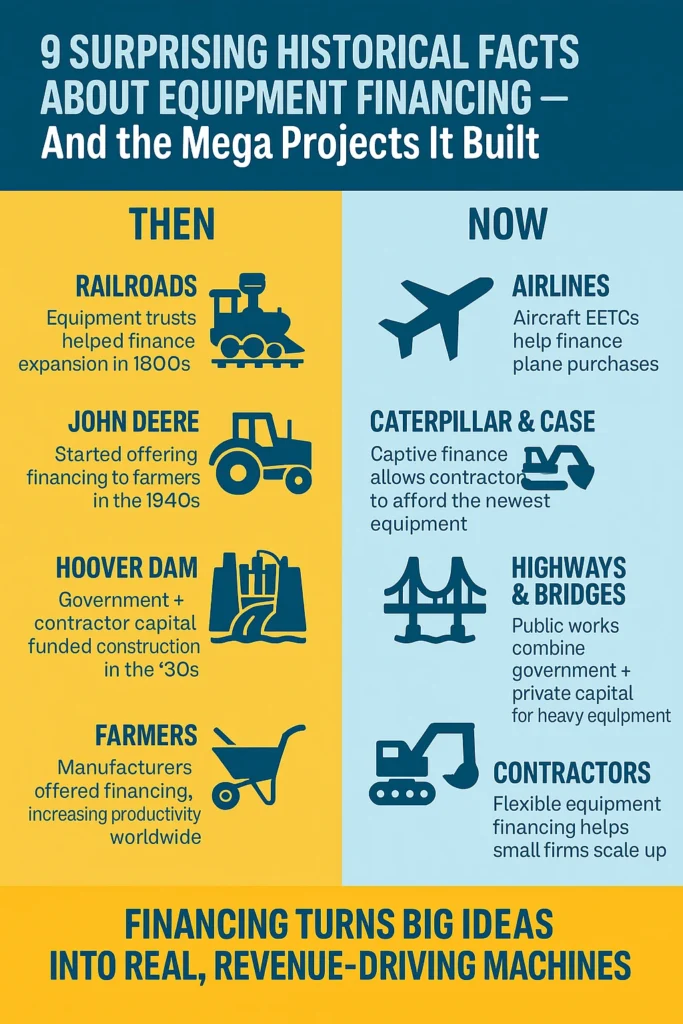
9 Surprising Historical Facts About Equipment Financing — And the Mega Projects It Built
INTRO: Equipment Financing — The Unsung Hero of Big Dreams
When you think about history’s biggest infrastructure marvels—railroads, dams, massive farms, airports—you probably picture hard hats, steel beams, and maybe a few sweaty foremen shouting over the noise.
But behind the scenes? There was equipment financing quietly doing the heavy lifting. Without it, many of the machines that built our modern world might never have existed outside of an architect’s sketchbook.
From 19th-century locomotives to 21st-century aircraft fleets, financing has been the bridge between “We could” and “We did.” And as you’ll see, the stories behind it aren’t just about money—they’re about ingenuity, risk-taking, and changing entire industries.
1. The Railroads Invented a Finance Trick That’s Still Used Today
Back in the late 1800s, railroads were the Silicon Valley start-ups of their day—capital-hungry and expansion-obsessed. But locomotives and rail cars were expensive (we’re talking millions in today’s dollars), so the industry came up with a clever workaround: the equipment trust certificate.
Here’s how it worked:
- Investors bought “certificates” that funded the purchase of trains.
- The railroad used the trains while making regular payments.
- Once the final payment was made, the railroad officially owned the equipment.
This structure didn’t just move goods—it moved capital markets. In fact, the same concept powers today’s Enhanced Equipment Trust Certificates (EETCs) for aircraft financing.
2. John Deere Turned Farmers Into Finance Customers
By the early 20th century, tractors, combines, and harvesters were replacing horses. The only problem? Not many farmers could write a check for a shiny new machine.
Enter John Deere Credit (now John Deere Financial). Instead of letting cost slow down mechanization, Deere gave farmers financing plans so they could pay over time—just like we finance cars today.
This wasn’t just good for farmers—it was genius for Deere. The company locked in loyal customers while fueling America’s agricultural boom.
3. The Hoover Dam Was a 1930s “Mega-Project” Funded by Government + Contractor Capital
During the Great Depression, six major construction companies joined forces as Six Companies, Inc. to build the Hoover Dam—a project that needed an insane amount of specialized equipment: tunnel drills, cranes, transport rigs.
Financing came from:
- Federal government funding
- Public bonds
- Contractor capital and supplier credit
It’s a classic example of public-private partnership financing equipment at scale. Without that mix of funding sources, this 726-foot-high icon might never have been built.
4. Airlines Took a Page From the Railroad Playbook
Planes are even more expensive than trains, but airlines faced the same problem: how to buy equipment without sinking under the cost.
The solution? Bring back equipment trusts—this time as EETCs. These securities allow investors to finance aircraft purchases while giving airlines flexible repayment terms. Combine that with the rise of aircraft leasing companies (so airlines don’t have to own all their planes), and you’ve got a financing model that powers global aviation.
Fun fact: In 2023, over 50% of the world’s commercial fleet was leased rather than owned.
5. Equipment Financing Helped Mechanize Farming Around the World
Beyond John Deere, companies like Caterpillar, Case IH, and Kubota set up “captive finance arms” so farmers could get their hands on machinery without waiting decades to save up.
Why it worked:
- Payments matched to seasonal crop cycles
- Dealers became finance agents
- Equipment upgrades became more common
The result? A massive productivity boom in agriculture, feeding millions more people globally.
6. Leasing & Financing Aren’t New — They’re Ancient Ideas With Modern Suits
Think leasing is a recent invention? Think again.
The concept of paying for the use of an asset over time dates back to ancient Mesopotamia, where farmers leased oxen and plows. The only difference now is that the contracts are written in legalese instead of cuneiform, and the “oxen” are 300-ton bulldozers.
7. Public Works + Private Financing = Magic
Projects like highways, bridges, and ports often combine government bonds with private contractor financing to buy the heavy machinery needed to get the job done.
It’s a win-win:
- Governments spread the cost over decades
- Contractors get the equipment they need without tying up all their capital
8. Modern Railroads Still Spend Billions on Equipment
Freight railroads in the U.S. are still massive spenders when it comes to equipment and infrastructure, with annual capital investments in the tens of billions. Locomotives, freight cars, maintenance-of-way machinery—most are financed over time rather than bought outright.
It’s a living reminder that the financing model invented over a century ago is still going strong.
9. The Common Thread: Financing Turns “Impossible” Into “Operational”
From the Hoover Dam to modern airlines, the pattern is the same:
- Big ideas need big machines.
- Big machines need big money.
- Equipment financing bridges the gap.
Whether it’s historical equipment leasing, construction equipment financing, or modern merchant cash advances, the principle hasn’t changed: make the tools affordable today so they can start paying for themselves tomorrow.
Why This History Matters for Your Business
The same principles that helped railroads conquer continents and airlines circle the globe can help today’s contractors, farmers, and builders scale faster.
If you need an excavator, skid steer, or crane now but don’t have the full cash—financing turns that “someday” purchase into a “let’s start tomorrow” reality.
Final Takeaway
Equipment financing is more than a spreadsheet—it’s a time-tested growth engine that’s powered entire industries. So the next time you see a mega-project or a shiny piece of machinery on a jobsite, remember: somewhere behind it, there’s a financing story making it all possible.
💬 Pro Tip: If you want to write your own chapter in this history, modern solutions like merchant cash advances or flexible equipment financing plans can get you the gear you need—fast.