
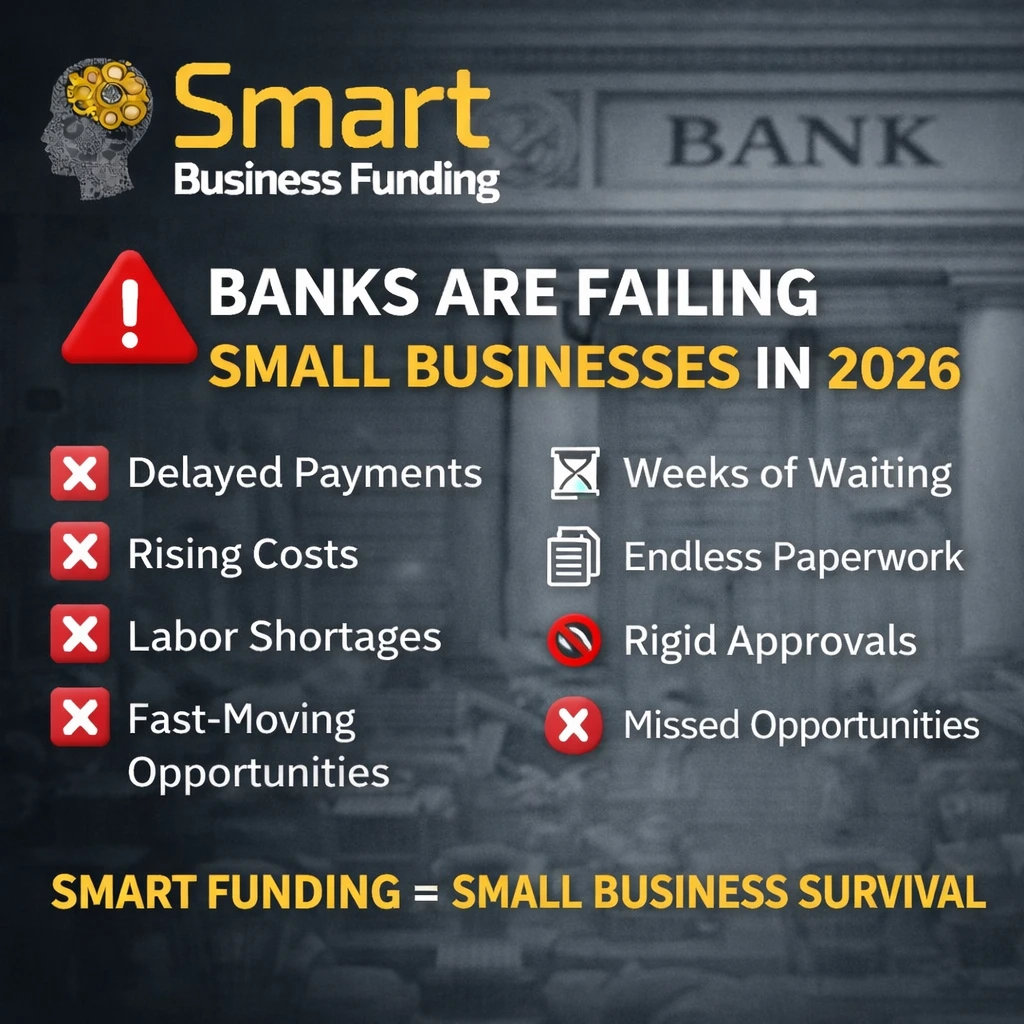
10 Reasons Banks Are Failing Small Businesses in 2026
For decades, banks were the default solution for small business financing.
In 2026, that assumption is breaking down — fast.
Across industries like construction, trucking, retail, hospitality, auto repair, real estate, and property management, business owners are discovering that banks are no longer built for how modern small businesses operate.
This isn’t about bad intentions.
It’s about outdated systems colliding with today’s economic reality.
Here are the 10 biggest reasons banks are failing small businesses in 2026 — and why relying on them can quietly stall or destroy growth.
1. Banks Move Too Slowly for Modern Business
Speed matters in 2026.
Opportunities don’t wait:
- A job needs upfront materials
- Inventory prices spike
- Equipment deals expire
- Payroll is due
Banks still take:
- Weeks to review applications
- Multiple rounds of documentation
- Committees to approve decisions
By the time funding arrives, the opportunity is often gone.
Slow money is expensive money.
2. Approval Standards Are Detached From Reality
Banks focus heavily on:
- Personal credit scores
- Long operating history
- Conservative debt ratios
- Perfect financial statements
Many profitable businesses don’t fit that mold — especially those:
- Growing fast
- Seasonal
- Managing receivables
- Scaling operations
In 2026, strong cash flow matters more than perfect paperwork.
Banks still haven’t adjusted.
3. Banks Don’t Understand Cash-Flow-Based Businesses
Small businesses don’t operate on smooth, predictable timelines.
They deal with:
- Delayed customer payments
- Insurance reimbursements
- Progress billing
- Seasonal revenue swings
Banks prefer consistency.
Most small businesses operate on timing gaps.
That mismatch causes denials — even when businesses are healthy.
4. Banks Penalize Growth Instead of Supporting It
Ironically, growth often hurts bank approval odds.
Rapid expansion can:
- Increase expenses temporarily
- Tighten short-term cash flow
- Distort ratios on paper
Banks see this as risk.
Entrepreneurs see it as opportunity.
In 2026, banks often reward stagnation and punish ambition.
5. One “No” Can Freeze Everything
A single bank rejection can:
- Delay expansion plans
- Kill momentum
- Force underbidding or underpricing
- Lead to desperate decisions
Worse, businesses often wait months just to hear “no.”
In a fast-moving economy, delay is damage.
6. Banks Are Over-Regulated and Over-Cautious
Banks aren’t just conservative — they’re constrained.
In 2026, increased regulations force banks to:
- Limit risk exposure
- Favor large, established borrowers
- Avoid industries deemed “volatile”
That leaves many small businesses — even profitable ones — without access to capital.
7. Banks Don’t Fund Real-World Business Needs Well
Banks prefer:
- Long-term, specific-use loans
- Narrowly defined purposes
Small businesses need:
- Working capital
- Payroll coverage
- Inventory funding
- Flexibility
When capital isn’t flexible, businesses bend their operations to fit the loan — instead of the other way around.
8. Banks Create Cash Flow Gaps Instead of Solving Them
Banks fund slowly, disburse cautiously, and repay rigidly.
That creates:
- Payroll stress
- Missed inventory windows
- Delayed growth
- Operational bottlenecks
In 2026, businesses need funding that fills gaps, not creates new ones.
9. Banks Are Built for Stability — Not Survival
Banks work best when:
- The economy is stable
- Growth is slow and predictable
- Businesses aren’t under pressure
But 2026 is defined by:
- Volatility
- Competition
- Rising costs
- Tight labor markets
Small businesses don’t need “perfect conditions.”
They need support under pressure.
10. Banks Leave Businesses With No Backup Plan
When a bank says no, most businesses have no alternative lined up.
That leads to:
- Underbidding jobs
- Delaying growth
- Cutting corners
- Personal stress and burnout
The businesses that survive and grow in 2026 are the ones with multiple capital options — not just a bank relationship.
The Real Cost of Relying Only on Banks
When banks fail small businesses, the consequences aren’t theoretical:
- Lost contracts
- Missed growth windows
- Staff turnover
- Reputation damage
- Cash flow crises
Most businesses don’t fail because they’re unprofitable.
They fail because timing and capital don’t line up.
Why Smart Businesses Are Rethinking Funding in 2026
Modern businesses are shifting toward:
- Faster approvals
- Cash-flow-based funding
- Flexible repayment structures
- Capital designed for real operations
They’re not abandoning banks — they’re no longer depending on them exclusively.
Final Thought: Banks Aren’t the Enemy — But They’re Not the Solution Alone
Banks weren’t designed for the speed, volatility, and competition of 2026.
Small businesses that rely only on banks:
- Move slower
- Take fewer chances
- Miss opportunities
Businesses that build smart funding strategies:
- Stay agile
- Protect cash flow
- Grow with confidence
In 2026, survival and growth belong to the businesses that plan beyond the bank.